TOKYO, Japan – Japan’s government bond market is undergoing a major repricing as rising yields and expectations for further interest-rate increases reshape the country’s borrowing costs and potentially alter international capital flows.
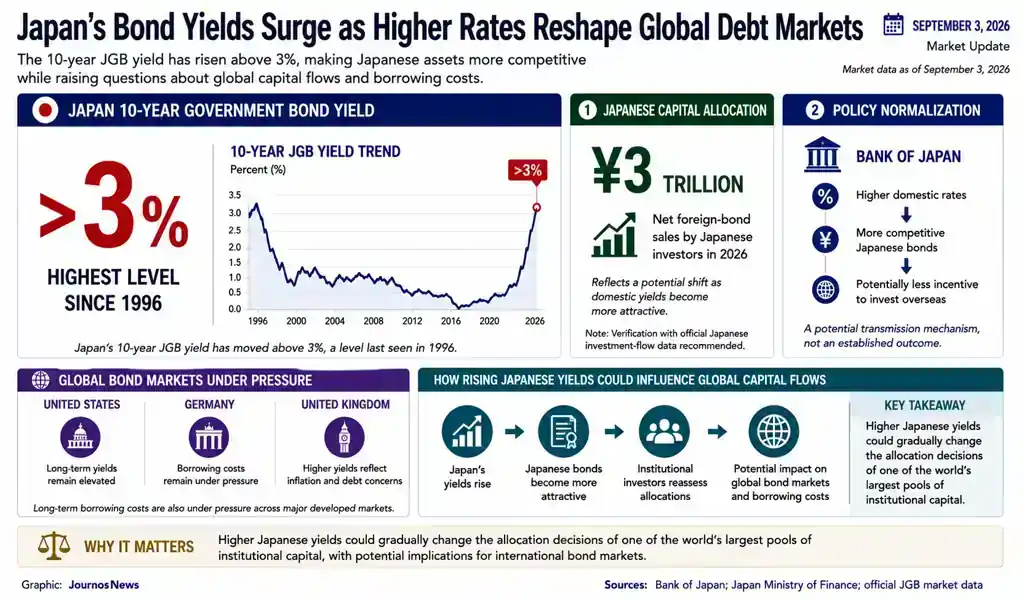
The yield on Japan’s benchmark 10-year government bond reached 3%, its highest level since 1996, as investors reassessed inflation, fiscal risks and the outlook for monetary policy.
The move is significant beyond Japan. Japanese investors have historically been major buyers of foreign government debt, including U.S. Treasuries. Higher returns available at home could make domestic bonds more attractive and reduce some of the incentive to invest overseas.

Japan’s low-rate era is changing
For decades, Japan operated with exceptionally low interest rates as the Bank of Japan attempted to overcome deflation and stimulate economic activity.
That environment helped make Japanese government bonds relatively unattractive compared with higher-yielding assets abroad. Japanese investors therefore became important participants in international bond markets.
The sharp rise in domestic yields is changing that calculation.
Reuters reported that Japanese investors had sold a net ¥3 trillion ($18.7 billion) of foreign bonds during 2026 as domestic yields became more competitive.
The shift does not necessarily mean Japanese investors will rapidly withdraw from global markets, but it creates the possibility of a gradual reallocation of capital.

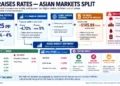
Higher Japanese yields can affect global borrowing costs
Japan’s bond market is closely connected to global financial markets because of the country’s enormous pool of institutional savings and overseas investments.
If Japanese investors demand higher returns before purchasing foreign bonds, borrowing costs in markets such as the United States and Europe can face additional upward pressure.
The change can also affect currency-hedged investments. When the cost of protecting against exchange-rate movements rises, foreign bonds may become less attractive to Japanese investors even when their headline yields remain higher.
That could contribute to a broader reassessment of international fixed-income portfolios.
Global bond markets are already under pressure
Japan’s move comes as government bond yields are rising across major economies.
The United States, Germany and the United Kingdom have also experienced sharp increases in long-term borrowing costs as investors contend with inflation concerns, large government debt burdens and higher energy prices.
The latest global bond selloff has been intensified by higher oil prices linked to the conflict in the Middle East.
More expensive energy raises concerns that inflation could remain elevated, making investors less confident that central banks will be able to reduce interest rates quickly.
The Bank of Japan faces a difficult balance
Higher bond yields reflect expectations that Japan’s monetary policy will continue moving away from the ultra-loose conditions of previous years.
Investors are watching the Bank of Japan for signals about how quickly interest rates could rise.
Vanguard expects Japan’s policy rate could reach 1.5% by the end of 2026 if the central bank continues its normalization process.
Higher rates could support the yen and improve returns for savers, but they also increase borrowing costs for households, companies and the Japanese government.
Government debt makes the move especially important
Japan has one of the world’s largest government debt burdens relative to the size of its economy.
When bond yields remain extremely low, the government can refinance large amounts of debt relatively cheaply.
As yields rise, however, the cost of issuing and refinancing government debt gradually increases.
That creates a difficult policy environment in which authorities must balance economic support, fiscal spending and debt sustainability against the need to prevent inflation from becoming entrenched.
Banks face mixed effects
Japanese financial institutions do not all benefit equally from higher yields.
Large banks can benefit from improved lending margins as interest rates rise, potentially increasing profitability.
But banks and other institutions holding large portfolios of older bonds can face losses because existing bonds become less valuable when newly issued securities offer higher yields.
The adjustment therefore creates both opportunities and risks across Japan’s financial system.
The yen carry trade is another risk
Japan’s historically low interest rates also supported the yen carry trade, in which investors borrowed cheaply in yen and invested in higher-yielding assets elsewhere.
If Japanese interest rates continue rising while overseas yields remain relatively attractive, the economics of those trades can change.
A significant unwinding could increase market volatility by forcing investors to sell overseas assets and repay yen-denominated borrowing.
However, higher Japanese yields do not automatically mean a sudden reversal of global capital flows.
A structural change for global investors
The bigger story may be the gradual end of an unusually long period in which Japanese interest rates were among the world’s lowest.
For international investors, Japan is becoming a more competitive destination for capital.
For governments elsewhere, the change could mean that one of the world’s largest pools of foreign investment becomes more selective about where it places money.
That makes the Japanese bond market increasingly important to global interest-rate expectations.
What Happens Next
Investors will watch the Bank of Japan’s rate decisions, Japanese inflation, government bond auctions and overseas investment flows for evidence of how far the repricing can go.
The key question is whether higher Japanese yields remain primarily a domestic adjustment or become a broader force pushing global borrowing costs higher.
For now, Japan’s bond market is signaling that the era of exceptionally cheap money is becoming increasingly distant.
Key Facts
- 10-year JGB yield: Above 3%
- Highest level: Since 1996
- Major policy shift: Japan continues moving away from ultra-low interest rates
- 2026 foreign bond sales by Japanese investors: About ¥3 trillion net
- Global impact: Potential changes in international capital flows and borrowing costs
- Key risks: Inflation, fiscal pressure and market volatility
- Status: DEVELOPING — GLOBAL MARKETS
Reporting Credit: Bank of Japan — monetary policy and interest-rate outlook; Ministry of Finance Japan — government bond market and fiscal data; U.S. Treasury — international holdings and Treasury market data; U.S. Energy Information Administration — global energy-market conditions affecting inflation expectations.