LONDON – Oil prices climbed Wednesday as renewed fighting between the United States and Iran increased fears that the conflict could once again disrupt crude supplies moving through the Strait of Hormuz, a critical energy route connecting the Persian Gulf with global markets.
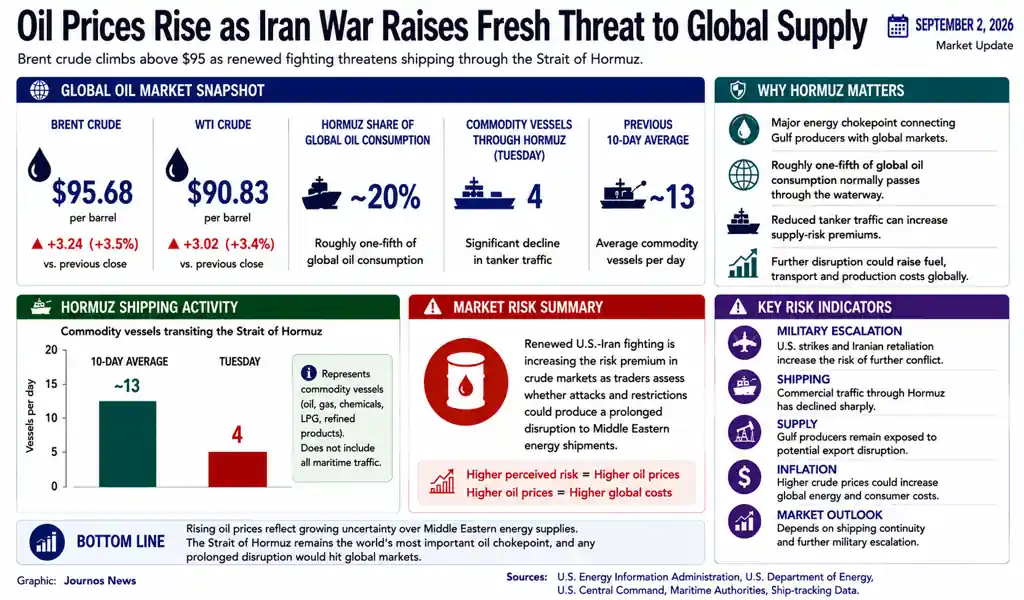
Brent crude, the international benchmark, rose to about $95.68 a barrel, while U.S. West Texas Intermediate climbed to roughly $90.83. Both benchmarks had surged more than $4 a barrel in the previous session after the United States launched fresh strikes against Iranian targets and Iran retaliated with missile and drone attacks against U.S. positions in the region.
The renewed price increase represents a sharp reversal from the calmer conditions of recent months, when improved shipping through Hormuz helped ease fears of a prolonged global supply shortage.

Hormuz again becomes the central risk
The Strait of Hormuz is one of the world’s most important oil chokepoints.
Before the current conflict, approximately 20% of global oil consumption moved through the waterway. The strait also carries a significant share of global liquefied natural gas trade.
Any prolonged disruption could therefore affect not only crude prices but also gasoline, diesel, aviation fuel, petrochemicals and other products dependent on energy.
The latest military escalation has already affected shipping activity.
Preliminary data from ship-tracking company Kpler showed only four commodity vessels transited the Strait of Hormuz Tuesday, compared with an average of about 13 over the preceding 10 days. The figures may change because some vessels turn off their tracking systems.




Shipping faces renewed uncertainty
The decline in vessel traffic is particularly significant because the oil market had been recovering from the earlier disruption caused by the war.
U.S. Energy Secretary Chris Wright said 17 million barrels of oil passed through Hormuz on Monday, the highest daily volume since the conflict sharply reduced traffic.
The contrasting figures illustrate how quickly conditions can change.
A sustained reduction in tanker movements could tighten supplies and increase the risk premium built into crude prices. If shipping resumes more normally, some of that premium could disappear.
Iran threatens tighter restrictions
Iran’s Islamic Revolutionary Guard Corps has warned that continued U.S. military action could further restrict movement through the strait.
That threat is closely watched by energy traders because alternative routes cannot easily replace the volume normally transported through Hormuz.
The waterway’s importance means even the threat of disruption can raise prices before a major physical shortage occurs.
Oil market reacts to military escalation
Tuesday’s fighting marked the latest direct escalation after a period of relative calm.
The United States said its military action was aimed at Iranian military capabilities and threats to American forces and commercial shipping. Iran subsequently launched attacks toward U.S. bases and facilities in several countries across the Gulf region.
The developments have forced traders to reassess whether the conflict can remain contained or whether another prolonged disruption to Middle Eastern energy supplies is developing.
Higher oil could revive inflation concerns
A sustained increase in crude prices would extend beyond the energy market.
Higher oil prices generally raise gasoline and diesel costs and can increase expenses for airlines, shipping companies, manufacturers and other businesses. Those higher costs can eventually reach consumers through transportation, food and other goods.
That creates an additional problem for central banks already trying to manage inflation.
The U.S. Treasury market has already come under pressure from renewed inflation concerns following the latest rise in energy prices.
Global economy remains exposed
The Strait of Hormuz connects major oil-producing countries, including Saudi Arabia, Iraq, Kuwait, the United Arab Emirates and Qatar, with international markets.
The U.S. Energy Information Administration has previously described Hormuz as the world’s most important oil transit chokepoint because of the enormous volume of petroleum moving through the narrow waterway.
Earlier in the conflict, disruptions forced Gulf producers to reduce production as storage facilities filled and export capacity became constrained. The EIA estimated that affected producers collectively shut in millions of barrels per day during the initial disruption.
Markets now watch the next military move
The immediate direction of oil prices will depend heavily on whether the latest U.S.-Iran confrontation expands or begins to de-escalate.
If commercial shipping continues to decline, traders could price in a larger and longer supply shortage.
If the waterway remains open and tanker traffic recovers, the recent surge could lose momentum.
For now, the market is responding to a renewed geopolitical risk premium, with investors placing greater value on the possibility of supply disruption.
What Happens Next
The most important indicators will be tanker traffic through the Strait of Hormuz, further attacks on commercial vessels, crude production in Gulf countries and the next military decisions by Washington and Tehran.
A prolonged disruption could put renewed upward pressure on global fuel prices and inflation. A rapid restoration of shipping, by contrast, could ease some of the pressure on crude markets.
Key Facts
- Brent crude: About $95.68 a barrel
- WTI crude: About $90.83 a barrel
- Key chokepoint: Strait of Hormuz
- Normal significance: About 20% of global oil consumption
- Tuesday commodity vessels through Hormuz: 4
- 10-day average: About 13 vessels
- Main risk: Prolonged supply and shipping disruption
- Main trigger: Renewed U.S.-Iran military escalation
- Status: DEVELOPING — GLOBAL ENERGY MARKETS
Reporting Credit: U.S. Energy Information Administration — global oil flows and Strait of Hormuz analysis; U.S. Department of Energy — energy supply information; U.S. Central Command — military operations and regional developments; maritime authorities and ship-tracking data — commercial vessel activity and Strait of Hormuz traffic.