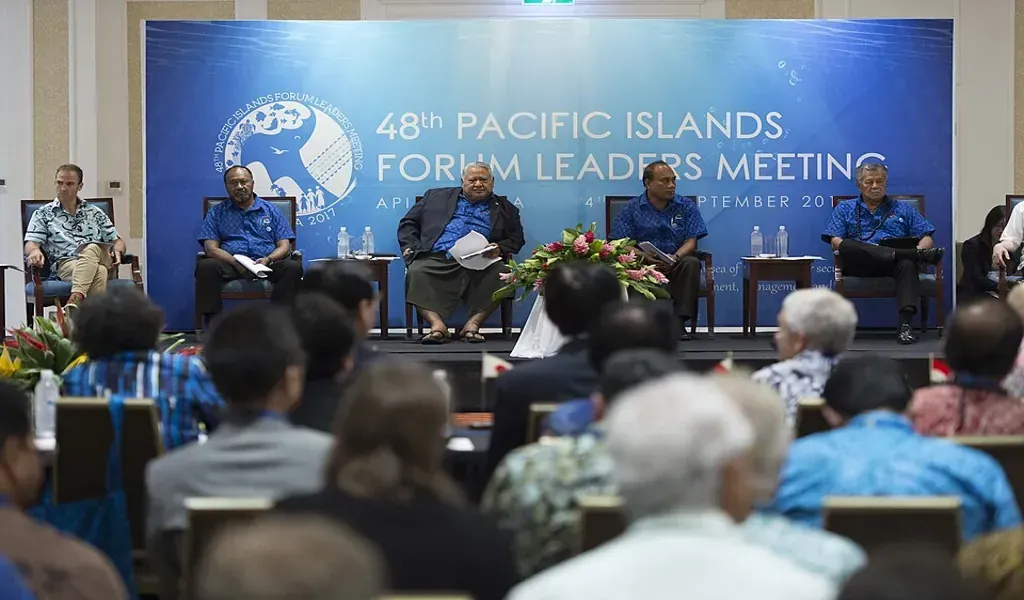
KOROR, Palau — Leaders from across the Pacific are gathering in Palau for the Pacific Islands Forum Leaders Meeting, where some of the world’s smallest nations are seeking to keep their own priorities at the center of discussions as competition among larger powers increasingly shapes the region.
The summit officially opens Monday and runs through September 4. The agenda includes climate change, economic resilience, infrastructure, connectivity and implementation of the 2050 Strategy for the Blue Pacific Continent. But behind those issues is an increasingly difficult question for the 18-member forum: how can Pacific nations maintain regional unity while the United States, China, Taiwan, Australia and New Zealand compete for influence?
Palau President Surangel Whipps Jr. has urged outside powers not to turn the summit into a venue for their geopolitical competition.

“The Pacific is our home, not a theater for geopolitical competition,” Whipps said Sunday.
He has called for the meeting to focus on challenges facing Pacific communities, particularly climate change and economic vulnerability.
Small nations, large strategic importance
Many Pacific Islands Forum members have populations of only thousands or tens of thousands of people.
Their strategic importance, however, is considerably larger than their populations suggest.
Pacific island countries control enormous exclusive economic zones, giving them access to valuable fisheries and potentially important seabed resources. Their locations also sit along major maritime routes across the Pacific, making them increasingly important to countries concerned about military access, shipping and regional security.
That strategic importance has encouraged major powers to expand diplomatic, economic and security relationships throughout the region.




China has increased infrastructure investment and diplomatic engagement. The United States has strengthened security and economic partnerships. Australia and New Zealand have sought to maintain their traditional influence, while Taiwan continues to maintain diplomatic relationships with several Pacific nations.
For the island states themselves, that competition creates opportunities for investment but also risks turning regional cooperation into a contest between outside powers.
Taiwan becomes a major point of tension
The issue is particularly visible in Palau.
Palau is one of the few countries that still maintains formal diplomatic relations with Taiwan, while China considers Taiwan part of its territory and opposes other governments treating Taipei as a sovereign state.
Taiwan’s Foreign Minister Lin Chia-lung is attending side events connected with the summit, including a Pacific Islands Forum dialogue and the Pacific Prosperity Exhibit. His participation has prompted objections from Beijing.
China has urged Pacific organizers to exclude Taiwanese representatives.
Beijing’s pressure has created a difficult situation for the forum, which must balance its relationships with powerful dialogue partners while preserving its own authority over who participates in regional meetings.
The dispute is particularly sensitive because Palau is hosting the event.
China expands its presence
China’s influence in the Pacific has grown significantly over the past decade through infrastructure projects, trade, diplomatic engagement and security cooperation.
Beijing has developed closer relationships with several Pacific governments, including countries that previously maintained diplomatic ties with Taiwan.
That expansion has raised concerns in Australia, New Zealand and the United States about China’s long-term strategic ambitions.
But many Pacific leaders reject the idea that their countries should have to choose between major powers.
Their governments often seek investment, trade, climate financing and development assistance from multiple partners while retaining control over their own foreign-policy decisions.
The United States seeks deeper engagement
Washington is also attempting to strengthen its position in the Pacific.
The United States has expanded diplomatic and security engagement and is participating in the forum as a dialogue partner.
U.S. Deputy Secretary of State Christopher Landau is attending the summit and has emphasized American commitments to regional security, commercial ties, disaster resilience and infrastructure.
The United States has also highlighted cooperation on undersea communications cables, maritime security and development.
For Washington, the Pacific is increasingly viewed as an important part of the broader Indo-Pacific strategic environment.
For Pacific governments, however, security is only one part of the relationship.
They also want greater economic opportunities and help addressing climate-related threats.
Australia and New Zealand remain central
Australia and New Zealand are longstanding members of the Pacific regional system and maintain extensive economic, political and security relationships with island nations.
Australian Prime Minister Anthony Albanese is attending the summit, while New Zealand Foreign Minister Winston Peters has emphasized the need for practical action rather than lengthy discussions.
Australia has recently expanded security cooperation with Pacific governments, including a new military agreement with Fiji.
China criticized that agreement, warning Australia against what Beijing described as geopolitical rivalry in the Pacific.
The competing security arrangements illustrate how Pacific nations are increasingly being asked to navigate relationships with several major powers at once.
Climate change remains the region’s priority
For many Pacific governments, climate change remains more immediate than great-power rivalry.
Low-lying island nations face rising sea levels, coastal erosion, extreme weather and threats to freshwater supplies and food security.
The forum is expected to discuss climate financing and regional preparations ahead of COP31.
Palau’s Whipps has also proposed greater investment in renewable energy across Pacific island states, arguing that wealthy countries seeking deeper relationships with the region should help finance a transition toward renewable energy.
The emphasis reflects a longstanding Pacific position: regional countries want outside powers to address the issues they identify as existential rather than impose priorities based on strategic competition.
Economic pressures are growing
Energy costs and economic vulnerability are also high on the agenda.
Rising fuel prices increase transportation costs for island economies that depend heavily on imported goods.
Limited infrastructure, expensive connectivity and small domestic markets make economic development particularly difficult.
The forum is therefore expected to discuss investment in resilient infrastructure, transportation, digital connectivity, employment and economic diversification.
The Asian Development Bank is also participating in discussions about regional economic development.
China missile test exposes divisions
Regional disagreements over security became particularly visible after China conducted a long-range missile test in the Pacific in July.
The missile landed near Tuvalu’s exclusive economic zone, prompting concern among several Pacific governments.
Pacific foreign ministers subsequently failed to agree on a joint statement specifically condemning the Chinese test.
The disagreement demonstrated the difficulty of maintaining consensus when member states have different relationships with Beijing.
Kiribati and Nauru, both of which have strengthened ties with China, were associated with the debate over how the issue should be addressed. Their governments argued for a broader approach that would not single out China while other countries also conduct missile tests in the Pacific.
Some leaders are absent
The summit is also being affected by the absence of several national leaders.
The heads of government of Fiji, Vanuatu, Samoa, Solomon Islands and Kiribati are among those not attending, although their countries are represented by senior officials.
Solomon Islands Prime Minister Matthew Wale returned home after a no-confidence challenge emerged against his government.
The absence of several leaders has raised concerns about whether the forum can achieve the level of regional consensus it hoped to demonstrate.
New Zealand’s Peters described the absences as disappointing but said the participating delegations remained strong.
The “Pacific Way” faces pressure
The Pacific Islands Forum traditionally operates through consensus, often described as the “Pacific Way.”
That approach allows small states to negotiate collectively and amplify their voices on international issues.
But consensus becomes harder when member countries have sharply different relationships with China, Taiwan, the United States and Australia.
Oliver Nobetau of the Lowy Institute said the consensus-based system can sometimes result in paralysis when members cannot agree on a common position.
The challenge is not simply ideological.
Individual governments have their own economic needs, security concerns and diplomatic priorities.
As major powers offer infrastructure funding, security agreements, migration opportunities and other incentives, Pacific governments have more partnerships to choose from—but also more pressure to manage.
Pacific leaders want to avoid choosing sides
The underlying message from many Pacific governments is that the region should not become a proxy battlefield for global competition.
Their countries may cooperate with China on infrastructure, with Australia on security, with the United States on defense and with Taiwan on development while maintaining their own diplomatic positions.
That flexibility is increasingly important as strategic competition intensifies.
The challenge for the Pacific Islands Forum will be maintaining a collective voice while allowing individual members to pursue different national interests.
A summit about sovereignty
The gathering ultimately raises a broader question about who gets to shape the future of the Pacific.
For the major powers, the region has become strategically important because of its location, maritime territory and potential economic resources.
For the island nations themselves, sovereignty means having the ability to decide which partnerships serve their people.
Palau’s government has made clear that it wants the summit to remain focused on Pacific priorities.
Whether the forum can achieve that will depend on its ability to keep climate change, economic resilience and regional development at the center of discussions while managing increasingly intense pressure from outside powers.
What Happens Next
The Pacific Islands Forum Leaders Meeting formally opens in Koror on Monday and continues through September 4.
Leaders and senior officials are expected to discuss climate policy, economic resilience, regional security, infrastructure and the future structure of the forum’s engagement with external powers.
The handling of China’s missile test and Taiwan’s participation will provide an important test of whether the forum can reach consensus on sensitive geopolitical issues.
For the Pacific’s smallest nations, the objective is clear: remain united enough to make their voices heard without allowing great-power competition to determine the region’s priorities.
Key Facts
- Event: Pacific Islands Forum Leaders Meeting
- Host: Palau
- Location: Koror
- Forum members: 18 Pacific countries and territories
- Major external powers involved: China, United States, Taiwan, Australia and New Zealand
- Main regional priorities: Climate change, economic resilience, infrastructure and security
- Major dispute: China’s influence and Taiwan’s participation
- Recent security issue: China’s July missile test in the Pacific
- Decision-making: Consensus-based
- Current status: DEVELOPING — SUMMIT UNDERWAY
Reporting Credit: Pacific Islands Forum — official summit and regional policy information; Government of Palau — summit proceedings and regional priorities; China and Taiwan — official statements on regional participation; U.S., Australian and New Zealand governments — Pacific engagement and security cooperation.