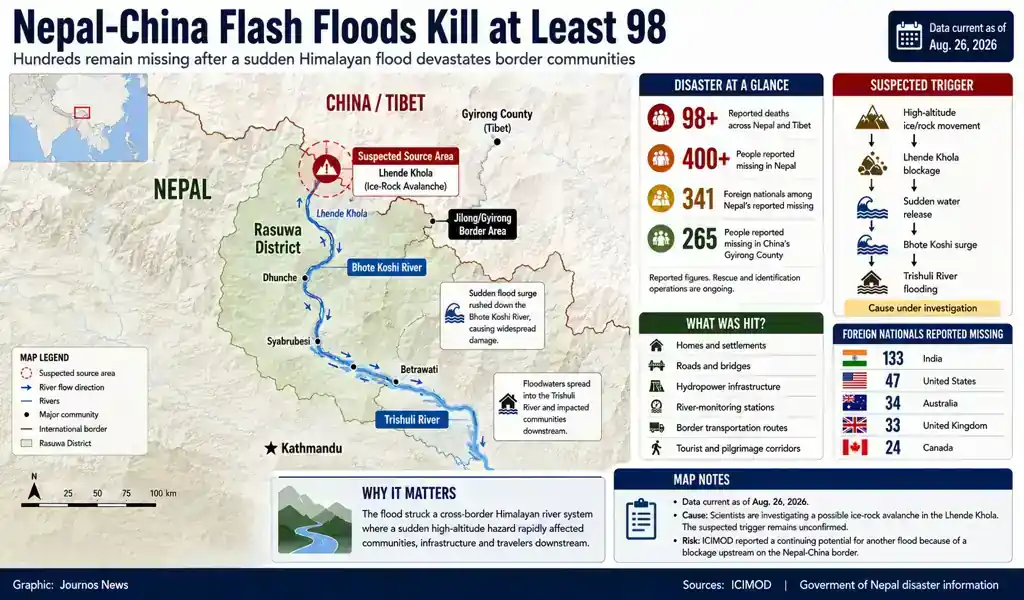
KATHMANDU, Nepal — At least 98 people have died after a massive flash flood struck communities along the Nepal-China border, while hundreds of people remain missing as rescue teams search damaged settlements, river corridors and infrastructure sites.
Nepal’s Prime Minister’s Office reported at least 95 deaths in Nepal. Across the border, China’s state broadcaster CCTV reported three deaths and 265 people missing after a mudslide struck Gyirong County in Tibet.
The combined toll has reached at least 98, although casualty figures remain subject to change as authorities continue search and rescue operations.

The disaster struck Wednesday, Aug. 26, in the Himalayan border region and sent a powerful surge of water, sediment and boulders through the Bhote Koshi and Trishuli river systems. The flooding destroyed roads, buildings and other infrastructure and disrupted movement through a strategically important corridor linking Nepal with Tibet.
The International Centre for Integrated Mountain Development, or ICIMOD, said water levels in the Bhote Koshi basin began rising rapidly at about 9 a.m. local time. The flood then moved downstream through the Bhote Koshi into the Trishuli River system.
Hundreds remain missing
Nepalese authorities reported 403 people missing, including 341 foreign nationals.
Among those reported missing were 133 Indian pilgrims traveling toward Mount Kailash in Tibet, along with citizens of the United States, Australia, Britain and Canada. People trekking in the Gosaikunda Lake area of Rasuwa were also reported missing.
Police personnel and workers at infrastructure projects were among those unaccounted for.
■ Related News



The number of missing people remains fluid because communications have been disrupted and authorities are still working to reconcile reports from different locations.
The disaster has prompted several governments to seek information about their citizens and coordinate with Nepalese authorities over rescue efforts. India has offered assistance, while other governments have issued statements expressing concern for nationals believed to be in affected areas.
Flood tears through Himalayan corridor
The worst-affected areas include Nepal’s Rasuwa district and communities farther downstream along the Trishuli River.
The region is important for both local communities and cross-border travel. Rasuwa contains routes used by travelers heading toward the Nepal-China border and by pilgrims traveling toward Mount Kailash.
The flooding damaged roads and bridges, swept away vehicles and affected hydropower infrastructure. The destruction has made access to some affected areas more difficult for rescuers.
ICIMOD reported that several hydropower facilities are located along the Bhote Koshi and connected river systems. Several water-monitoring stations were also damaged or washed away during the flood.
The organization said the Trishuli River at Galchchi reportedly rose by as much as nine meters in 30 minutes, while water levels at Malekhu increased by seven meters over a similar period.
The speed of the rise illustrates the difficulty of warning communities when a sudden mountain flood develops.
Scientists investigate possible ice-rock avalanche
The precise cause of the disaster remains under investigation.
Scientists from ICIMOD and partner institutions in Nepal and China are examining whether an ice-rock avalanche from a high-altitude area entered the Lhende Khola, a tributary of the Bhote Koshi River.
Preliminary assessments based on video footage and information from affected areas suggest that a large mass of ice and rock may have entered the river and temporarily blocked its flow. A sudden release could then have produced the powerful downstream surge.
ICIMOD described an ice avalanche in the Lhende Khola as the suspected trigger, but emphasized that the cause has not been confirmed.
Researchers are also investigating unusual seismic signals recorded around the time of the disaster. However, ICIMOD said no causal connection between seismic activity and the flood has been established.
That distinction is important because a magnitude 4.4 earthquake was also reported in the broader Nepal-Tibet border region around the time of the disaster. Whether seismic activity contributed to the event remains under investigation.
A second flood threat remains possible
The immediate danger may not have ended.
ICIMOD said a blockage remained upstream on the Nepal-China border and warned of the possibility of another flood. Authorities in the affected area issued evacuation orders for Jilong port on the Chinese side.
The potential for a secondary flood adds another challenge for rescue teams and communities already dealing with damaged roads, disrupted communications and unstable terrain.
Scientists are continuing to assess the size and stability of any blockage and the potential consequences if water accumulates behind it and is suddenly released.
Foreign nationals among those missing
The disaster has taken on an international dimension because the affected corridor is used by tourists, pilgrims and foreign workers.
Indian nationals account for a significant portion of those reported missing. The missing also include citizens from North America, Europe, Australia and Asia.
South Korean officials reported citizens working on a hydropower project among those unaccounted for, while Malaysian authorities said they were seeking information about nationals believed to have been in Rasuwa.
The presence of foreign nationals has prompted embassies and governments to coordinate with Nepalese authorities as rescue teams attempt to establish who has survived, who remains trapped and who is still missing.
Because the flood destroyed communications and transportation links, authorities face difficulties verifying individual reports.
China reports deaths and missing people in Tibet
The disaster also affected China’s Tibet region.
CCTV reported that a mudslide in Gyirong County killed at least three people and left 265 missing. The mudslide affected the Gyirong port area near the Nepal border and disrupted roads, communications and power infrastructure.
The Chinese side of the disaster is being handled separately from Nepal’s rescue operation, although the two events are connected geographically through the Himalayan river and border corridor.
The cross-border nature of the disaster highlights the difficulty of managing hazards in mountain watersheds where events originating in one area can rapidly affect communities downstream in another country.
Infrastructure damage complicates rescue
The flooding caused extensive damage to roads, bridges, buildings and infrastructure.
In Nepal, debris and mud covered sections of communities while vehicles were swept away or buried. Some river crossings and transportation routes became unusable.
The damage to monitoring stations is particularly significant because those systems provide information used to track river levels and warn communities downstream.
With some monitoring infrastructure destroyed, authorities may have less real-time information available while the risk of additional flooding remains.
Rescue teams must also work around unstable slopes, damaged roads and rapidly changing river conditions.
Himalayan hazards are becoming more complex
The disaster has renewed attention on the growing range of hazards affecting the Hindu Kush Himalaya.
The region is exposed to floods, landslides, glacier-related hazards, earthquakes and extreme rainfall. These hazards can also combine, producing cascading events that are difficult to predict and respond to.
ICIMOD cautioned against assigning climate change as the direct cause of this particular flood. Scientists are still determining what triggered the event and what role, if any, changing climate conditions played.
The organization did, however, emphasize the growing importance of stronger regional cooperation and real-time warning systems as mountain hazards become increasingly complex.
The Lhende Khola area has experienced another major flood within the past 14 months, according to ICIMOD researchers. That history adds urgency to efforts to improve monitoring and early-warning systems in vulnerable Himalayan valleys.
Rescue effort remains the immediate priority
For authorities in Nepal and China, the immediate priority is locating missing people, treating survivors and restoring access to isolated communities.
The large number of missing people means the final death toll could rise as rescue teams reach areas that remain inaccessible.
At the same time, authorities must balance rescue operations with the possibility of additional flooding from unstable terrain or a blocked river upstream.
The disaster demonstrates how quickly a mountain hazard can cross administrative and national boundaries.
A sudden event high in the Himalayas sent water and debris through river systems, destroyed critical infrastructure and disrupted a major travel corridor. Hundreds of people remain unaccounted for, including foreign tourists, pilgrims and workers.
For now, the search for survivors continues while scientists work to determine exactly what triggered the flood and whether additional danger remains upstream.
This article is an original Journos News rewrite and synthesis based on reporting by The Associated Press, supplemented with scientific and institutional information from the International Centre for Integrated Mountain Development (ICIMOD) and other publicly available official reporting.