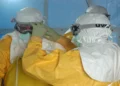
KINSHASA, Congo – A U.S. citizen working for a humanitarian organization in Congo has tested positive for Ebola, the U.S. Centers for Disease Control and Prevention said Friday, as health authorities work to contain an outbreak that has already killed hundreds of people.
The CDC said it was coordinating with the person’s employer, U.S. agencies, Congolese health authorities and other partners to prevent further transmission and identify people who may have had close contact with the patient. The agency did not provide additional details about the individual.
The case adds an international dimension to an outbreak that has placed further strain on Congo’s public health response. The Africa Centres for Disease Control and Prevention said earlier this week that the outbreak was the fastest-growing Ebola outbreak ever recorded in Africa, with 1,830 confirmed cases and 648 deaths in Congo. Cases have also been confirmed in neighboring Uganda.

Outbreak has spread amid wider health and security pressures
Congo declared a new Ebola outbreak on May 15 after the virus had been transmitting for weeks without being officially detected, according to the World Health Organization.
The outbreak is being caused by the rare Bundibugyo virus, for which there is no approved vaccine or treatment, according to the supplied reporting. The absence of approved medical countermeasures adds to the challenges facing health authorities as they seek to limit transmission.
Containment efforts have also been hindered by a shortage of funding, attacks on health centers and an ongoing conflict in eastern Congo, where the outbreak is centered. Those overlapping pressures have complicated the ability of health workers and authorities to respond to the disease.
The detection of an infection among a U.S. humanitarian worker also underscores the risks facing international personnel involved in the response. Earlier in the outbreak, an American doctor working in Congo tested positive and was transferred to Germany for treatment.
U.S. evacuation plans face obstacles
The U.S. response has also been affected by uncertainty over where Americans exposed to Ebola abroad would receive treatment.



Trump administration officials had initially said the United States planned to send Americans exposed to Ebola overseas to a new facility in Kenya rather than transport them back to the United States. That project was later suspended following an order from a Kenyan court.
The CDC said it was working with U.S. and Congolese authorities as well as the infected person’s employer to identify close contacts and prevent additional transmission. It did not disclose details about the person’s condition or treatment arrangements.
Clinical trials begin as containment efforts continue
Medical researchers have begun testing potential treatments as authorities confront an outbreak for which the virus responsible has no approved vaccine or treatment.
Clinical trials for Ebola treatment began last week, following the launch of a study intended to evaluate therapies against the Bundibugyo virus. The trials represent an effort to expand treatment options while public health teams continue efforts to contain transmission.
The immediate response remains complicated by the combination of the outbreak, limited funding, attacks on health facilities and conflict in eastern Congo. Authorities and their partners are continuing efforts to identify contacts and prevent further spread as the number of confirmed cases rises.
This report is based on reporting by The Associated Press.