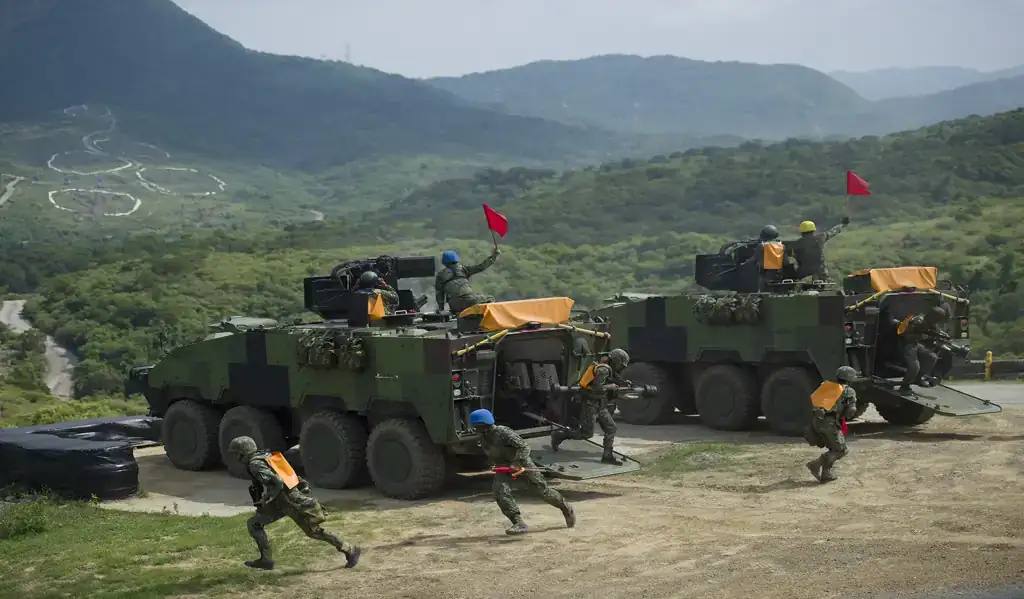
TAIPEI, Taiwan – Annual Han Kuang military exercises are placing greater emphasis on combat readiness, reserve mobilization and civilian resilience, reflecting what analysts describe as closer alignment with U.S. military practices as Taipei responds to sustained military pressure from China.
The live-fire exercises began Wednesday and will continue through Aug. 14 across Taiwan. This year’s drills are designed to test the armed forces’ ability to sustain continuous 24-hour defensive operations while responding to China’s so-called “gray-zone tactics”—military activities intended to increase pressure without escalating into open conflict.
The expanded focus reflects Taiwan’s evolving defense strategy as cross-strait tensions remain elevated and the island seeks to strengthen deterrence while deepening practical military cooperation with the United States.

Drills Incorporate U.S.-Style Military Practices
One of the most notable changes in this year’s Han Kuang exercises is the adoption of “backbriefing,” a command method widely used by the U.S. military in which subordinate commanders explain how they intend to carry out assigned missions.
Military analysts say the approach is intended to improve battlefield coordination by encouraging frontline commanders to exercise greater initiative while ensuring operations remain aligned with overall objectives.
William Yang, senior Northeast Asia analyst at the International Crisis Group, said the incorporation of American-style operational practices represents one of the most significant developments in this year’s exercises.
According to Yang, Taiwan’s military is moving beyond demonstrations of military hardware and placing greater emphasis on improving operational effectiveness, command flexibility and combat readiness.
Reserve Forces and Civilian Preparedness Expanded
The exercises also feature a larger role for reserve forces.
■ Related News

Local media reported that approximately 20,000 reservists are expected to participate, although Taiwan’s Ministry of National Defense has not officially confirmed the figure.
Yang said strengthening reserve mobilization reflects Taiwan’s effort to offset the significant numerical advantage held by China’s military, which has more than 2 million active-duty personnel compared with Taiwan’s much smaller armed forces.
Civil defense preparedness has also become a central component of the exercises.
Urban resilience drills are scheduled in Taipei, Taichung and Kaohsiung, including simulations involving temporary reductions in mobile internet connectivity to test how government agencies, emergency responders and civilians would operate during a major security crisis.
Domestic Politics Influence Defense Planning
Lev Nachman, a political scientist at National Taiwan University, said the increased emphasis on readiness and civil resilience reflects the priorities of President Lai Ching-te while acknowledging domestic political constraints.
Lai has sought legislative approval for a special defense budget worth approximately $40 billion to expand domestic defense production and purchase additional U.S. weapons systems.
Taiwan’s opposition-controlled legislature ultimately approved a reduced package valued at about $24.8 billion.
Nachman said those budget limitations have encouraged the government to strengthen military preparedness through improved training, reserve integration and civil defense measures rather than relying exclusively on new weapons acquisitions.
Future U.S. Arms Support Remains Uncertain
The exercises are taking place as uncertainty continues over a proposed $14 billion U.S. arms package that has yet to receive approval from President Donald Trump.
Following a visit to China in May, Trump described arms sales to Taiwan as “a very good negotiating chip” in relations with Beijing, raising questions in Taipei about the future direction of U.S. military support.
Trump also said after meeting Chinese President Xi Jinping that he did not want to “travel 9,500 miles (15,300 kilometers) to fight a war” over Taiwan.
Despite those remarks, Nachman said Taiwan’s continued adoption of U.S. military planning and training methods demonstrates that defense cooperation between Taipei and Washington remains active.
He said that while political messaging from Washington has at times appeared mixed, military-to-military engagement continues to strengthen Taiwan’s operational capabilities.
Cross-Strait Security Remains a Regional Focus
China considers Taiwan part of its territory and has repeatedly stated that it does not rule out the use of force to bring the self-governed island under Beijing’s control.
Taiwan rejects China’s sovereignty claims and maintains that its future should be determined by its own people.
Although the United States does not formally recognize Taiwan as an independent state, U.S. law requires Washington to provide the island with defensive capabilities.
As the Han Kuang exercises continue through mid-August, Taiwan’s emphasis on combat readiness, reserve mobilization and civilian resilience highlights its broader strategy of strengthening deterrence while adapting its defense posture to an increasingly complex regional security environment.
This report is based on reporting by The Associated Press.