Scientists using the U.S. National Science Foundation (NSF) Daniel K. Inouye Solar Telescope have identified a long-theorized physical process occurring on the Sun’s visible surface, providing new insight into how solar magnetic energy is transported and potentially helping explain the origin of powerful space weather.
The U.S. National Science Foundation National Solar Observatory (NSF NSO) announced that researchers have achieved the first high-resolution detection of Kelvin-Helmholtz instability (KHI) in the Sun’s photosphere. Until now, the phenomenon had existed only in theoretical models and computer simulations.
The international research team, which included scientists from the NSF National Solar Observatory, the NSF National Center for Atmospheric Research (NCAR) High Altitude Observatory and Germany’s Max Planck Institute for Solar System Research, published the findings in the journal Nature.

The study combined observations from the four-meter Daniel K. Inouye Solar Telescope on Haleakalā, Maui, with advanced numerical simulations.
Tiny Solar Vortices Reveal Hidden Plasma Instability
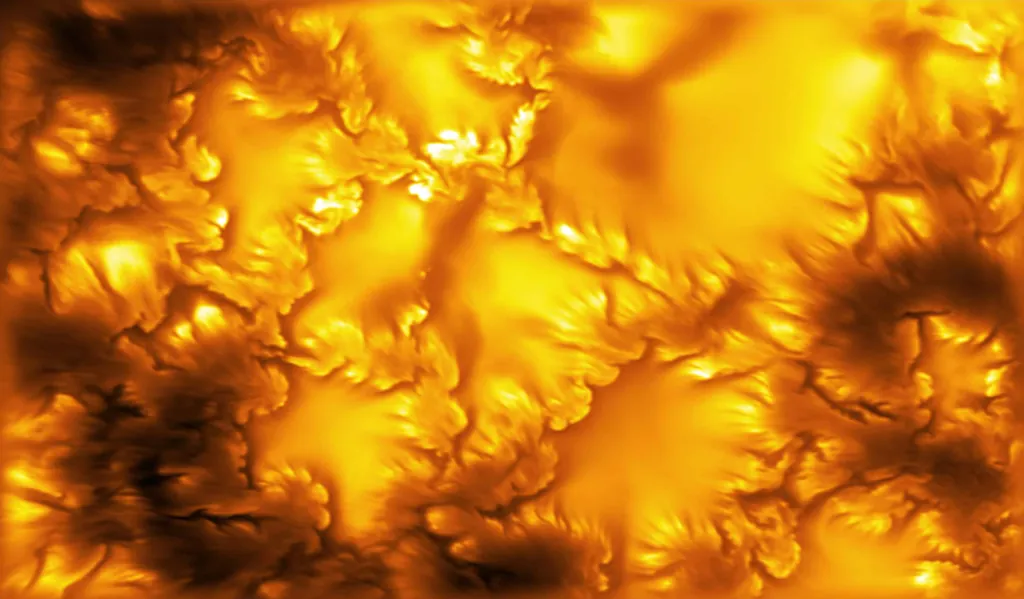
Researchers observed previously unseen whirlpool-like structures forming along the edges of magnetic regions on the Sun’s surface.
According to the team, these vortices are the visible signature of Kelvin-Helmholtz instability, a physical process that develops when adjacent layers of fluid or plasma move past one another at different speeds.
Although Kelvin-Helmholtz instability has been observed in Earth’s atmosphere, oceans, giant planetary atmospheres and interactions between the solar wind and planetary magnetic fields, it had never before been directly detected in the Sun’s photosphere.
Scientists said the unprecedented resolution of the Inouye Solar Telescope made it possible to identify the extremely small structures for the first time.
■ Related News



NSF National Solar Observatory Deputy Director David Boboltz described the discovery as a significant advance in understanding the dynamics of solar and stellar plasma.
Discovery Could Improve Understanding of Solar Eruptions
Researchers believe the newly detected instability may help explain how magnetic energy accumulates before being released during solar flares, coronal mass ejections and other forms of solar activity.
Magnetic energy generated within the Sun powers phenomena ranging from relatively small nanoflares to major eruptions capable of producing space weather that can disrupt satellites, GPS services, radio communications and electrical power systems on Earth.
Scientists have long proposed that magnetic field lines gradually twist together through a process known as flux braiding before reconnecting and releasing enormous amounts of energy.
The newly observed Kelvin-Helmholtz vortices may continuously twist magnetic field lines throughout active regions of the Sun, providing a previously missing mechanism that helps transport magnetic energy into the upper solar atmosphere.
NSF National Solar Observatory Senior Scientist Friedrich Wöger said researchers are only beginning to understand the broader implications of the discovery for magnetic plasma motion and energy transport.
Simulations Confirm Telescope Observations
To verify the findings, researchers compared telescope observations with advanced radiative magnetohydrodynamic simulations produced using the MURaM computational model.
The simulations reproduced dozens of vortex-like structures along magnetic boundaries that closely matched those observed by the telescope.
Both observations and simulations measured instability wavelengths averaging approximately 50 to 65 kilometers, providing strong evidence that the observed structures were indeed produced by Kelvin-Helmholtz instability.
Researchers also found that the Sun’s constantly convecting surface naturally creates neighboring plasma layers moving at different speeds around concentrated magnetic fields, producing ideal conditions for the instability to develop.
High Altitude Observatory Senior Scientist Matthias Rempel said the observations also provide the highest-resolution validation of modern solar magnetohydrodynamic simulations to date.
Findings May Help Explain the Sun’s Superheated Corona
Beyond improving understanding of solar eruptions, researchers said the discovery could help answer one of astrophysics’ longest-standing questions: why the Sun’s outer atmosphere, or corona, reaches temperatures of millions of degrees while the visible surface remains far cooler.
The study found that Kelvin-Helmholtz instability efficiently mixes magnetized and non-magnetized plasma, allowing magnetic energy to diffuse more effectively throughout the solar atmosphere.
Researchers said this process may contribute to transporting energy into higher atmospheric layers, helping heat the corona.
National Solar Observatory Chief Technologist Thomas Rimmele said the instability is likely one of the mechanisms responsible for the Sun’s extremely hot outer atmosphere.
The researchers also believe the discovery could improve understanding of the Sun’s approximately 11-year magnetic activity cycle.
Astronomer David Kuridze said Kelvin-Helmholtz instability may provide a previously missing source of magnetic diffusion needed to explain how solar magnetic fields evolve over time.
Telescope Opens New Window into Solar Physics
The research team plans to develop automated methods for identifying Kelvin-Helmholtz vortices across the expanding archive of high-resolution observations collected by the Daniel K. Inouye Solar Telescope.
Scientists hope the work will quantify how much energy these vortices transport into the Sun’s upper atmosphere and clarify their contribution to magnetic field evolution.
NSF Program Director Jacqueline Keane said understanding the small-scale processes occurring on the Sun is essential for improving knowledge of the space weather that affects Earth.
Researchers said the discovery highlights the capabilities of the four-meter Daniel K. Inouye Solar Telescope, whose large primary mirror and advanced adaptive optics system enable observations that were previously impossible.
The team concluded that the findings open a new avenue for investigating how magnetic energy moves through the Sun and other stars while providing valuable observational evidence for testing theories of plasma physics and stellar magnetic activity.
This report is based on reporting by the U.S. National Science Foundation National Solar Observatory (NSF NSO).