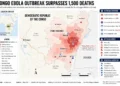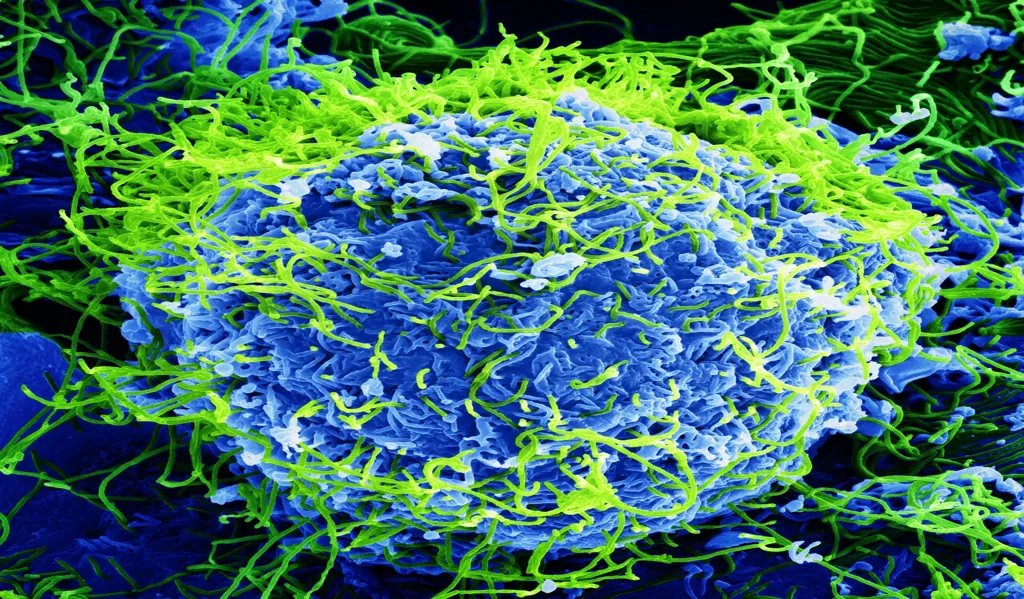
BUNIA, Congo – Health authorities in the Democratic Republic of the Congo warned Tuesday that the country’s Ebola outbreak continues to accelerate, with more than 1,700 people now dead as infections spread faster than response teams can contain them.
Government data show the outbreak has reached 3,802 confirmed cases and 1,707 deaths since it was declared on May 15, making it one of the deadliest Ebola epidemics ever recorded in the country.
Officials from the Africa Centres for Disease Control and Prevention (Africa CDC) said the outbreak remains unpredictable, with no clear indication of when infections will reach their peak.

Community Transmission Continues to Rise
Africa CDC Director-General Dr. Jean Kaseya, speaking during a visit to Bunia in Ituri province, said the outbreak has entered a more dangerous phase as community transmission increasingly replaces identifiable chains of infection.
According to Kaseya, between 60% and 70% of newly confirmed cases are now being detected through community spread rather than through contact tracing.
“Contact tracing is not working,” Kaseya said. “We don’t like the trajectory of this outbreak, and it’s already the second largest outbreak in the world.”
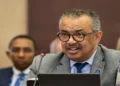
World Health Organization Director-General Dr. Tedros Adhanom Ghebreyesus is expected to travel to the Democratic Republic of the Congo later this week as international agencies expand support for the response.
Conflict and Limited Medical Options Hamper Response
Health officials say efforts to contain the outbreak continue to face significant obstacles.
■ Related News



The epidemic involves the Bundibugyo strain of the Ebola virus, for which there are currently no approved vaccines or licensed treatments.
Africa CDC said insecurity, armed conflict, delayed contact tracing, limited access to remote communities, misinformation and attacks on health facilities have all slowed containment efforts.
Researchers have launched clinical trials in Ituri province to evaluate post-exposure treatments, while experimental vaccine studies are continuing in the United Kingdom and Canada.
Nearly 90% of all confirmed infections have occurred in Ituri province, although cases have also been detected in five other provinces, including the city of Kisangani.
Neighboring Uganda officially declared its own Ebola outbreak over after its final patient recovered.
Thousands of Contacts Remain Under Surveillance
Investigators have yet to determine how the outbreak began, complicating efforts to interrupt transmission.
Population displacement caused by armed conflict and illegal mining has made identifying exposed individuals especially difficult.
The World Health Organization said more than 17,000 people who may have been exposed to Ebola are currently being monitored, with nearly 80% receiving daily follow-up.
WHO Regional Director for Africa Dr. Mohamed Janabi said laboratory testing capacity has expanded significantly, increasing from about 20 tests per day early in the outbreak to more than 2,000 daily samples.
Health Workers Face Growing Pressure
The Ebola response is also being strained by labor disputes and shortages of frontline personnel.
Healthcare workers in Mongbwalu warned they would intensify protests unless overdue wages are paid, following similar strikes by medical staff in Bunia over unpaid salaries and unsafe working conditions.
The WHO said more than 100 healthcare workers have contracted Ebola since the outbreak began.
Officials also continue to cite funding shortages, attacks on health facilities and ongoing violence in eastern Congo as major obstacles to bringing the epidemic under control.
Meanwhile, researchers have begun enrolling patients in a closely watched clinical trial evaluating two experimental Ebola treatments as health authorities seek new tools to slow one of the country’s most severe outbreaks.
This report is based on reporting by The Associated Press.