NEW YORK – U.S. stocks fell sharply Wednesday while oil prices surged as renewed concerns over Middle East energy supplies and uncertainty surrounding the Federal Reserve’s interest-rate outlook weighed on financial markets. Technology companies tied to the artificial intelligence boom led the market decline.
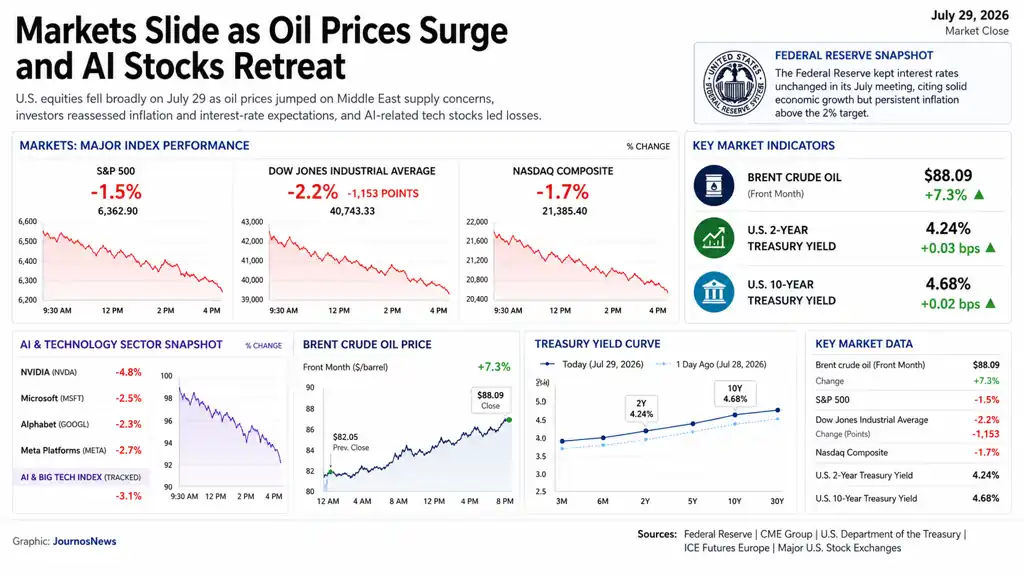
The S&P 500 fell 1.5% after a volatile session, while the Dow Jones Industrial Average dropped 1,153 points, or 2.2%. The Nasdaq Composite lost 1.7%, extending its decline to 9.8% below the record high it reached last month as investors reassessed valuations across high-growth technology companies.
Energy markets moved in the opposite direction. Brent crude oil rose 7.3% to settle at $88.09 per barrel following renewed fighting involving Iran that heightened concerns about potential disruptions to global oil supplies.

Oil Rally Revives Inflation Concerns
Oil prices have swung sharply in recent weeks as markets reacted to uncertainty over whether the United States and Iran could reach an agreement that would help maintain oil shipments from the Middle East.
Brent crude traded as low as $72 per barrel earlier in the month before climbing to $102 last week and settling at $88.09 on Wednesday.
The renewed increase in energy prices raised concerns that inflationary pressures could intensify, complicating the Federal Reserve’s effort to balance price stability with economic growth.
According to CME Group data, traders entered Wednesday assigning roughly a 34% probability that the Federal Reserve would raise interest rates.
Higher borrowing costs typically help curb inflation by slowing economic demand but can also reduce the appeal of higher-risk investments such as equities.
■ Related News




Federal Reserve Holds Rates Steady
The Federal Reserve ultimately left its benchmark federal funds rate unchanged, although three members of the Federal Open Market Committee supported an increase.
Federal Reserve Chair Kevin Warsh said rising Treasury yields may already be contributing to tighter financial conditions, noting that long-term borrowing costs had risen significantly since the central bank’s previous meeting.
Warsh reaffirmed the Fed’s commitment to returning inflation to its 2% target while maintaining a cautious approach toward signaling future monetary policy.
“Did the Fed take an explicit change in its policy rate today? No, but I think that’s the beginning of the story,” Warsh said following the decision.
The absence of stronger forward guidance added to investor uncertainty at a time when markets were already responding to shifting expectations for inflation, interest rates and corporate earnings.
Treasury Yields Reflect Diverging Expectations
Treasury markets showed mixed movements after the Fed’s announcement.
The yield on the two-year Treasury note, which closely tracks expectations for Federal Reserve policy, slipped to 4.24% from 4.26%.
Meanwhile, the benchmark 10-year Treasury yield rose to 4.68% from 4.61%, reflecting investor concerns about longer-term inflation and economic growth.
The increase in long-term yields has already pushed U.S. mortgage rates to their highest level in nearly a year while increasing borrowing costs for businesses and consumers.
AI Stocks Lead Technology Decline
Technology companies associated with artificial intelligence faced renewed selling pressure as investors questioned whether future earnings could justify elevated valuations.
Although semiconductor companies have reported strong revenue and profit growth, investors increasingly scrutinized whether the AI sector can sustain the pace of expansion anticipated by the market.
South Korea’s Kospi Index, which has significant exposure to technology companies, fell 6% after dropping 10.8% the previous session, reducing its gain for the year to 34.4%.
Shares of SK Hynix declined 9.6% despite reporting record quarterly revenue and profit driven by AI-related demand. Investors nevertheless viewed the results as falling short of elevated expectations.
In the United States, Nvidia was the largest contributor to the S&P 500’s decline after its shares fell 3.6%.
KLA Corp. dropped 10.8% despite reporting quarterly revenue and earnings that exceeded analysts’ forecasts. The company’s shares had already risen nearly 150% during the first half of the year.
Broad Market Weakness Extends Beyond Technology
Earlier in the week, gains in sectors outside artificial intelligence had helped offset weakness in technology stocks.
That trend reversed Wednesday as selling broadened across most sectors of the market.
Hims & Hers Health fell 14.7% after the Federal Trade Commission, together with authorities in Utah and California, alleged the company shared consumers’ sensitive health information with third-party advertising platforms despite privacy assurances.
The company disputed the allegations, calling the lawsuit an attempt to “manufacture claims” through an incorrect interpretation of the law.
At the close of trading, the S&P 500 had fallen 112.63 points to 7,316.15, the Dow Jones Industrial Average lost 1,153.18 points to 51,594.14, and the Nasdaq Composite declined 433.97 points to 24,442.94.
Global markets delivered mixed performances, with Hong Kong’s Hang Seng Index rising 2% while Japan’s Nikkei 225 fell 1.5%.
The combination of higher oil prices, uncertainty surrounding Federal Reserve policy and renewed scrutiny of AI-related valuations heightened volatility across global financial markets as investors weighed inflation risks against the outlook for economic growth.
This report is based on reporting by The Associated Press.