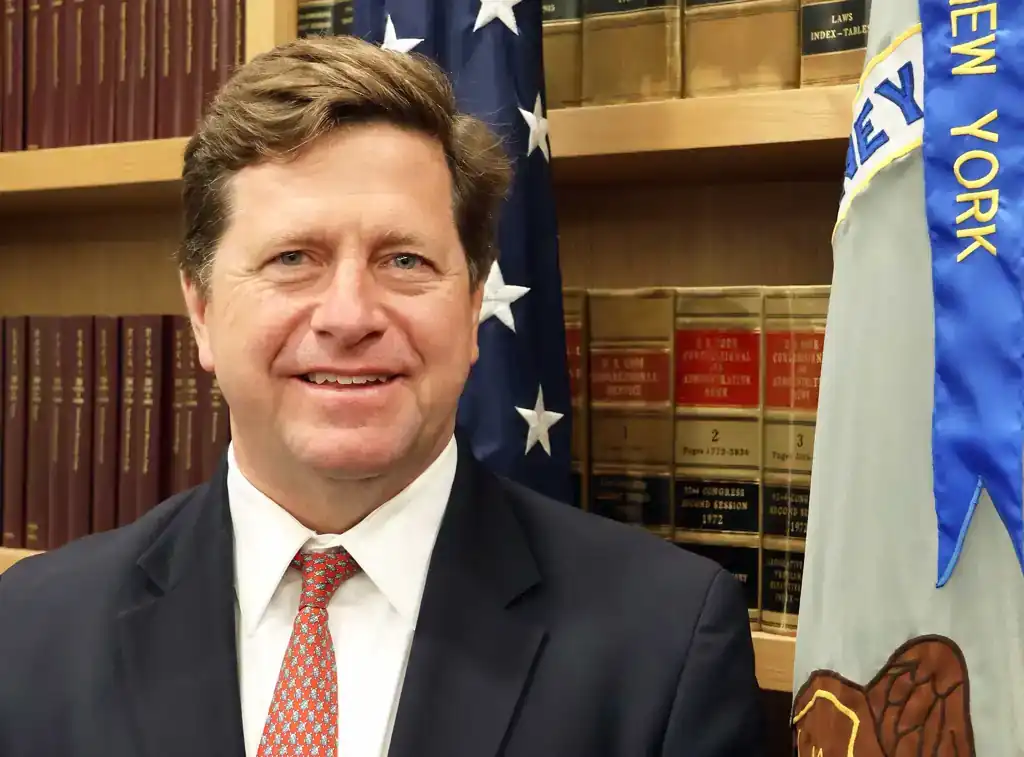
WASHINGTON – President Donald Trump’s nominee to serve as Director of National Intelligence faced sustained questioning from Senate Democrats on Wednesday, with lawmakers repeatedly pressing Jay Clayton to state whether former President Joe Biden won the 2020 presidential election during a contentious confirmation hearing.
Clayton, the U.S. attorney for the Southern District of New York and former chairman of the Securities and Exchange Commission, repeatedly acknowledged that the 2020 election results were certified for Biden but declined to directly answer whether Biden defeated Trump.
The exchanges dominated much of Clayton’s appearance before the Senate Intelligence Committee, underscoring continuing partisan divisions over Trump’s false claims that the 2020 election was stolen and prompting questions from Democrats about how Clayton would safeguard the independence of the U.S. intelligence community.

Democrats Press Clayton on the 2020 Election
Georgia Sen. Jon Ossoff was among several Democratic lawmakers who repeatedly asked Clayton whether Biden won the 2020 election. Clayton responded that he had already answered the question by noting that the election results had been certified.
“I’ve answered it,” Clayton told Ossoff after declining several opportunities to directly acknowledge Biden’s victory.
Virginia Sen. Mark Warner, the committee’s ranking Democrat, said he was disappointed with Clayton’s testimony despite previously supporting Trump’s decision to nominate him. Warner said Democrats remain concerned that intelligence agencies could face political pressure on election-related matters if Clayton is confirmed.
Senate Democratic Leader Chuck Schumer later described Clayton’s performance as “abysmal,” suggesting it diminished prospects for Democratic support during the confirmation process.
Although Clayton continues to enjoy broad Republican backing, the hearing may complicate efforts to secure bipartisan cooperation for a quicker Senate confirmation.
■ Related News


Nominee Highlights Intelligence Leadership Priorities
In his opening statement, Clayton emphasized experience gained through previous government service and said effective intelligence leadership requires sound judgment, integrity and cooperation across federal agencies.
He pledged that, if confirmed, he would uphold those principles while serving as the nation’s top intelligence official.
Senate Intelligence Committee Chairman Tom Cotton, Republican of Arkansas, defended Clayton’s nomination, describing him as a public official known for “morality, decency and integrity.” Cotton expressed hope the nomination would ultimately receive bipartisan support.
The committee is expected to vote on Clayton’s nomination next week.
Questions Extend to Tulsi Gabbard and Election Investigations
Democrats also questioned Clayton about former Director of National Intelligence Tulsi Gabbard’s visit to a Georgia election office during an FBI search connected to the 2020 election.
Lawmakers noted that Trump administration officials have offered differing explanations for Gabbard’s involvement in the visit, which appeared unrelated to her intelligence responsibilities.
Clayton declined to evaluate whether Gabbard’s participation was appropriate or explain how he would have handled a similar situation. He said he had not been aware of the visit until preparing for the hearing before later clarifying that it had not previously been on his mind.
Warner responded that the explanation “strains credibility.”
Democrats also asked whether Clayton had any involvement in Trump’s planned primetime address on elections after the president suggested he could revisit long-discredited claims surrounding the 2020 election. Clayton said he played no role in preparing the speech.
Senators Raise Press Freedom Concerns
Beyond election-related issues, senators questioned Clayton about decisions made during his tenure as U.S. attorney in Manhattan.
Democrats raised concerns over subpoenas issued to four New York Times journalists following reporting on security issues involving a Qatari-gifted Air Force One aircraft. The Committee to Protect Journalists has criticized the subpoenas as an escalation of pressure on independent media organizations.
Clayton declined to discuss details of the investigation or whether he communicated with the White House before the subpoenas were issued, citing restrictions on discussing ongoing matters. He said he remained confident in procedures intended to protect press freedom.
Lawmakers also reviewed Clayton’s record overseeing terrorism, espionage, securities fraud and public corruption prosecutions. During his tenure, prosecutors facilitated the unsealing of thousands of pages of court records related to Jeffrey Epstein and Ghislaine Maxwell while also overseeing criminal charges against former Venezuelan President Nicolás Maduro and his wife, Cilia Flores, on drug trafficking allegations.
Confirmation Could Influence Surveillance Debate
Clayton’s confirmation could also affect negotiations over renewing Section 702 of the Foreign Intelligence Surveillance Act (FISA), which expired in June after renewal legislation stalled in the Senate.
Some Democrats withheld support for the measure while Bill Pulte served as acting Director of National Intelligence following Gabbard’s departure. Republicans had hoped to install Clayton before Pulte assumed the interim role, but Trump’s decision to delay the nomination allowed Pulte to serve temporarily.
Even if Congress advances new surveillance legislation, uncertainty remains over whether Trump would sign it. When announcing the delay of Clayton’s nomination in June, Trump said he would oppose renewing Section 702 unless Congress also approved legislation requiring proof of citizenship for all voters, a proposal that currently lacks sufficient support in the Senate.
This report is based on reporting by The Associated Press.