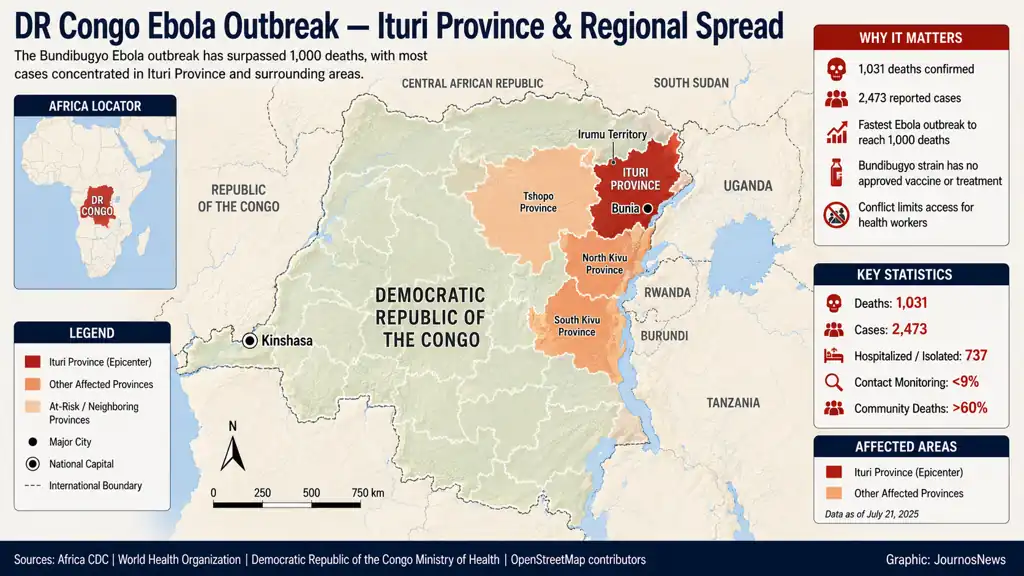
BUNIA, Congo – More than 1,000 people have died in the Democratic Republic of the Congo’s latest Ebola outbreak, marking a grim milestone in what African health officials say is the fastest-spreading Ebola epidemic recorded to date.
Speaking at a health summit in Ghana on Wednesday, Africa Centres for Disease Control and Prevention (Africa CDC) Director-General Dr. Jean Kaseya said 1,031 deaths had been confirmed, warning that insecurity, limited medical resources and funding shortages continue to undermine efforts to contain the virus.
“These are people dying. They are dying because we don’t have vaccines, we don’t have medicine, we don’t have funding,” Kaseya said.
According to the Congolese Ministry of Health, 2,473 Ebola cases had been recorded as of Monday, with at least 737 patients hospitalized or in isolation.

Outbreak Reaches Unprecedented Pace
The outbreak, officially declared on May 15, differs from previous Ebola emergencies because it is caused by the Bundibugyo virus, a strain for which there are currently no approved vaccines or specific treatments.
Health officials say the epidemic reached 1,000 deaths more quickly than any previous Ebola outbreak.
By comparison, the 2014–2016 West Africa Ebola epidemic—the deadliest on record—killed more than 11,000 people among over 28,000 confirmed infections, but took approximately eight months to surpass 1,000 deaths.
The World Health Organization (WHO) has warned the actual number of infections could be two to four times higher than official figures because insecurity has limited surveillance in several affected areas.
Conflict and Community Resistance Hinder Containment
The outbreak remains centered in Ituri Province, although confirmed cases have also been reported in four additional provinces.
■ Related News



Health officials say armed conflict has made many communities inaccessible, while resistance from some residents has complicated disease-control efforts.
Authorities estimate that approximately 80% of newly confirmed infections are occurring outside previously identified transmission chains, suggesting the virus is spreading faster than health workers can identify and isolate new cases.
Robert Ndjalonga, head of civil protection in Ituri Province, said resistance to safe burial procedures remains one of the response’s greatest challenges.
Some families continue to favor traditional burial practices instead of allowing trained Ebola teams to conduct safe burials, increasing the risk of additional infections.
“The biggest challenge remains resistance from or outright refusal by some communities to accept response teams,” Ndjalonga said.
“On several occasions, burial teams have had to be escorted by security forces to ensure that safe and dignified burials could be carried out without incident.”
He added that shortages of burial equipment and the absence of operational burial teams in several health zones have delayed responses following reported deaths.
Violence and Funding Shortages Slow Response
Violence has further complicated containment efforts across eastern Congo.
Attacks targeting health facilities and Ebola response teams have forced humanitarian organizations to suspend operations in some areas.
Some health workers have also gone on strike, saying they have not received salaries since the outbreak began.
Provincial authorities said a member of a safe burial team was injured last week after assailants threw stones at the team’s vehicle following a burial in Bunia.
Officials in Irumu Territory have described Ebola as posing a more immediate threat than the long-running insurgency by the Islamic State-affiliated Allied Democratic Forces, urging residents to cooperate with health workers rather than attack them.
Gaps in Surveillance Raise Further Concerns
A humanitarian worker involved in the Ebola response, speaking anonymously because they were not authorized to comment publicly, described persistent operational challenges.
According to the worker, weak coordination among response agencies, delays in transporting patients to treatment centers and laboratory turnaround times exceeding four days have slowed efforts to isolate infected individuals.
Those delays have resulted in some patients leaving treatment facilities before receiving confirmed test results, increasing the likelihood of continued community transmission.
Speaking at the Africa health summit, Kaseya warned that stronger international support is urgently needed.
“If we do not stop this outbreak today, it could become one of the worst Ebola outbreaks the world has ever documented,” he said.
Africa CDC reported that fewer than 9% of contacts linked to confirmed Ebola patients are currently being monitored—well below the level considered necessary to interrupt transmission.
The agency also said more than 60% of Ebola-related deaths occur within communities before patients can reach medical care.
Pierre Akilimali, Ebola response incident manager at the National Public Health Institute of the Democratic Republic of the Congo, said the high proportion of community deaths suggests many infections are going undetected until it is too late to isolate patients.
Experts Warn the Outbreak Could Continue Expanding
Researchers at the U.S. Centers for Disease Control and Prevention used computer modeling last month to examine how the outbreak could develop.
Under a worst-case scenario, they concluded the epidemic could approach the scale of the 2014–2016 West Africa Ebola outbreak.
Trish Newport, emergency program manager for Doctors Without Borders, said the outbreak is spreading faster than response teams can contain it.
“There’s never been an Ebola outbreak that started with so many cases because it was so late to be identified,” Newport said.
“It’s like the outbreak is outrunning the response.”
Dr. Jean Nachega, an epidemiologist at the University of Pittsburgh advising African public health authorities, said he does not expect the epidemic to reach the CDC’s worst-case projections but cautioned that the challenges facing health authorities remain severe.
With conflict continuing, no approved vaccine or treatment available for the Bundibugyo strain, and significant gaps in surveillance and contact tracing, health officials say stronger international assistance will be critical to slowing transmission and preventing the outbreak from escalating further.
This report is based on reporting by The Associated Press.
Article Topics: Democratic Republic of the Congo | Ebola Outbreak | Africa CDC | World Health Organization | Public Health | Infectious Diseases | Humanitarian Crisis | Disease Surveillance