DUBAI, United Arab Emirates – U.S. President Donald Trump threatened military action Tuesday against an underground Iranian nuclear facility known as Pickaxe Mountain, drawing renewed attention to a site that remains inaccessible to international inspectors and has become a focus of concerns over Iran’s nuclear program.
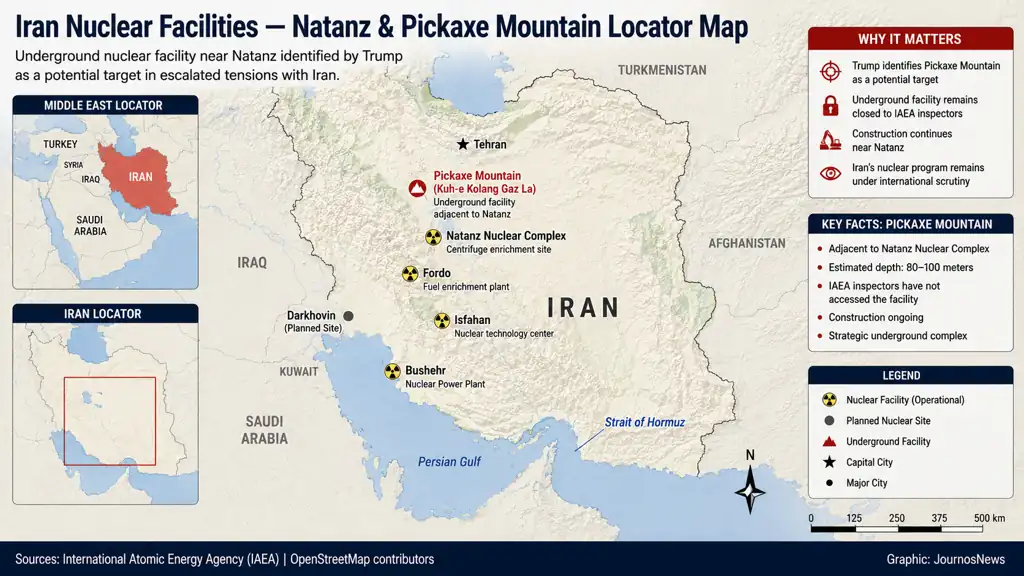
The facility, formally known as Kuh-e Kolang Gaz La, lies immediately south of Iran’s Natanz uranium enrichment complex, which was struck by U.S. forces during Operation Midnight Hammer in the 2025 conflict between Iran and Israel. Although Natanz sustained damage during the operation, construction beneath Pickaxe Mountain has continued, leaving questions about the facility’s purpose and capabilities unanswered.
Trump Identifies Pickaxe Mountain as a Potential Target
Speaking alongside Lebanese President Joseph Aoun in the Oval Office on Tuesday, Trump acknowledged the possibility that Iran may have relocated uranium-enrichment centrifuges into the underground complex.

“We’ll be hitting that area … probably pretty soon. And there’s not a thing they can do about it,” Trump said.
Trump said U.S. officials remain primarily focused on Iran’s stockpile of highly enriched uranium rather than the facility itself.
“We follow the material, that’s where the action is,” he said.
The president later described Pickaxe Mountain as a possible military target if hostilities with Iran continue.
“Normally I wouldn’t say that,” Trump said. “If I thought they could do something about it, I would never say that, but we’ll be hitting that area pretty soon. And very heavily.”
Underground Complex Remains Closed to Inspectors
Little is publicly known about the construction beneath Pickaxe Mountain because inspectors from the International Atomic Energy Agency (IAEA) have never been granted access.
The complex is located adjacent to Natanz, about 225 kilometers (140 miles) south of Tehran. Natanz has remained at the center of international scrutiny since its existence became public more than two decades ago.
Iran began constructing the underground complex after repeated attacks on Natanz, including acts of sabotage widely attributed to Israel that destroyed a centrifuge manufacturing facility.

The protected area covers roughly 2.7 square kilometers (1 square mile) and is guarded by air-defense systems, perimeter fencing and personnel from Iran’s Islamic Revolutionary Guard Corps. Satellite imagery shows several tunnel entrances extending into the mountain.
An Associated Press analysis published in 2023, citing specialists from the James Martin Center for Nonproliferation Studies, estimated that the underground complex was being excavated 80 to 100 meters (260 to 328 feet) below the surface. Construction has continued since then, and some analysts believe portions of the facility could extend even deeper.
Those specialists assessed that the site could eventually be used both for centrifuge production and uranium enrichment within a heavily fortified underground environment.
Depth Presents Military Challenges
Centrifuges are tube-shaped machines arranged in cascades that rapidly spin uranium gas to increase its enrichment level.
According to the U.S. military, the GBU-57 Massive Ordnance Penetrator was developed to strike deeply buried facilities by penetrating at least 60 meters (200 feet) of earth before detonation.
Military analysts have discussed the possibility of employing multiple bunker-busting weapons against deeply buried targets. However, it remains uncertain whether such strikes would be sufficient to destroy a facility believed to extend as deep as Pickaxe Mountain.
Regional Conflict Keeps Nuclear Facilities in Focus
Iran said areas surrounding its only operational nuclear power plant at Bushehr have come under attack during the current conflict, although officials reported no damage to the Russian-operated reactor.
Tehran also accused the United States of striking the cleared construction site designated for the planned Darkhovin nuclear power plant. The IAEA said no nuclear material was present there during its most recent inspection.
Iran further claimed that the Barakah Nuclear Energy Plant in the United Arab Emirates had also been targeted during the conflict and warned it would take unspecified “required actions” in response to the reported strike on Darkhovin.
Iran’s Nuclear Program Remains Under International Scrutiny
Iran’s nuclear program has remained a source of international concern for decades.
During the 2025 conflict, the United States struck uranium enrichment facilities at Fordo, Isfahan and Natanz, with Washington and Israel saying the objective was to prevent Iran from acquiring the capability to produce a nuclear weapon.
Iran continues to maintain that its nuclear program is intended exclusively for peaceful purposes.
The IAEA and Western governments say they do not believe Iran has operated an active military nuclear weapons program since 2003, although Iranian officials had increasingly suggested before the recent conflict that the country could pursue nuclear weapons if circumstances changed.
The Associated Press also reported that Iran’s late Supreme Leader Ayatollah Ali Khamenei had previously issued a religious ruling declaring nuclear weapons to be incompatible with Islam. According to the report, his successor, Supreme Leader Mojtaba Khamenei, has not publicly stated whether he supports or opposes pursuing nuclear weapons.
Experts say producing a deliverable nuclear weapon would require enriching uranium to weapons-grade purity, manufacturing a nuclear device, miniaturizing it and integrating it with a missile delivery system—a process that could take months or years and would likely remain subject to international intelligence monitoring.
This report is based on reporting by The Associated Press.
Article Topics: Iran Nuclear Program | Pickaxe Mountain | Natanz Nuclear Site | Donald Trump | Middle East Security | IAEA | Uranium Enrichment | U.S.-Iran Relations