DUBAI, United Arab Emirates (Journos News) – Iran’s wartime leadership faces growing scrutiny after President Masoud Pezeshkian apologized to neighboring states even as Iranian missiles and drones continued targeting locations across the Gulf.
The message, delivered in a hurried video address on Saturday, revealed deeper tensions inside Tehran’s command structure. Iran is now governed by a temporary leadership council following the death of Supreme Leader Ayatollah Ali Khamenei in a Feb. 28 airstrike.
However, the country’s most powerful military force — the Islamic Revolutionary Guard Corps (IRGC) — retains operational control over Iran’s missile arsenal.

That imbalance has raised new questions about who truly directs Iran’s military campaign as the war expands.
According to reporting by The Associated Press, the president’s remarks came as Iran launched another wave of missiles and drones tied to the escalating conflict with Israel and the United States.
Command Fractures Surface Inside Iran’s Wartime Leadership
Pezeshkian’s apology suggested that civilian leaders may not fully control the military operations now unfolding across the region.
“I should apologize to the neighboring countries that were attacked by Iran,” the president said.
He added that Iran should avoid targeting nearby states unless those countries directly attack Iran.




But statements from Iran’s military quickly complicated that message.
Gen. Abolfazl Shekarchi, spokesperson for the Iranian armed forces, said Tehran had avoided striking countries that did not allow U.S. forces to operate from their territory.
His comments conflicted with reports of missile alerts and interceptions across several Gulf states that host American forces.
Iran’s mission to the United Nations later issued a separate statement. It claimed Iranian forces targeted only U.S. bases and military assets in the region.
The mission also suggested that damage to other sites may have occurred during interception attempts by regional air defense systems.
These differing explanations highlighted growing uncertainty within Iran’s wartime command structure.
Leadership Vacuum Intensifies Strategic Uncertainty
Iran has not yet chosen a successor to Khamenei, leaving the country without its most powerful political authority.
Under Iran’s constitution, the Assembly of Experts must select the next supreme leader.
Senior cleric Ayatollah Nasser Makarem Shirazi urged the body to act quickly. He warned that prolonged delays could weaken Iran’s ability to manage the conflict.
Without a supreme leader, the Revolutionary Guard may operate with greater independence than usual.
The organization controls Iran’s ballistic missile program and oversees many of the country’s regional proxy networks.
Analysts say that dynamic could complicate diplomatic efforts if civilian leaders attempt to slow the conflict.
Military operations may continue even if political leaders signal interest in negotiations.
Washington Raises Pressure on Tehran’s Leadership
The leadership uncertainty in Tehran comes as the United States signals that military pressure could increase.
U.S. President Donald Trump warned that additional Iranian officials may become potential targets.
In a social media post, Trump referenced Pezeshkian’s apology while repeating his demand for Iran’s “unconditional surrender.”
U.S. officials also approved a $151 million arms package for Israel during the ongoing conflict.
Israeli strikes continued overnight in western Tehran, according to video verified by The Associated Press.
Israeli officials said one strike hit an airport facility used to transfer weapons and financial support to militant groups.
Residents in parts of the Iranian capital reported hearing repeated explosions as bombardments continued.
Regional Security Network Faces New Stress
Iranian missile launches triggered alerts across several Gulf states early Saturday.
Authorities in Bahrain activated warning sirens after detecting incoming missiles.
Saudi Arabia reported intercepting drones headed toward the Shaybah oil field, one of the kingdom’s largest energy installations.
Saudi officials also said air defenses destroyed a ballistic missile aimed at Prince Sultan Air Base, which hosts U.S. forces.
In the United Arab Emirates, explosions were heard across Dubai as air defense systems activated.
Passengers at Dubai International Airport were directed into underground train tunnels for safety.
Airline Emirates briefly suspended flights before resuming operations later in the day.
The incidents raised new concerns about the vulnerability of regional energy infrastructure and aviation routes.
Lebanon Front Adds New Pressure to Expanding Conflict
The conflict is also intensifying along Israel’s northern border with Lebanon.
The Iran-backed group Hezbollah said its fighters clashed with Israeli forces in eastern Lebanon’s mountain region late Friday.
Fighting and airstrikes continued into Saturday.
Lebanon’s Health Ministry reported that Israeli strikes in the town of Nabi Chit killed at least 41 people and wounded dozens more.
The Lebanese army said three of its soldiers were among the dead.
Israel has not confirmed the ground clashes but continues airstrikes in Beirut’s southern suburbs.
Those districts contain large Hezbollah networks but also house hundreds of thousands of civilians.
The continued strikes raise concerns about further regional escalation.
Naval Developments Signal Wider Strategic Reach
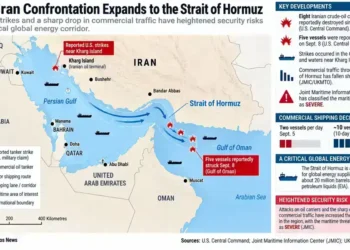
The conflict has also spread into surrounding maritime zones.
India’s foreign minister Subrahmanyam Jaishankar confirmed that the Iranian naval vessel IRIS Lavan docked in the port city of Kochi.
India granted access after the ship reported technical problems shortly after the war began.
The development followed a separate naval incident earlier in the week.
A U.S. submarine sank the Iranian warship IRIS Dena off the coast of Sri Lanka, according to regional officials.
Another Iranian vessel, IRIS Bushehr, has also requested assistance from Sri Lankan authorities.
More than 200 sailors from that ship are being brought ashore.
Both vessels had recently participated in naval exercises hosted by India.
Strategic Control in Tehran Remains Uncertain
Casualty numbers continue to rise as the war expands.
Iranian officials report more than 1,200 deaths inside the country since the fighting began.
Lebanese authorities say over 200 people have died there. Israel reports 11 fatalities, while six U.S. troops have been killed.
Missile alerts also continued across Israel, including in Jerusalem, where residents again rushed to bomb shelters.
But the most significant uncertainty may lie inside Iran’s leadership structure.
Without a new supreme leader, the balance of authority between political officials and military commanders remains unclear.
How Tehran resolves that leadership gap could shape the next phase of the conflict across the Middle East.