Updated February 24, 2026
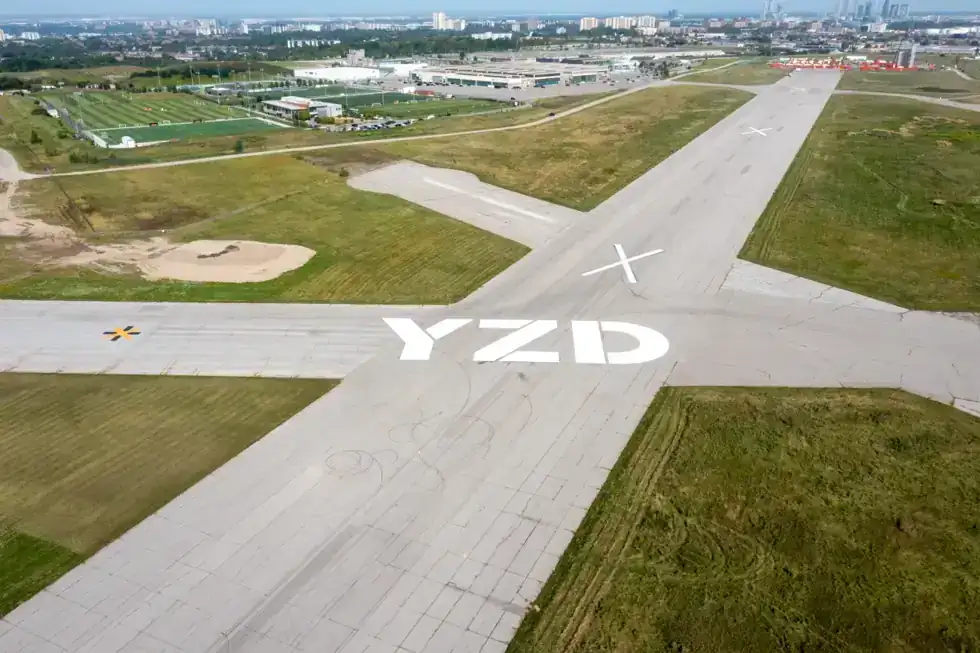
The Downsview Airport site, once a cornerstone of Canadian aviation and industry, is entering a new era. The airport, historically home to aircraft pioneers, is being redeveloped into YZD—a $30 billion, 30-year project designed to host over 50,000 residents across seven neighborhoods. The plan balances the site’s heritage with a vision for a greener, more connected urban future.
Downsview’s story stretches back more than a century. The first airfield rose amid farmland roughly 100 years ago, soon attracting De Havilland Canada, which became a global aviation leader. During World War II, the site expanded into warplane production. Bombardier acquired the airfield in the 1990s, but its closure in 2024 ended an industrial era and paved the way for a major urban transformation.

Construction on YZD is scheduled to begin in early 2026. The project revolves around the airport’s 2-kilometer-long runway, which will transform into a pedestrian park linking all seven neighborhoods. Each district will include housing, schools, libraries, community centers, and retail spaces, with the runway serving as the “connective tissue.” Derek Goring, CEO of Northcrest Developments, emphasized the importance of preserving the site’s character: “We want to lean into what’s there and make as much use of it as possible. It helps bring character and it makes it more interesting and unique.”
Sustainability at the Core
YZD is designed to reduce its environmental impact. By retaining existing structures, the development avoids the carbon footprint associated with demolition and new construction. Industrial hangars from the 1950s to 1990s will be repurposed for film production, light manufacturing, and clean technology. Green roofs will help absorb rainwater, reduce flood risk, and increase biodiversity.
Materials from the runway will also be recycled. Concrete and asphalt will serve as aggregate for roads and pavements, reflecting circular economy principles. Environmental consultants are assessing and mitigating potential contamination from the site’s industrial and military past, ensuring the redevelopment is safe and sustainable.
Michael van Valkenburgh Associates (MVVA), selected through an international design competition, leads the runway redesign. Their plan restores native habitats reminiscent of the pre-airfield Carolinian forest. Emily Mueller De Celis, a partner at MVVA, explained that re-naturalizing the site will enhance local ecology and support water management through bioswales and strategic plantings that reduce flood risks downstream.
The sustainability approach extends beyond ecology. Planners anticipate climate change and extreme weather over the coming decades. Northcrest is also collaborating with Danish firm SLA, known for integrating green urban spaces into city infrastructure, to implement the “City Nature” concept, prioritizing pedestrian-friendly streets and accessible public green spaces.
Connectivity and Urban Integration
YZD leverages Toronto’s transit network. Surrounding train stations and subways allow the development to focus on walking, cycling, and last-mile bus services. While cars will remain in certain areas, Goring notes that the runway park and cycle lanes will make walking and cycling safer, more convenient, and the preferred mode of travel.
The project joins a global trend of converting former airports into sustainable urban spaces, similar to Tempelhofer Feld in Berlin and Ellinikon Metropolitan Park in Athens. YZD differs, Goring argues, due to its scale, central location, and focus on city-building rather than solely park creation. “The fact that our site sits at the geographic center of the largest metro area in Canada, with existing public transit infrastructure, means that it’s more of a city-building exercise than a park,” he said.
Phased Development and Long-Term Planning
The first phase, the 100-acre “Hangar District,” will feature 3,000 new homes, with completion targeted for 2031. Developers plan to build in stages, generating returns from each phase to fund subsequent construction. Goring emphasizes flexibility: “The world’s going to change a lot … we’re not trying to decide in 2025 what the future should be 20 or 30 years from now.”
Over three decades, YZD aims to evolve with urban needs, climate realities, and technological innovations. Its ultimate goal is to create a high-quality living environment that blends seamlessly into Toronto, preserving history while fostering sustainability and connectivity. “We want it to feel like a part of Toronto,” Goring said.
Goring puts it, “Ultimately, it’s about delivering a really high quality of life and merging into the current city. We want it to feel like a part of Toronto.
Source: CNN – Inside the abandoned airport being transformed into a $30 billion sustainable city