CAIRO/GAZA CITY (Journos News) – Israel’s killing of a senior Hamas commander has injected fresh uncertainty into the fragile ceasefire in Gaza, with the group’s chief negotiator warning the strike could undermine already delicate truce arrangements.
In remarks broadcast from exile on Sunday, Hamas negotiator Khalil al-Hayya said the assassination risks destabilizing the agreement reached in October, urging the United States to intervene. According to reporting by Reuters, al-Hayya called on U.S. President Donald Trump to pressure Israel to comply with the terms of the ceasefire.
The strike targeted Raed Saed, a senior figure within Hamas’ armed wing. His death marks one of the most significant killings of a Hamas commander since the truce began, raising new questions about whether the pause in hostilities can hold.

Strategic Deterrence Tested
The assassination of Saed strikes at the core of Hamas’ military infrastructure at a moment when both sides are attempting to manage an uneasy ceasefire rather than a formal end to the war.
Hamas sources have described Saed as a senior operational commander responsible for weapons manufacturing and logistics inside the organization’s military apparatus. Israeli officials have previously linked him to planning roles associated with the October 7 attacks, the event that triggered the ongoing war.
The Hamas armed wing said it had already appointed a successor, signaling an attempt to maintain operational continuity. However, the group warned the killing would not deter its broader military objectives.
Such targeted strikes during a ceasefire risk shifting the balance from managed de-escalation back toward confrontation, particularly if retaliatory pressures inside Gaza intensify.
Leadership Gaps Deepen Internal Strain
Saed’s death further exposes leadership fragility within Hamas following the earlier killing of Yahya Sinwar by Israeli forces in 2024.




Since Sinwar’s death, Hamas has avoided appointing a single overall leader, instead operating through a collective five-member leadership council that includes al-Hayya. The arrangement has allowed the group to maintain political cohesion, but analysts say it also reflects a leadership structure adapting to sustained Israeli targeting.
With the loss of another senior commander, Hamas must now balance internal command restructuring while maintaining its negotiating position in ongoing ceasefire talks.
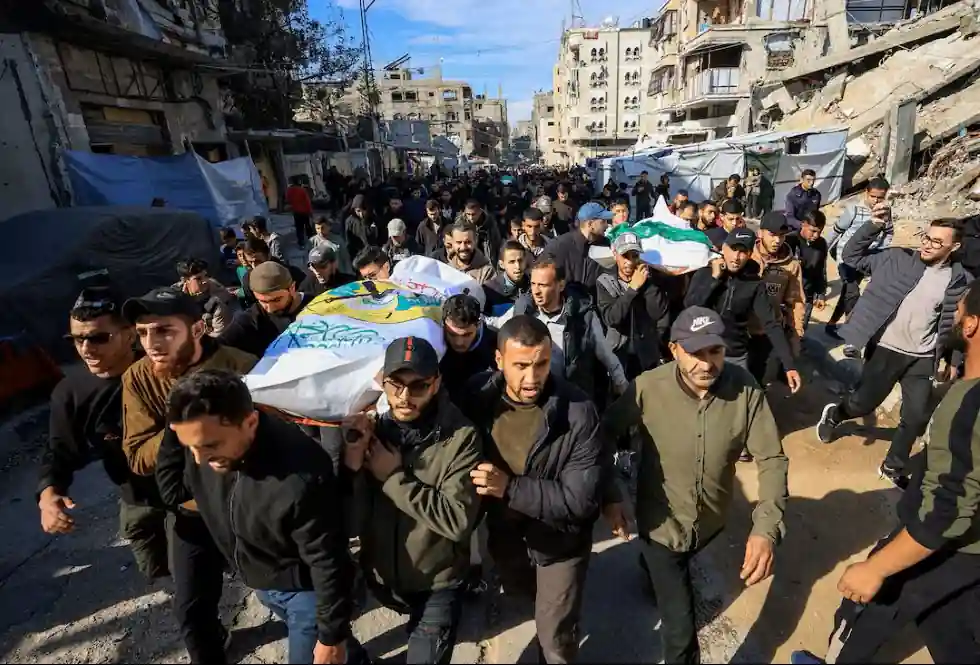
Public displays of support appeared intended to project stability. Thousands gathered in Gaza City for Saed’s funeral procession, one of the largest demonstrations of Hamas presence since the ceasefire began.
Territorial Reality Complicates Negotiations
The ceasefire has not resolved the core territorial divide across Gaza.
Israeli forces continue to control large sections of the enclave’s eastern zone, an area largely depopulated during the conflict. Hamas, meanwhile, has re-established administrative and security control over western areas where the majority of Gaza’s more than two million residents now live amid extensive destruction.
Negotiations over the next phase remain stalled. Israel insists that Hamas must disarm and be excluded from any future governing role in Gaza. Hamas has rejected both conditions, insisting Israeli forces must withdraw completely.
These unresolved demands continue to define the strategic impasse at the center of the ceasefire.
International Stabilization Plan Faces Political Limits
International mediators are attempting to construct a security framework that could sustain the truce.
The ceasefire agreement includes provisions for a multinational stabilization mission authorized by the United Nations. Planning discussions are scheduled in Doha, where United States Central Command is expected to host partner nations to explore deployment options.
Hamas, however, has already signaled resistance to a broad international presence inside the territory. Al-Hayya said any foreign force should remain confined to Gaza’s borders rather than operating within the enclave itself.
Those limitations could complicate efforts to build a peacekeeping arrangement acceptable to both sides.
Internal Security Violence Signals Fragmentation Risks
The fragile environment inside Gaza was underscored by a separate killing on Sunday.
Gunmen shot dead Ahmed Zamzam, an officer involved in counter-collaboration investigations within Gaza’s security services. The Gaza Interior Ministry accused collaborators acting under Israeli direction of carrying out the attack.
Responsibility was claimed by Ghassan Duhine, who said his faction had targeted Zamzam in retaliation against Hamas.
Reuters reported that the circumstances of the attack could not be independently verified, and Israeli officials did not immediately comment.
The incident highlights growing friction between Hamas and rival armed factions operating in areas still under Israeli control—an additional pressure point that could destabilize governance inside the enclave.
Ceasefire Stability Now Hinges on External Mediators
With targeted killings, leadership disruptions, and internal rivalries emerging simultaneously, the Gaza ceasefire faces mounting structural stress.
Diplomatic mediators—particularly the United States and regional partners—are now under increased pressure to preserve the truce framework while negotiations over Gaza’s long-term governance continue.
Whether the assassination of a senior commander proves to be an isolated escalation or the start of renewed confrontation may determine the durability of the ceasefire in the weeks ahead.