Updated – February 23, 2026
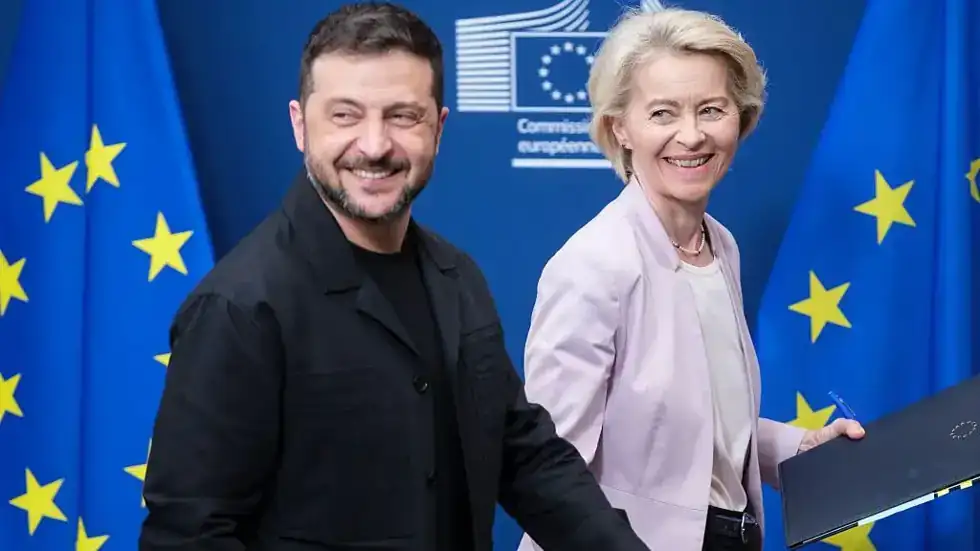
The European Union has agreed to immobilise indefinitely up to €210 billion in Russian central bank assets frozen since Moscow’s full-scale invasion of Ukraine in February 2022. The move marks a shift from temporary sanctions renewal to a longer-term financial strategy that could underpin loans to Kyiv as the war approaches its fifth year.
The decision reflects mounting fiscal pressure on Ukraine and a recalibration of Europe’s approach to wartime financing. But it also raises complex legal, financial and geopolitical questions, particularly for Belgium, where most of the funds are held.

Why Russian assets are frozen in Europe
Within days of the invasion, the EU, alongside G7 partners, froze assets belonging to the Central Bank of the Russian Federation. The objective was to restrict Moscow’s ability to access foreign reserves and stabilise its currency.
Approximately €185 billion of those funds are held at Euroclear, a Brussels-based financial services firm that settles securities transactions globally. The assets were initially held in securities but have largely matured into cash over time. Legally, the funds remain Russian sovereign property; they are immobilised, not confiscated.
Until now, EU governments renewed the freeze every six months. That mechanism required unanimity, creating recurring political uncertainty. Under the new decision, EU ambassadors used an emergency provision in Article 122 of the EU treaties to immobilise the assets indefinitely, citing an “immediate threat to the economic interests of the Union.” This means the freeze would remain in place as long as that threat persists or until Russia pays reparations.
This procedural shift reduces the risk of a single member state blocking renewal. It also signals that Europe views the asset freeze as a structural feature of its Russia policy rather than a temporary sanction.
From windfall profits to loan guarantees
So far, the EU has avoided directly using the underlying assets. Instead, it has transferred “windfall profits” generated by those holdings to Ukraine. In 2024, that amounted to €3.7 billion. Because the interest income is not itself sovereign Russian property, EU officials argue its use carries fewer legal risks.
The new debate concerns the principal. Ukraine faces an estimated €135.7 billion funding gap over the next two years to sustain both its military effort and broader economy. European governments aim to cover roughly two-thirds of that need, or around €90 billion.
Two broad proposals are under discussion.
The first would see the EU borrow on capital markets, using the EU budget as a guarantee. This option resembles the bloc’s pandemic-era joint borrowing. However, it would require unanimous approval by member states. Governments such as Hungary and Slovakia have signalled opposition to funding Ukraine’s military, complicating that route.
The second proposal involves leveraging the immobilised Russian assets as collateral for a loan to Kyiv. In this model, the principal would not be confiscated outright but would serve as backing for EU-issued debt. If structured carefully, officials argue, the assets could secure a large loan without technically transferring ownership.
European Commission officials maintain that sufficient legal safeguards can be designed. They also argue that if Russia sought damages in Russian courts, any rulings would not be recognised within the EU legal order.
Belgium’s dilemma
Belgium finds itself at the centre of the issue because Euroclear is headquartered in Brussels and the bulk of the assets sit within its accounts.
Belgian Prime Minister Bart De Wever has publicly supported Ukraine but requested “rational, reasonable and justified” conditions before endorsing a reparations-style loan plan. The concern is not geopolitical alignment but legal and financial exposure.
Euroclear’s chief executive has warned that forcing the clearing house to participate in a large-scale loan arrangement could destabilise aspects of the international financial system. Financial market infrastructure firms are subject to strict capital and liquidity rules. Concentrating risk around a single, politically charged asset pool raises regulatory questions.
Legal scholars in Belgium have pointed out that, in a worst-case scenario, if Euroclear faced losses on its own immobilised assets in Russia — estimated at €16–17 billion — and required state support, Belgium’s relatively small economy could be disproportionately exposed. Belgian GDP is roughly €565 billion. While such an outcome remains hypothetical, the scale of the frozen Russian funds relative to Belgium’s economy underscores the perceived risk.
The European Commission says it has addressed these concerns by proposing a comprehensive guarantee mechanism. If Euroclear suffered losses in Russia, those could be offset against assets belonging to Russia’s own clearing institutions that are held in the EU. Officials also argue that any Russian legal retaliation would have limited enforceability inside the bloc.
Whether those safeguards are sufficient remains under discussion ahead of a key EU summit.
Legal and systemic implications
At the heart of the debate lies a tension between political urgency and legal precedent.
Under international law, sovereign assets are typically protected from confiscation. Direct seizure could trigger legal challenges and set a precedent affecting how other countries hold reserves abroad. Some policymakers worry about implications for the euro’s role as a global reserve currency if foreign governments perceive their holdings as vulnerable.
By contrast, using assets as collateral for a loan, rather than transferring ownership, is presented as a narrower step. EU officials argue this approach maintains formal respect for property rights while recognising that Russia’s invasion created extraordinary circumstances.
Still, legal uncertainty persists. Russia’s central bank has initiated legal action in Moscow against Euroclear. While EU officials describe European institutions as legally protected, cross-border litigation could add complexity and prolong disputes.
Financial stability concerns also extend beyond Belgium. Clearing houses like Euroclear play a central role in global securities markets. Any perception that they are instruments of geopolitical policy could prompt market participants to reassess risk.
Broader geopolitical pressures
The EU’s move comes amid shifting transatlantic dynamics. Military and financial support from the United States has declined sharply in 2025 following policy changes under President Donald Trump. Europe has sought to fill the gap, but internal divisions and fiscal constraints limit its options.
Some EU officials also express concern that Washington could pursue its own approach to Russia’s frozen assets as part of potential peace negotiations. Early drafts of US proposals reportedly contemplated using a portion of Russian assets for reconstruction while allocating part of the proceeds to US interests. European policymakers argue that immobilising the assets indefinitely makes it harder for external actors to redirect them without EU consent.
Russia, for its part, describes the EU plan as theft and warns of retaliation. Hungarian Prime Minister Viktor Orbán has criticised what he calls a departure from strict legal norms, reflecting broader divisions within the bloc.
What happens next
The immediate objective for EU leaders is to finalise a structure capable of delivering up to €90 billion in support to Ukraine. The choice between unanimous borrowing and asset-backed lending remains politically sensitive.
The indefinite immobilisation of assets reduces procedural uncertainty. It does not, however, eliminate the legal and systemic questions that accompany any move from freezing to leveraging sovereign reserves.
The outcome will likely shape not only Ukraine’s short-term financing but also longer-term debates about sanctions policy, financial sovereignty and the architecture of the international monetary system. For Europe, the challenge lies in balancing legal caution, financial stability and geopolitical resolve.
As the war continues, the question is less whether the frozen assets will remain immobilised — that now appears settled — and more how far European governments are prepared to go in converting them into tangible support for Kyiv.
Source: BBC – EU backs indefinite freeze on Russia’s frozen cash ahead of loan plan for Ukraine