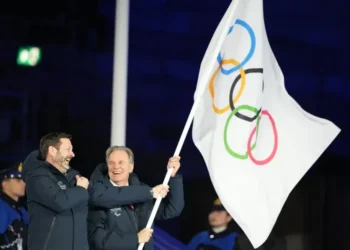
MILAN (Journos News) – As Italy hosts the Olympic and Paralympic Games during the Muslim holy month of Ramadan, the contrast between its cosmopolitan cities and Alpine mountain towns has come into sharper focus. While Milan offers established Islamic centers and interfaith outreach, access to prayer spaces in smaller host communities such as Cortina d’Ampezzo is more limited.
The overlap between the Games and Ramadan places questions of religious accommodation, visibility and integration into a global spotlight. It also reflects broader shifts within Italian society, where Muslim communities have grown steadily over recent decades, even as the country remains culturally shaped by Catholic traditions.
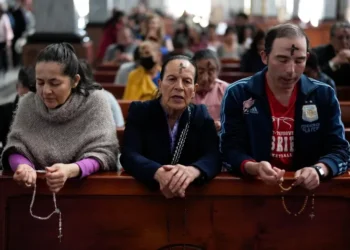
Italy is home to approximately 1.7 million Muslims, according to data from the Milan-based research institute ISMU. In a nation of roughly 59 million people, the majority are baptized Catholic, though regular church attendance has declined significantly over time. Migration from North Africa, South Asia and parts of the Balkans has reshaped the country’s demographic profile, particularly in northern regions such as Lombardy.

This demographic evolution provides important context for understanding how Ramadan is being observed across Italy’s Olympic host cities — and why experiences differ so markedly between Milan and the Dolomite mountains.
Milan: A Multicultural Setting with Established Institutions
Milan, Italy’s second-largest city and the capital of Lombardy, has long served as a hub of commerce, migration and cultural exchange. The region hosts nearly 400,000 Muslims, making it one of the country’s most religiously diverse areas.
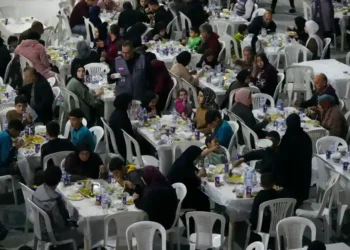
Within this setting, the Al-Wahid mosque — officially recognized by municipal authorities since 2000 — has opened its doors during Ramadan not only to Muslim worshippers but also to members of other faith communities. Interfaith iftars, the evening meals that break the daily fast, have become a recurring feature in recent years.
Imam Yahya Pallavicini, vice president of the Islamic religious association COREIS, has described the Olympics as a symbolic moment, suggesting that sport and culture can help reduce prejudice and fear toward particular religious identities. His comments reflect a broader theme: in Milan, Ramadan observance is intertwined with public visibility and civic dialogue.
Friday congregational prayers during Ramadan draw large crowds, and open invitations to municipal officials and Catholic representatives indicate an effort to frame Islamic observance as part of Italy’s wider social fabric. Such initiatives mirror similar interfaith gatherings seen in countries where Muslims are minorities, including Australia and the United States.
■ Related News
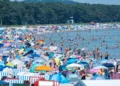

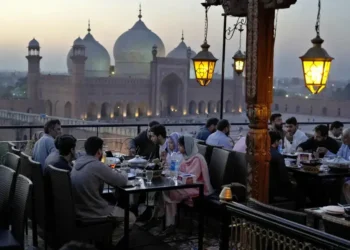
The atmosphere at sunset in Milan’s mosque — worshippers standing shoulder to shoulder, breaking their fast with dates before sharing simple meals — underscores how communal rituals adapt to local context while maintaining religious continuity. The setting is unmistakably Italian, yet the practices are part of a global Islamic tradition observed by millions worldwide.
Cortina d’Ampezzo: Geography and Access
The experience differs in Cortina d’Ampezzo, an Alpine resort town perched at about 1,220 meters in the Dolomites. Known for its winter tourism and small permanent population of just over 5,000 residents, Cortina lacks the established mosque infrastructure found in larger urban centers.
Several Muslim residents and workers interviewed by the Associated Press described difficulties in locating formal prayer spaces. One worker said the nearest mosque he could find was in Brunico, more than an hour’s drive away on challenging mountain roads.
Such accounts illustrate how geography shapes religious practice. Mountain towns are often dispersed and less densely populated, limiting the demand and financial viability of dedicated religious facilities. In contrast to Milan’s established Islamic centers, smaller Alpine communities rely on informal networks or travel to neighboring towns.
For Olympic athletes, interfaith prayer rooms are available within residential villages. However, these spaces are not accessible to the broader public, creating a distinction between accommodations for competitors and those available to residents or visiting workers.
Elsewhere in the Dolomites, including Brunico — a town of roughly 17,000 people — Friday prayers attract over a hundred attendees in modest rented spaces. Worshippers there contribute donations to cover rent and utilities, reflecting a community-based model of religious organization common among minority groups in Europe.
A Changing Religious Landscape
The contrast between Milan and Cortina reflects broader structural forces. Italy’s Muslim population has grown primarily through migration over the past three decades, with many arrivals from Morocco, Egypt, Bangladesh and Pakistan. A significant share of the community now includes second-generation Italians born and educated in the country.
At the same time, migration has been a politically charged issue. Since taking office in 2022, Prime Minister Giorgia Meloni has pledged stricter controls aimed at deterring irregular Mediterranean crossings. These policies form part of a wider European debate over migration management and integration.
Experts note that while public debate often focuses on border enforcement, the longer-term social reality involves integration within schools, workplaces and local communities. Ramadan observance in Italy therefore operates within a dual framework: religious continuity and civic negotiation.
In urban centers such as Milan, interfaith initiatives suggest efforts to situate Islam within Italy’s broader cultural heritage. In smaller towns, where Muslim populations are more limited, public religious expression may be quieter and less institutionalized.
Young Italian Muslims describe navigating this landscape with pragmatism. Some report that inviting non-Muslim neighbors to iftar dinners is less common in smaller communities, not necessarily due to hostility but because of limited social interaction or perceived disinterest. This points to the subtle, everyday dimensions of integration that rarely capture headlines.
The Olympics as a Symbolic Moment
Global sporting events often magnify local dynamics. The Olympics bring international athletes, workers and visitors into close proximity with host communities. When such events coincide with major religious observances, logistical and cultural questions naturally arise.
The availability of prayer rooms within athlete villages demonstrates formal recognition of religious diversity at the institutional level. Outside those facilities, however, access depends largely on local demographics and infrastructure.
This suggests that religious accommodation in Italy is neither uniform nor static. It varies by region, population density and civic engagement. Milan’s model of recognized mosques and interfaith outreach represents one trajectory. Cortina’s reliance on neighboring towns illustrates another.
For many Muslim residents, Ramadan in Italy is described as possible but not always straightforward. The ability to fast, gather and pray exists, yet it may require additional travel or coordination in less urban areas.
What This Reveals About Italy Today
Italy remains historically Catholic, but its religious landscape is increasingly plural. Declining church attendance among Catholics and the growth of Muslim communities indicate evolving patterns of belief and identity.
The Olympic spotlight has highlighted these realities without fundamentally altering them. Milan’s multicultural framework reflects decades of migration and institutional development. Cortina’s challenges stem from geography and scale rather than overt policy barriers.
Together, these experiences suggest that religious diversity in Italy is shaped less by singular national policy than by local context. Urban centers with large immigrant populations tend to develop structured accommodations. Smaller communities adapt incrementally.
As the Games conclude and Ramadan continues, the moment serves as a reminder that global events intersect with everyday life in complex ways. Religious practice, far from existing apart from civic space, interacts with it — sometimes seamlessly, sometimes with logistical friction.
The broader trend points toward gradual normalization of diversity within Italy’s public sphere. Whether that normalization deepens may depend on continued dialogue, demographic change and the evolving balance between tradition and pluralism.
Source: AP News – Catholic Italy’s Olympic host cities offer different access for Muslims to observe Ramadan