MEXICO CITY (Journos News) – Mexico’s security forces killed Nemesio Rubén Oseguera Cervantes, widely known as “El Mencho,” during a military operation in the western state of Jalisco, authorities said Sunday. His death marks the most significant blow yet against the powerful Jalisco New Generation Cartel (CJNG), a group accused of trafficking large quantities of fentanyl and other drugs to the United States.
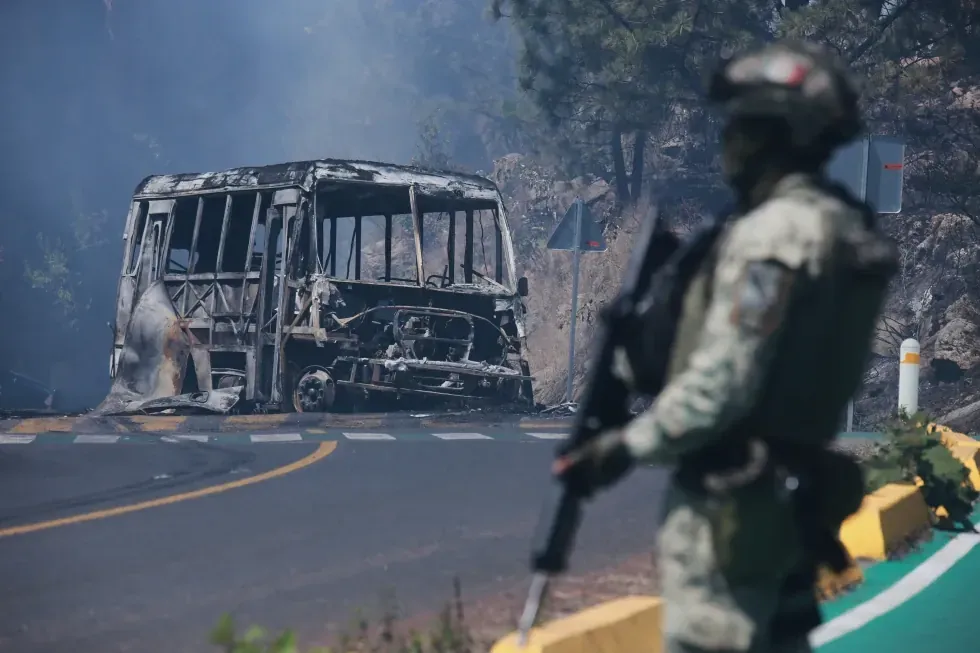
The operation triggered hours of coordinated violence across multiple states, underscoring the cartel’s reach and capacity for retaliation. Roadblocks, burning vehicles and flight cancellations disrupted daily life in cities including Guadalajara and Puerto Vallarta, as residents were urged to remain indoors.
For Mexico’s government, the killing of Oseguera Cervantes represents a pivotal moment in its security strategy and its cooperation with the United States against organized crime. It also raises renewed questions about whether dismantling cartel leadership will reduce violence or provoke further instability.

Operation in Tapalpa
According to Mexico’s Defense Department, troops attempted to capture Oseguera Cervantes in the town of Tapalpa, about two hours southwest of Guadalajara. Soldiers came under fire during the operation. Four people at the scene were killed, and three others — including Oseguera Cervantes — were wounded and later died while being transported to Mexico City.
Authorities said two suspects were arrested and that armored vehicles, rocket launchers and other heavy weapons were seized. Three members of the armed forces were injured and are receiving medical treatment.
Local officials, speaking on condition of anonymity because they were not authorized to comment publicly, reported additional casualties amid the unrest. A member of the National Guard was killed in Tapalpa, and several other security personnel died in separate incidents in Zapopan, Puerto Vallarta and Guadalajara as violence spread.
Roadblocks and airport disruption
In the hours following confirmation of Oseguera Cervantes’ death, vehicles were set ablaze and positioned to block highways in nearly a dozen states — a tactic frequently used by cartels to obstruct military movements.
Smoke was seen rising over parts of Puerto Vallarta, a major tourist destination on Mexico’s Pacific coast. Videos circulating online showed travelers running through Guadalajara’s airport amid confusion. Air Canada suspended flights to Puerto Vallarta, citing an ongoing security situation, while several Mexican and international carriers also canceled services.
■ Related News

Jalisco Governor Pablo Lemus urged residents to remain at home and suspended public transportation, describing the situation as “critical.” Schools were closed Monday in several affected states.
The U.S. State Department advised American citizens in Jalisco, Tamaulipas, Michoacán, Guerrero and Nuevo León to shelter in place. Canada’s embassy in Mexico issued similar guidance for its nationals in Puerto Vallarta.
U.S. cooperation and political context
The White House confirmed that U.S. authorities provided intelligence support for the operation. Press Secretary Karoline Leavitt described Oseguera Cervantes as a top target for both governments because of his alleged role in fentanyl trafficking into the United States.
The U.S. State Department had previously offered a reward of up to $15 million for information leading to his capture. In February 2025, the administration of President Donald Trump designated the CJNG as a foreign terrorist organization, intensifying bilateral security coordination.
President Claudia Sheinbaum praised Mexico’s armed forces and called for calm in a message posted on social media. Since taking office, Sheinbaum has faced pressure to demonstrate progress against drug trafficking while balancing concerns over sovereignty and the long-term effectiveness of targeting cartel leaders.
Security analysts note that previous “kingpin” operations have sometimes splintered criminal groups, fueling localized violence. Whether the CJNG will fragment or consolidate under new leadership remains unclear.
A powerful and aggressive cartel
The Jalisco New Generation Cartel emerged around 2009 and rapidly expanded its operations across Mexico and into international markets. U.S. authorities, including the Drug Enforcement Administration, have described it as one of the most powerful criminal organizations in the Western Hemisphere, with distribution networks spanning all 50 U.S. states.
The group has been linked to the production and trafficking of fentanyl, methamphetamine and cocaine. It has also gained notoriety for its military-style tactics, including attacks on helicopters, the use of explosive-laden drones and roadside mines.
In 2020, CJNG gunmen carried out a brazen assassination attempt in central Mexico City against the then police chief, highlighting the group’s operational reach.
The rise of “El Mencho”
Oseguera Cervantes, 59, was born in Aguililla, Michoacán. He became involved in drug trafficking in the 1990s and at one point lived in the United States, where he was convicted in 1994 in federal court in California for conspiracy to distribute heroin. After serving nearly three years in prison, he returned to Mexico.
Following the death of drug trafficker Ignacio “Nacho” Coronel Villarreal in 2010, Oseguera Cervantes helped establish the CJNG alongside Erik Valencia Salazar. Initially aligned with the Sinaloa Cartel, the group later split and became a principal rival, battling for territory across multiple states.
Since 2017, Oseguera Cervantes had faced multiple indictments in U.S. federal courts, including charges related to drug trafficking conspiracies, firearms offenses and directing a continuing criminal enterprise under the U.S. Drug Kingpin Enforcement Act.
Under his leadership, the CJNG developed a reputation for aggressive expansion and extreme violence. In recent years, authorities linked the group to alleged recruitment and training sites in Jalisco, where investigators discovered human remains and personal belongings believed to be associated with missing persons cases.
Uncertain aftermath
The killing of Oseguera Cervantes removes one of the most sought-after figures in Mexico’s drug war. Yet the immediate eruption of violence following his death reflects the enduring strength of organized crime networks.
Mexico’s government has pledged to restore order in affected areas and maintain coordination with international partners. For residents in Jalisco and beyond, the coming days will test whether the operation marks a turning point or the beginning of a new phase in a long-running conflict.
Source: AP News – Mexican army kills leader of powerful Jalisco New Generation Cartel during operation to capture him