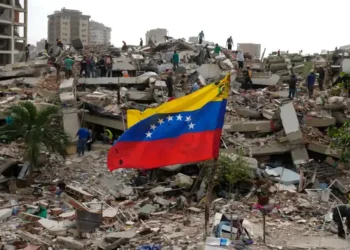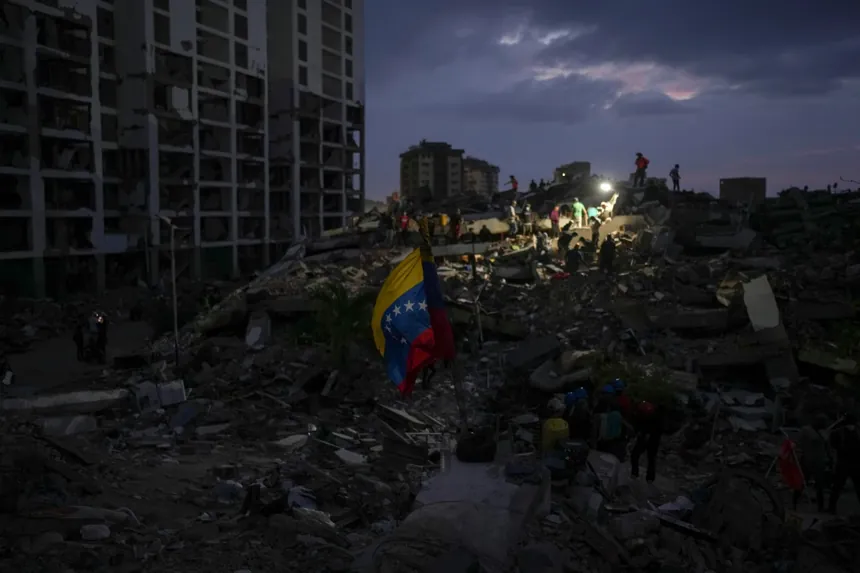
LA GUAIRA, Venezuela – As rescue operations following Venezuela’s devastating twin earthquakes shift toward recovery, many families say they have been left to retrieve the bodies of loved ones on their own, using little more than basic tools and their bare hands.
The search for survivors is increasingly giving way to the grim task of recovering the dead, with international rescue teams beginning to leave the country after nearly two weeks of operations.
Among those searching is 26-year-old Noel Márquez, whose family’s apartment building collapsed and caught fire during the June 24 earthquakes in La Guaira, one of the hardest-hit areas.

Márquez survived because he was away from home at the time. Returning to the scene, he found only his 17-year-old brother, Leonel, still alive beneath the wreckage.
Márquez and his father spoke with Leonel through layers of concrete as he pleaded for help while trapped under heavy columns. According to Márquez, they waited for heavy machinery that never arrived.
After several hours, Leonel’s voice fell silent.
Families Search for Closure
Márquez said the ordeal did not end with his brother’s death.
Unable to obtain equipment needed to recover his relatives, he attempted to retrieve their bodies himself.
■ Related News

He said he managed to recover the remains of his brother and mother but was forced to leave behind his pregnant sister, grandmother and other relatives still buried beneath the collapsed building.
“It’s unfair. It’s inhumane, everything that is happening,” Márquez said outside a makeshift morgue at the port of La Guaira.
“We couldn’t get my brother out because we didn’t get a response from the state … and after 11 days, we are still requesting a crane.”
Across the disaster zone, similar stories have emerged as families continue searching for missing relatives while hoping to recover bodies for burial.
“I found her hand, but her torso is crushed,” said Norely Rodríguez, who has been trying to recover the body of her 5-year-old daughter. “I want to see if I can get her out whole.”
Civilians Lead Recovery Efforts
Residents say they have received little assistance in recovering victims from collapsed buildings.
William Gomez, a firefighter in La Guaira, said recovery work has become increasingly difficult as bodies decompose beneath the rubble.
“It has been difficult because the bodies are already in an advanced state of decomposition, decomposed to such an extent that many times when we try to remove them, they fall apart,” Gomez said.
Authorities announced Monday that the confirmed death toll had risen to 3,535, while another 16,740 people were reported injured.
The total number of people still trapped remains unknown. More than 30,000 missing-person reports have been submitted through a website established by Venezuela’s political opposition.
According to the United Nations Development Programme, approximately 1.2 million tons of debris remain in the areas of La Guaira most heavily damaged by the earthquakes.
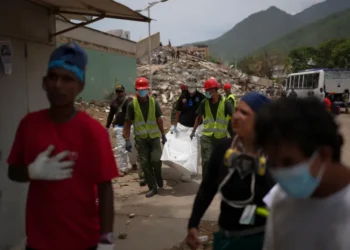
Over the weekend, few government emergency crews were visible in the hardest-hit neighborhoods. Most recovery efforts were being carried out by residents using shovels, pickaxes and their hands, occasionally assisted by firefighters and Mexican rescue personnel still operating in the country.
“We are the ones helping ourselves: our family. Nobody else helps us except for a few volunteers,” said resident Yeikhary Urbina, who recovered the bodies of her mother and brother after finding them beneath collapsed concrete.
Some communities have discussed pooling money to rent cranes privately, with one neighborhood reportedly facing a cost of $11,500 for heavy equipment.
Government Shifts Focus to Reconstruction
Several international search-and-rescue teams from countries including Italy, Argentina and Spain have already returned home.
Although Venezuelan authorities have not officially ended the search for survivors, government messaging has increasingly shifted toward reconstruction.
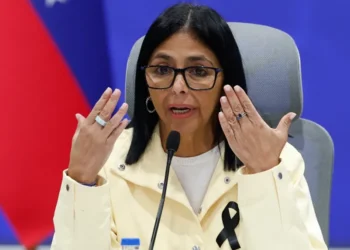
Acting President Delcy Rodríguez announced plans to rebuild damaged infrastructure through a program called “Venezuela Reborn.”
“Venezuela is entering a process of infrastructure recovery, of housing recovery,” Rodríguez said on state television.
She rejected criticism that the government’s response to the disaster had been too slow and accused some media organizations of spreading misinformation.
Questions Raised Over Building Safety
For many survivors, the recovery effort has also renewed concerns about the safety of public housing developments built years earlier under former President Hugo Chávez.
Entire residential towers collapsed during the earthquakes, prompting renewed scrutiny over construction standards.
Alexander, a police officer who asked that only his first name be used because he feared retaliation as a government employee, said he lost his wife and three daughters when their apartment building collapsed.
He criticized authorities for failing to address long-standing concerns raised by residents about the structural quality of the building and for what he described as delayed rescue efforts.
After searching for 11 days, he finally recovered the body of his 12-year-old daughter.
“She was waiting for me to pull her out,” he said while carrying her body in a black plastic bag.
As emergency operations wind down, thousands of Venezuelans continue searching through the debris, hoping to recover missing relatives while confronting the immense human toll left by one of the country’s deadliest natural disasters.
This report is based on reporting by The Associated Press.
Topics: Venezuela | Earthquake | Disaster Recovery | La Guaira | Humanitarian Crisis | Search and Rescue | Reconstruction | World News