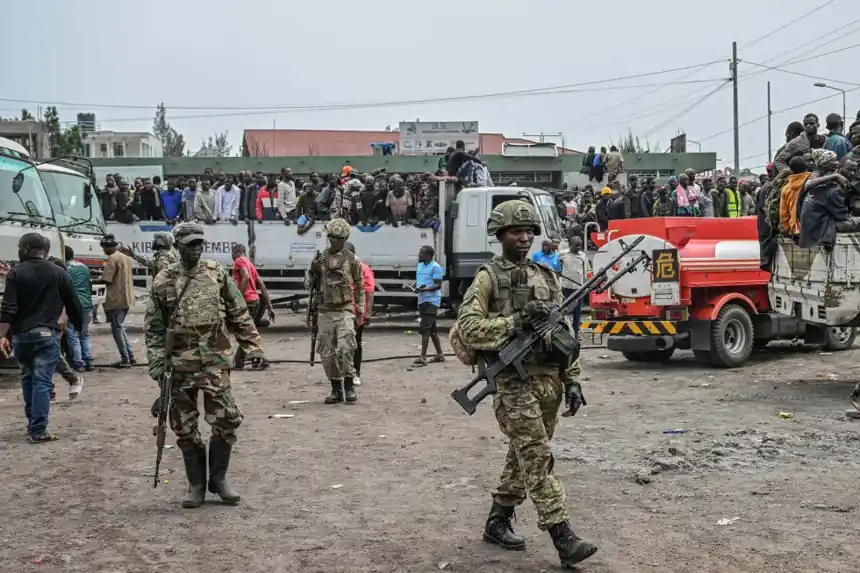
DAKAR, Senegal – A new report by United Nations experts has concluded that all major parties involved in the conflict in eastern Democratic Republic of Congo have failed to uphold commitments made under a December peace agreement, with violations continuing across the region despite international efforts to reduce the violence.
According to a U.N. experts’ report reviewed by the Associated Press, the Congolese armed forces, the M23 rebel movement and Rwanda have all failed to fully implement provisions of the U.S.-brokered agreement reached in December. The accord, initiated during the Trump administration, sought to curb hostilities and stabilize one of Africa’s longest-running conflicts.
Armed Groups Accused of Breaking Commitments
The U.N. panel said the Congolese military has continued cooperating with the Democratic Forces for the Liberation of Rwanda (FDLR), an armed Hutu group whose ranks include individuals linked to the 1994 Rwandan genocide. Kinshasa had pledged under the peace agreement to end any collaboration with the group.

The report also found that the Rwanda-backed M23 movement has not withdrawn from territory captured during its rapid military offensive in early 2025. Instead, investigators said the group has consolidated its positions and continues to pursue objectives that include challenging the authority of the government in Kinshasa.
U.N. Describes Extensive Rwandan Support
The panel concluded that Rwanda continues to exercise substantial influence over M23 and maintains a significant military presence inside eastern Congo.
According to the report, U.N. experts estimated that between 8,000 and 10,000 Rwandan troops remained deployed in South Kivu, with an additional 6,000 to 8,000 personnel operating in North Kivu during late 2025. Investigators said they found no evidence of major troop withdrawals after that period, describing the deployment as inconsistent with commitments made under the peace agreement.
Rwanda has consistently stated that its security actions are intended to counter the FDLR and address threats along its border. Congo and the United States, however, have accused Kigali of supporting M23 to strengthen access to eastern Congo’s valuable mineral resources. Rwanda has rejected those allegations.
Humanitarian and Security Concerns Persist
The U.N. report identified M23 as a leading perpetrator of conflict-related sexual violence in areas under its control and warned that the humanitarian situation remains severe.
■ Related News


The United Nations has repeatedly described the conflict in eastern Congo as one of the world’s most prolonged and complex humanitarian crises, with millions of civilians affected by displacement, insecurity and recurring violence.
Mineral Smuggling Remains a Key Concern
Investigators also said mineral resources extracted from Rubaya and other mining areas in the Masisi territory continue to be transported into Rwanda through networks controlled by M23.
According to the report, the rebel movement has established parallel administrative and economic structures in territories under its control, with mineral exports reportedly benefiting companies linked to Rwanda.
International Pressure Increases
The findings come as the Congolese government pursues legal action against Rwanda before the International Court of Justice, accusing its neighbor of responsibility for the violence that has destabilized eastern Congo.
Separately, the United States recently imposed sanctions on Gasabo Gold Refinery, a Rwanda-based company. U.S. authorities said the refinery formed part of a network operating in coordination with M23 and stated the measures were intended to support ongoing peace initiatives led by the United States and Qatar.
Diplomatic efforts to secure a lasting settlement remain underway, but the latest U.N. assessment suggests significant obstacles remain before the December peace agreement can be fully implemented.
Tags: Democratic Republic of Congo, Rwanda, M23, United Nations, Eastern Congo, FDLR, International Court of Justice, Conflict, Humanitarian Crisis, Mineral Smuggling, Sanctions, Africa