A surge of extreme heat across the United States is breaking March temperature records by wide margins, according to an analysis of weather data and forecasts from the National Weather Service. In some regions, temperatures have exceeded historical averages by more than 17°C, highlighting an unusually early-season heat event. Scientists say the scale and intensity of the heat are closely linked to long-term warming trends.
The Data Behind the Heat Event
Preliminary data from roughly 400 weather stations indicate that about a quarter of March heat records could be tied or broken during this event. These figures are based on Associated Press analysis of regional climate datasets, though final verification from the National Weather Service is pending.
In California and Arizona, daily temperatures have surpassed 38°C, significantly above typical March highs, which are generally at least 17°C lower. In Palm Springs, temperatures reached 42°C, exceeding the previous March record of 40°C set in 1966.

Regional Impact Across the United States
The most intense heat is concentrated in the western and southwestern United States, particularly in desert regions accustomed to high summer temperatures. However, current readings show these levels arriving weeks earlier than usual.
Other regions, including parts of the Midwest and Northwest, are also experiencing elevated temperatures. In states such as Oklahoma, Nebraska, northern Texas and South Dakota, temperatures are reaching at least 11°C above the 1991–2020 March average.
While triple-digit temperatures draw attention, data indicates that even 32°C conditions in typically cooler regions can have significant impacts, particularly where infrastructure and populations are less adapted to early-season heat.
Scientific Context and Climate Attribution
A rapid attribution analysis by World Weather Attribution, a group of international climate scientists, found that such an extreme March heat event would be “virtually impossible” without human-driven climate change. The analysis links the intensity of the event to greenhouse gas emissions from fossil fuel use, including carbon dioxide.
Attribution studies typically combine observational data with climate models to assess how human-induced warming influences the likelihood and severity of extreme weather. While such analyses are widely used in climate science, they carry uncertainties related to model assumptions and regional variability.
■ Related News




Forecast Outlook and Seasonal Trends
Forecasts from the National Weather Service indicate that the heat will persist in the near term, with additional record-breaking temperatures expected across multiple states. Analysis of forecast data suggests that up to 70 locations in 15 states could exceed historical March temperature records in the coming days.
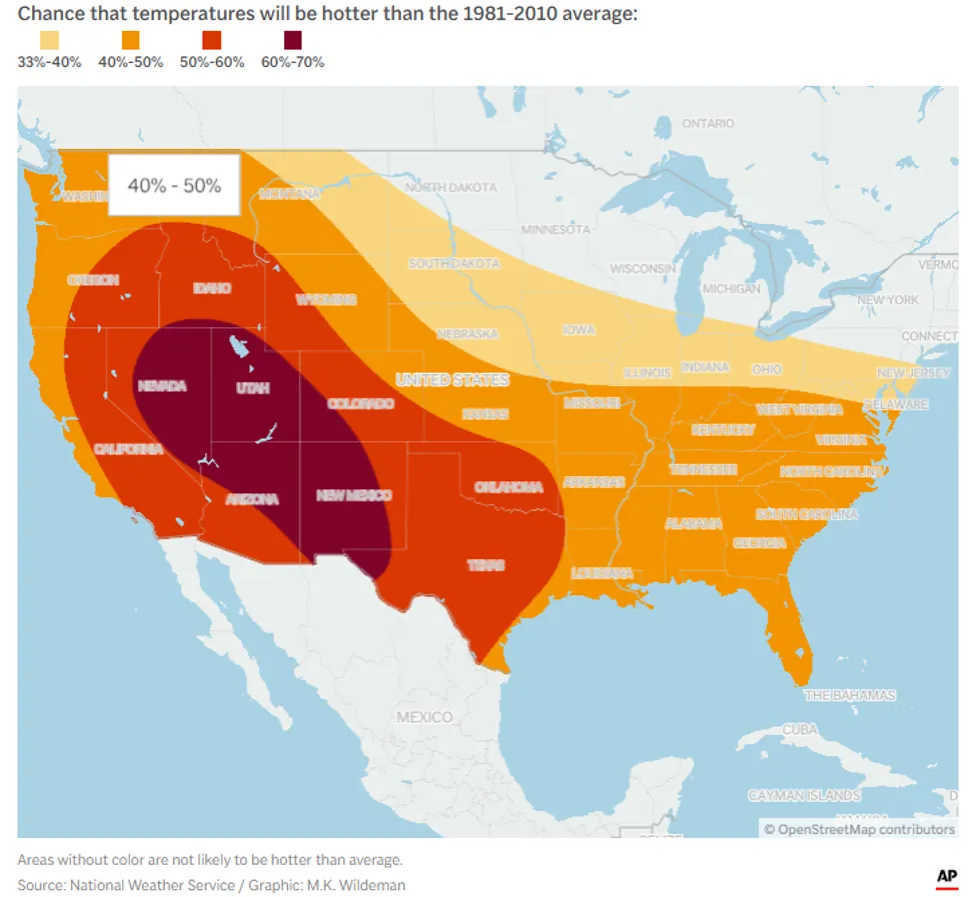
Longer-term projections indicate a higher probability of above-normal temperatures across most of the United States between April and June. The Southwest — including Arizona, Nevada, Utah and New Mexico — is expected to experience the strongest likelihood of sustained heat.
Policy and Infrastructure Implications
Early-season heat events present challenges for energy systems, water management and public health planning. Higher-than-average spring temperatures can increase electricity demand for cooling and place stress on water resources in already arid regions.
While no single heat event can be attributed solely to climate change, scientists note that rising global temperatures are increasing the frequency and intensity of such extremes. Policymakers are increasingly incorporating these trends into climate adaptation strategies, particularly in regions prone to heat stress.
What Remains Uncertain
Final temperature records require verification by official agencies, and some preliminary readings may be adjusted. Additionally, while attribution studies identify strong links between climate change and extreme heat, they do not eliminate natural variability as a contributing factor.
Seasonal forecasts also carry uncertainty, particularly at regional scales. While models indicate a high likelihood of above-average temperatures, localized conditions may differ due to atmospheric patterns.