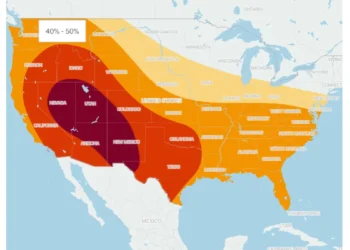
Record-breaking March heat across the United States is expanding eastward, with meteorologists warning that a large portion of the country could experience unusually high temperatures over the coming days. Data shows multiple states have already set new monthly records, raising questions about the role of atmospheric dynamics and longer-term warming trends.
The National Weather Service reports that at least 14 states recorded their hottest March temperatures since observations began, with temperatures in parts of Arizona and California reaching 44.4°C. Scientists say the scale and timing of the event are notable, even as uncertainties remain about its duration and broader implications.
The Data Behind the Heat Event
According to the National Weather Service, temperatures exceeded previous March records across states including California, Arizona, and Nevada, with some locations surpassing historical benchmarks by several degrees. The National Centers for Environmental Information reported that at least 479 weather stations broke monthly records over a four-day period, alongside more than 1,400 daily record highs.

Climatologist Maximiliano Herrera noted that similar anomalies extended into Mexico, where March temperatures exceeded previous May records in some regions. These observations are based on aggregated station data, though the total number of record-breaking sites may be higher due to broader datasets.
Atmospheric Drivers and Regional Spread
Meteorologists attribute the heat to a persistent “heat dome,” a high-pressure system that traps warm air over a region. According to the Weather Prediction Center, the system is shifting eastward, with temperatures in the southern and central Plains expected to reach the mid-30s Celsius.
Researchers explain that a stalled jet stream—responsible for moving weather systems west to east—has contributed to the event’s persistence. This has also coincided with heavy rainfall and flooding in Hawaii, illustrating contrasting regional impacts from the same large-scale atmospheric pattern.
Historical Context and Comparisons
Weather historians say the geographic extent of the current heat event may rival or exceed major episodes such as the 2012 U.S. heat wave and the 2021 Pacific Northwest event. However, scientists caution that intensity remains lower than summer heat waves, including those during the 1936 Dust Bowl period.
According to Jeff Masters, the timing in early spring reduces humidity-related risks typically seen in summer, although prolonged exposure to elevated temperatures can still have public health implications.
■ Related News




Climate Change Attribution
A rapid attribution analysis by the World Weather Attribution concluded that the event would have been “virtually impossible” without human-induced climate change. The study, which draws on peer-reviewed methodologies but is itself part of an emerging rapid-analysis framework, estimated that global warming made the event approximately 800 times more likely.
Researchers involved in the study, including Clair Barnes, estimate that climate change added around 2.6°C to the observed temperatures. Scientists note, however, that attribution studies rely on climate models and carry inherent uncertainties, particularly in isolating regional extremes.
What Remains Uncertain
Forecast models from the National Weather Service indicate the heat dome could persist into early April before dissipating. However, uncertainties remain regarding how long elevated temperatures will continue in eastern regions and whether additional records will be set.
Scientists emphasize that while individual events cannot be attributed solely to climate change, broader trends show increasing frequency and intensity of heat extremes. Further analysis will be needed to determine how this event fits into long-term climate patterns.