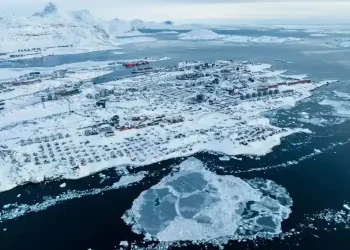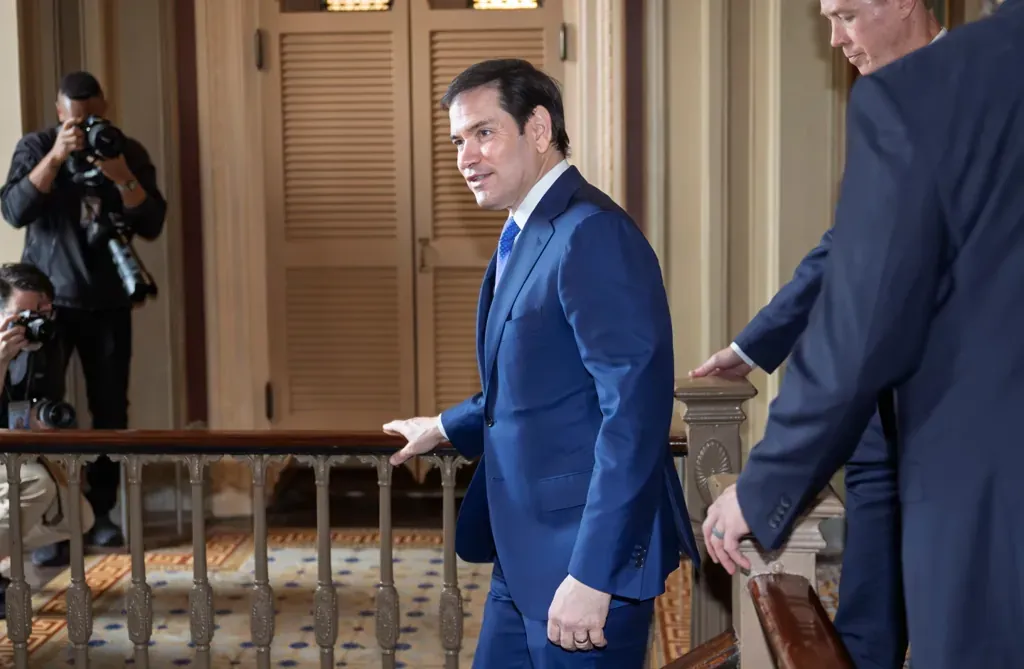
The United States plans to engage with Denmark next week over Greenland, the self-governing Arctic island, U.S. Secretary of State Marco Rubio said Wednesday. The announcement comes after the Trump administration reiterated its interest in acquiring the mineral-rich territory, citing strategic concerns amid rising Arctic tensions.
Rubio confirmed that the meeting follows requests from Danish Foreign Minister Lars Løkke Rasmussen and Greenland’s leader Vivian Motzfeldt. Previous attempts to arrange discussions had not succeeded, according to a statement posted on Greenland’s government website.
U.S. interest in Greenland
The discussion over Greenland escalated after the capture of former Venezuelan leader Nicolás Maduro, which revived U.S. concerns over China and Russia’s expanding influence in the Arctic. Rubio told a small group of U.S. lawmakers that the administration’s objective is a purchase of Greenland rather than military intervention, according to a Wall Street Journal report based on a private Capitol Hill briefing.

Speaking publicly in Washington, Rubio said President Donald Trump has long considered acquiring Greenland. “That’s always been the president’s intent from the very beginning,” Rubio said. “He’s not the first U.S. president that has examined or looked at how we could acquire Greenland.”
White House press secretary Karoline Leavitt noted that while military action remains an option in extreme circumstances, diplomacy is the administration’s preferred approach.
European leaders respond
The renewed U.S. interest drew concern from European nations. Leaders from France, Germany, Italy, Poland, Spain, and the United Kingdom joined Danish Prime Minister Mette Frederiksen in affirming that Greenland “belongs to its people.” Frederiksen warned that a U.S. takeover could destabilize NATO.
“The Nordics do not lightly make statements like this,” Maria Martisiute, a defense analyst at the European Policy Centre, told the Associated Press. “But it is Trump whose bombastic language, bordering on direct threats, is creating tension with an ally by suggesting he might control or annex the territory.”
U.S. Senate reactions
During a classified briefing on Capitol Hill, Rubio declined to comment on potential military measures, saying he would meet Danish officials next week to discuss the matter. “I’m not here to talk about Denmark or military intervention,” he said, adding that U.S. presidents retain the authority to address national security threats as needed.
Some Republican senators expressed strategic interest in Greenland but stopped short of endorsing force. Kansas Senator Roger Marshall said he hopes “we can work out a deal,” while North Dakota Senator John Hoeven described reports of a military takeover as “misconstrued.”
Alaska Senator Lisa Murkowski criticized the rhetoric surrounding Greenland, calling it “very, very unsettling.” Democratic Senator Jeanne Shaheen and Republican Senator Thom Tillis, co-chairs of the Senate NATO Observer Group, emphasized that coercing a NATO ally undermines the alliance’s principles of self-determination.
Strategic and security considerations
Experts argue that U.S. control of Greenland would provide limited practical advantage. Thomas Crosbie, an associate professor at the Royal Danish Defense College, said a formal takeover would not improve U.S. national security. “The United States will gain no advantage if its flag is flying in Nuuk versus the Greenlandic flag,” he told the AP. “Greenland already provides access to U.S. forces as a trusted ally.”
Denmark has allowed U.S. military access to its territory since a 2023 agreement expanded under the Biden administration. In June, Danish lawmakers approved legislation granting the United States broader access to Danish air bases, while reserving the right to terminate the agreement if Greenland were annexed. The U.S. operates the Pituffik Space Base in northwestern Greenland, which could be mobilized in a crisis.
Crosbie emphasized that a military takeover is unlikely to target the local population or Danish troops directly. “They don’t need to bring any firepower,” he said. “They could simply assert control symbolically, but the broader concern is the erosion of international norms and the precedent it sets.”
Implications for international law and alliances
Observers warn that any attempt to annex Greenland could undermine global perceptions of legal norms and treaty obligations. Crosbie said the primary risk lies in altering expectations about sovereignty and the respect for international agreements, rather than immediate military conflict.
While U.S. officials stress diplomacy, the renewed focus on Greenland highlights the island’s strategic importance in Arctic security, resource access, and transatlantic defense considerations. Analysts note that Greenland’s position at the gateway to the North Atlantic gives it outsized significance for both NATO allies and U.S. defense planning.
This article was rewritten by JournosNews.com based on verified reporting from trusted sources. The content has been independently reviewed, fact-checked, and edited for accuracy, neutrality, tone, and global readability in accordance with Google News and AdSense standards.
All opinions, quotes, or statements from contributors, experts, or sourced organizations do not necessarily reflect the views of JournosNews.com. JournosNews.com maintains full editorial independence from any external funders, sponsors, or organizations.
Stay informed with JournosNews.com — your trusted source for verified global reporting and in-depth analysis. Follow us on Google News, BlueSky, and X for real-time updates.