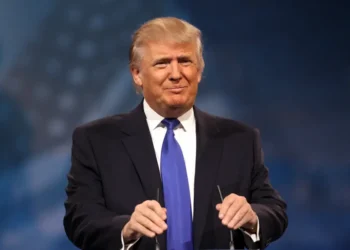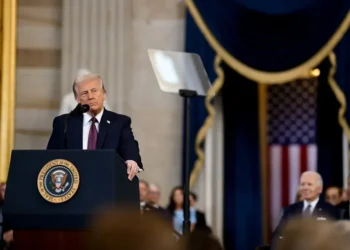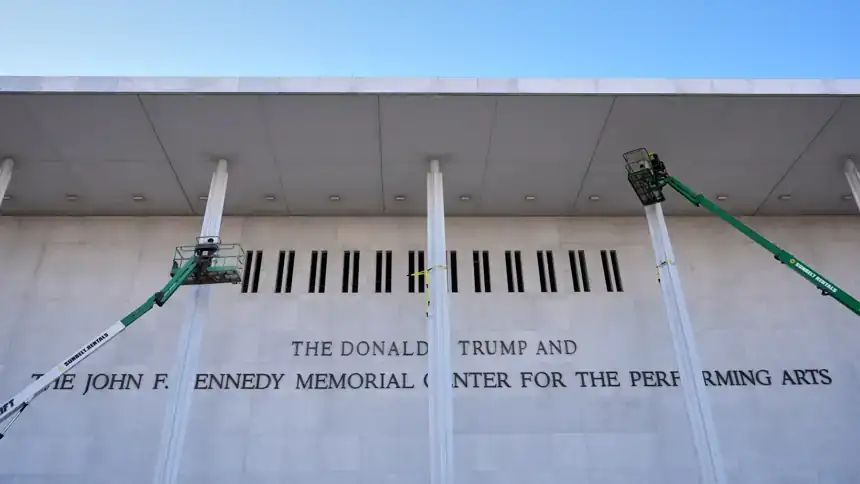
Washington, D.C. — The decision to add former U.S. President Donald Trump’s name to the John F. Kennedy Center for the Performing Arts has drawn global scrutiny, highlighting concerns over political influence in publicly supported cultural institutions. The move, confirmed through reporting by The Associated Press, marks a notable shift in how one of the United States’ most prominent arts venues is positioned symbolically and administratively.
The Kennedy Center, originally established by Congress as a living memorial to President John F. Kennedy, has long been viewed as a bipartisan cultural landmark. The addition of Trump’s name—linked to changes in the institution’s governing board—has prompted questions among international observers about the evolving intersection of politics and cultural governance in the United States.
Analysts say the development carries broader implications beyond domestic cultural policy, as it may influence how U.S. institutions are perceived globally, particularly in terms of political neutrality and artistic independence.

Cultural Governance Draws International Attention
The restructuring of the Kennedy Center’s leadership, including the decision to incorporate Trump’s name into its formal designation, reflects a broader recalibration of oversight at the institution. According to reporting from The Associated Press, the changes were enacted following adjustments to the center’s board composition, which is subject to federal appointment processes.
Cultural institutions tied to national identity often operate under varying degrees of government oversight worldwide. However, experts note that visible political branding—particularly in institutions designed as memorials—can reshape their symbolic role both domestically and internationally.
Observers interviewed by Financial Times suggest that such developments may prompt comparisons with other countries where governments exert stronger influence over cultural programming and institutional direction. In that context, the U.S. has traditionally positioned its major arts organizations as relatively independent, even when federally supported.
Diplomatic and Soft Power Implications
The Kennedy Center plays a significant role in U.S. cultural diplomacy, hosting international performers, state events, and global artistic collaborations. Changes to its identity could therefore carry implications for how the United States projects cultural soft power abroad.
Officials and analysts indicate that while the renaming itself may not immediately affect programming, it could influence perceptions among international partners. Cultural diplomacy has historically relied on institutions that are seen as politically neutral platforms for artistic exchange.


Reporting from the Associated Press indicates that reactions have varied, with some stakeholders viewing the move as a reflection of domestic political dynamics, while others raise concerns about potential reputational impact. For foreign governments and artists, institutional branding can signal broader political alignments or priorities.
Institutional Identity and Public Perception
The Kennedy Center’s original mandate as a tribute to John F. Kennedy has long been central to its identity. The introduction of additional political figures into its naming framework represents a departure from that singular commemorative focus.
Experts in cultural policy note that institutional identity plays a key role in maintaining public trust and international credibility. Adjustments to naming conventions, particularly those tied to contemporary political figures, can alter how institutions are understood by both domestic audiences and global observers.
While such changes are not unprecedented globally, they are less common in U.S. contexts where major cultural landmarks are often insulated from overt political rebranding. Analysts say this distinction has contributed to the international perception of American cultural institutions as stable and broadly representative.
Strategic Stakes for U.S. Cultural Leadership
The development comes at a time when cultural influence remains a key component of geopolitical competition. Nations increasingly leverage arts and cultural institutions to enhance their global standing and foster diplomatic relationships.
In this context, the Kennedy Center’s evolution may be closely watched as an indicator of how the United States balances political governance with cultural autonomy. Analysts suggest that maintaining credibility in cultural diplomacy requires institutions to project inclusivity and continuity, particularly in periods of domestic political change.
Looking ahead, the long-term impact of the renaming will likely depend on how the institution navigates its dual role as a national memorial and an international cultural मंच. For global audiences, the decision underscores the extent to which domestic political developments can shape the identity and perception of even the most established cultural institutions.