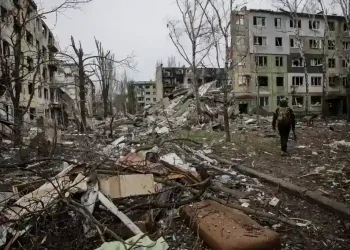
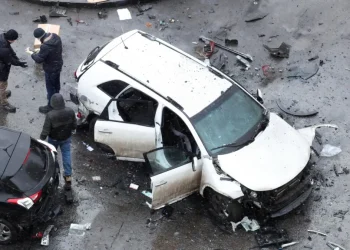
Villagers in northwestern Nigeria described fear and uncertainty after U.S. airstrikes targeting suspected Islamic State-linked militants caused homes to shake and the night sky to glow red. Nigerian authorities confirmed the operation was carried out with U.S. support, marking a significant escalation in international involvement in the country’s long-running security crisis.
Residents of Jabo, a rural community in Sokoto state, said the strikes occurred shortly after midnight on Thursday, close enough to the village to trigger panic but without causing civilian casualties. For many, it was the first time they had experienced such an operation so near their homes.
Night of fear in Jabo
Sanusi Madabo, a 40-year-old farmer, said he was preparing for bed when a deafening sound jolted him awake. Rushing outside with his wife, he saw the sky glowing an intense red.

“It was almost like daytime,” Madabo said, adding that the light persisted for hours. At the time, he did not know the source of the explosion or what had been hit.
Other residents told The Associated Press that homes shook violently and heat from the strikes could be felt inside rooms. Abubakar Sani, who lives on the edge of the village, recalled that fire appeared in the distance as the explosions landed.
“Our rooms began to shake, and then fire broke out,” he said. “We have never experienced anything like this before.”
Despite the proximity of the strikes, villagers reported no injuries or deaths in Jabo itself. Residents said the area has not previously been targeted directly, even though attacks by armed groups have occurred in nearby communities.
Nigerian and U.S. officials confirm operation
U.S. President Donald Trump announced late Thursday that the United States had carried out what he described as a “powerful and deadly strike” against Islamic State militants in Nigeria. The Nigerian government later confirmed that it had cooperated with the United States in the operation.
Government spokesperson Mohammed Idris said on Friday that the strikes were launched from the Gulf of Guinea in the Atlantic Ocean. According to Idris, the operation involved 16 GPS-guided precision missiles as well as MQ-9 Reaper drones.
He said the targets were areas used as staging grounds by what he described as foreign Islamic State fighters who had crossed into Nigeria from the Sahel region. Nigerian authorities did not provide casualty figures or detail the extent of damage at the targeted sites.
Security forces have since sealed off the strike zone, restricting access to the area and limiting information available to local residents.
Diplomatic tensions and shifting cooperation
The airstrikes come after months of strained relations between Abuja and Washington. The Trump administration has previously claimed that Nigeria is experiencing a genocide of Christians, an assertion Nigerian officials have repeatedly rejected.
In a statement following the strikes, Nigeria’s Ministry of Foreign Affairs said the operation was the result of intelligence sharing and strategic coordination between the two governments, signaling closer security cooperation despite earlier diplomatic friction.
Foreign Minister Yusuf Tuggar described the strikes as “a new phase of an old conflict” and suggested further military action could follow.
“For us, it is something that has been ongoing,” Tuggar said, referring to years of violence affecting both Christian and Muslim communities across parts of Nigeria.
Questions over targets and transparency
Security analysts say uncertainty over who was targeted has added to local anxiety. Bulama Bukarti, a sub-Saharan Africa security analyst at the Tony Blair Institute, said a lack of clear information has compounded fear among villagers.
“The more opaque the governments are, the more panic there will be on the ground,” Bukarti said, warning that poor communication risks escalating tensions rather than calming them.
Analysts suggest the strikes may have been aimed at the Lakurawa group, a relatively new armed faction operating in northwestern Nigeria. The group’s first known attacks were recorded around 2018, with Nigerian authorities formally acknowledging its presence last year.
Researchers say Lakurawa fighters are believed to include a significant number of foreign nationals from the Sahel. However, experts caution that confirmed links between the group and the Islamic State remain unproven.
By contrast, the Islamic State West African Province, a recognized IS affiliate, is primarily active in northeastern Nigeria, where it has been engaged in a prolonged power struggle with Boko Haram.
“What might have happened is that, working with the American government, Nigeria identified Lakurawa as a threat and identified camps that belong to the group,” Bukarti said.
Lingering fear among villagers
In Jabo, residents remain uneasy in the aftermath of the strikes. Village leader Aliyu Garba said debris from the explosions was scattered across the area, drawing curious locals to the site.
Some residents collected fragments of metal, hoping to sell them, prompting fears that unexploded material could pose a danger.
Seventeen-year-old Balira Sa’idu said the experience has disrupted her plans for an upcoming wedding.
“I am supposed to be thinking about my wedding, but right now I am panicking,” she said. “My family is afraid, and I don’t even know if it is safe to continue with the wedding plan in Jabo.”
As security forces maintain a cordon around the area and officials offer few details, villagers say their sense of vulnerability has only deepened, underscoring the human impact of an expanding conflict far from Nigeria’s main battlefronts.
This article was rewritten by JournosNews.com based on verified reporting from trusted sources. The content has been independently reviewed, fact-checked, and edited for accuracy, neutrality, tone, and global readability in accordance with Google News and AdSense standards.
All opinions, quotes, or statements from contributors, experts, or sourced organizations do not necessarily reflect the views of JournosNews.com. JournosNews.com maintains full editorial independence from any external funders, sponsors, or organizations.
Stay informed with JournosNews.com — your trusted source for verified global reporting and in-depth analysis. Follow us on Google News, BlueSky, and X for real-time updates.