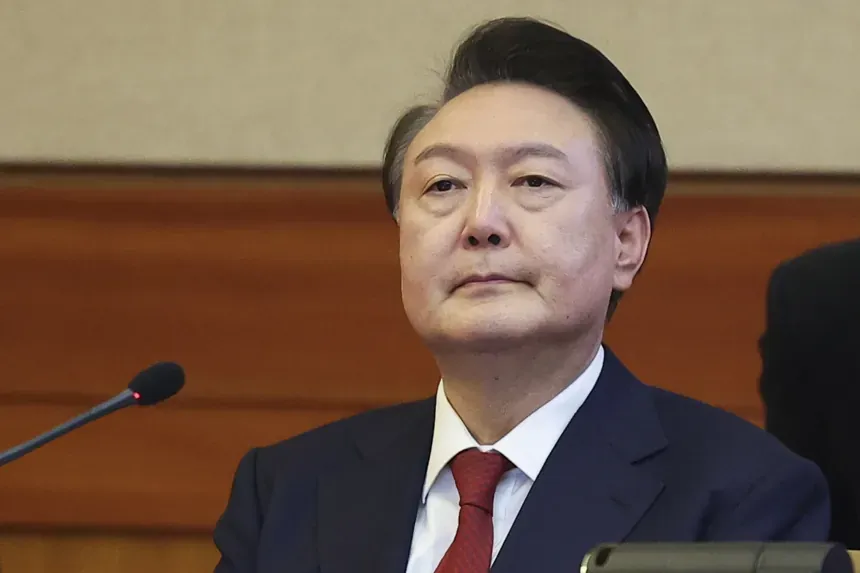
South Korea’s constitutional crisis intensified as suspended President Yoon Suk Yeol personally defended his brief martial law declaration before the Constitutional Court in Seoul, marking his first public appearance since his detention. The hearing carries major international implications for democratic stability in East Asia, investor confidence, and Seoul’s credibility among strategic allies.
Democratic Institutions Face a Critical Test
In testimony before acting chief justice Moon Hyung-bae, Yoon denied allegations that he instructed military commanders to forcibly remove lawmakers from the National Assembly during the Dec. 3 emergency decree. His remarks directly challenged earlier testimony from military officials who said they were told to break through parliamentary doors and extract legislators before they could overturn the order.
The dispute lies at the heart of the impeachment case, which will determine whether South Korea’s presidency can be restored under a leader accused of attempting to override constitutional checks. For global readers, the case is being closely watched as a measure of institutional resilience in one of Asia’s leading democracies.

Regional Stability and Alliance Confidence Under Pressure
The failed martial law order, which lasted only hours before lawmakers unanimously rejected it, has already disrupted South Korea’s diplomatic rhythm and unsettled regional security calculations. Seoul’s partners, particularly the United States and Japan, have monitored the proceedings closely as political instability risks complicating coordination on North Korea, supply chains, and Indo-Pacific defense strategy.
International reporting from The Associated Press and Reuters indicates that Yoon’s legal team continues to argue the troop deployment was intended as a political warning to the opposition rather than a direct attempt to obstruct parliament.
Legal Exposure Expands Beyond Impeachment
Separate criminal investigations into rebellion, abuse of power, and obstruction of parliament continue alongside the constitutional process. Because South Korean law excludes rebellion and treason from presidential immunity protections, the proceedings have evolved from a domestic political crisis into a landmark legal confrontation with broader democratic implications.
The Constitutional Court has until June to decide whether to permanently remove Yoon or reinstate him, though observers cited by international media expect a faster ruling. The decision could trigger a snap election and recalibrate regional political alignments at a sensitive geopolitical moment.
International Reputation and Market Risks Grow
The episode has already rattled financial markets and damaged South Korea’s image as a stable democratic and economic power. Violent scenes involving supporters storming a Seoul court building after a detention ruling further heightened global concern over domestic polarization and rule-of-law pressures.


For foreign governments and investors, the immediate concern is whether the crisis remains contained within constitutional mechanisms or evolves into a broader governance shock affecting policy continuity, regional diplomacy, and economic confidence.
Conclusion
The impeachment hearing now stands as more than a domestic legal reckoning: it is a defining test of democratic durability in South Korea and a closely watched signal for allies, markets, and regional rivals. The court’s eventual ruling is likely to shape not only Seoul’s internal political order but also its diplomatic posture across East Asia in the months ahead.