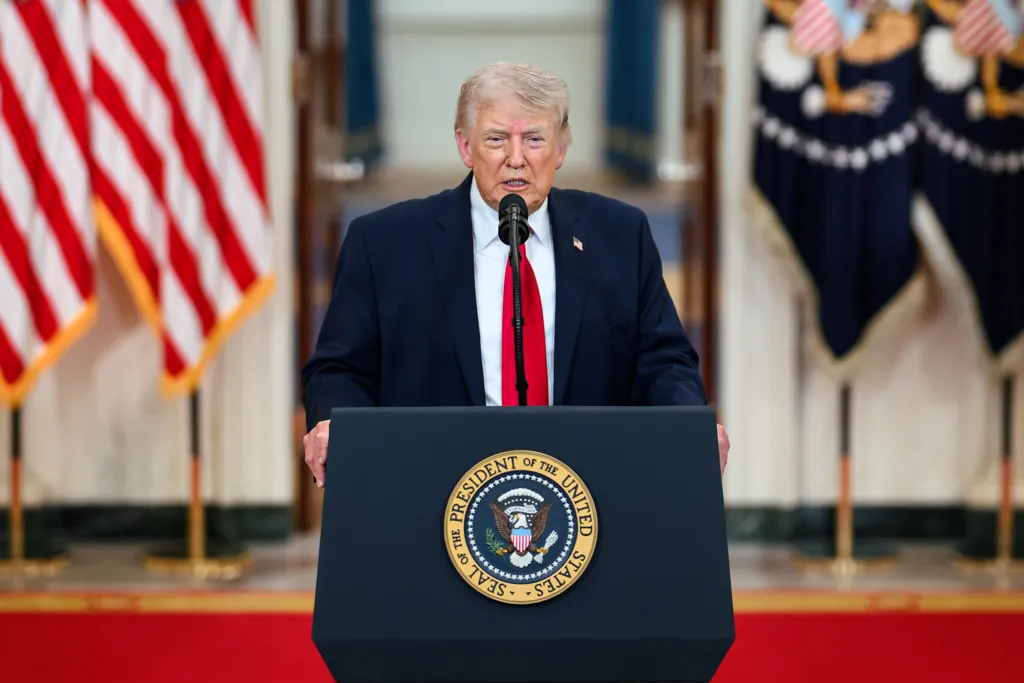
WASHINGTON – President Donald Trump said Thursday that an agreement had been reached to begin the disarmament of Hamas and the withdrawal of Israeli forces from Gaza, describing the proposal as a major step toward implementing a broader ceasefire. However, neither Israel nor Hamas immediately confirmed they had accepted the plan, and U.S. officials acknowledged that significant challenges remain before it could be carried out.
The proposal comes about nine months after a U.S.-brokered ceasefire agreement was signed. Negotiations over its second phase have largely stalled, particularly on Hamas’ future role in Gaza, the group’s weapons and plans for governing and rebuilding the territory.
In a social media post, Trump said the agreement would be implemented through “carefully structured phases.” He said Israeli forces would withdraw as Hamas completed the process of disarmament. He also said an International Stabilization Force, working alongside a new Palestinian police force, would assume responsibility for security in Gaza.

According to the framework outlined by Trump, Hamas would surrender its weapons, dismantle its tunnel network and relinquish military infrastructure. Israeli forces would withdraw from Gaza, while a technocratic Palestinian administration would take over governance. The proposal also calls for an international security force and long-term reconstruction efforts.
Disarmament Planned in Phases
U.S. officials and representatives of the Board of Peace, an international body established by the Trump administration to oversee implementation of the Gaza ceasefire, briefed reporters on condition of anonymity under White House guidelines.
Officials described the proposal as an important step forward but said they could not provide firm deadlines for Hamas or other armed groups, including Palestinian Islamic Jihad, to surrender their weapons.
According to the officials, Gaza’s police force would begin transferring its weapons to a technocratic administration backed by the Board of Peace within two weeks.
They noted, however, that the police force does not include most Hamas fighters and that heavy weapons are excluded from the initial phase.
■ Related News



A Board of Peace official said heavier weapons would be surrendered later. The dismantling of Hamas tunnels and military infrastructure is expected to take between 200 and 350 days, according to the proposed timetable.
Israel Has Not Publicly Endorsed the Proposal
A U.S. official said Israeli leaders were consulted throughout negotiations despite longstanding concerns over whether Hamas would fully relinquish its weapons or political influence in Gaza.
According to the official, Israel would not be expected to undertake commitments beyond those included in Trump’s 20-point ceasefire proposal, including withdrawing military forces and ending airstrikes as implementation progresses.
The official added that Trump would be “very, very disappointed” if Israel failed to honor the agreement.
Trump met Israeli Prime Minister Benjamin Netanyahu at the White House on Tuesday. Neither leader publicly disclosed details of their discussions about Gaza following their first face-to-face meeting since the military campaign involving Israel and Iran.
Israel’s mission to the United Nations declined immediate comment on Trump’s announcement.
Hamas Response Remains Unclear
The U.S. official said Iran remains an unpredictable factor. According to the official, Tehran encouraged Hamas not to accept the proposal, although Iran’s ability to support the group has been constrained while dealing with its own confrontation with the United States.
Hamas has consistently maintained that the first phase of the ceasefire should be fully implemented before negotiations over its weapons begin.
The group’s founding charter supports armed resistance against Israel, and its military capabilities—including rockets, anti-tank missiles and explosives—have remained central to its operations.
Earlier this month, however, Hamas announced it had dissolved its governing administration in Gaza and was preparing to transfer civilian authority to a technical committee backed by the United Nations as part of the ceasefire process.
Neither Hamas nor Israel immediately confirmed acceptance of Trump’s proposed framework.
Conflict Continues to Shape Gaza
The war began after the Hamas-led attack on southern Israel on Oct. 7, 2023, during which about 1,200 people were killed and 251 people were taken hostage, according to Israeli authorities.
Israel’s subsequent military campaign has killed more than 73,000 Palestinians, including people who died after the ceasefire took effect, according to Gaza’s Health Ministry.
ChatGPT cannot independently verify casualty figures reported by either side.
Israeli forces continue to control more than half of Gaza. Large numbers of Palestinians remain displaced, with many living in tent camps or heavily damaged urban areas as reconstruction efforts remain tied to progress toward a lasting political and security agreement.
This report is based on reporting by The Associated Press.