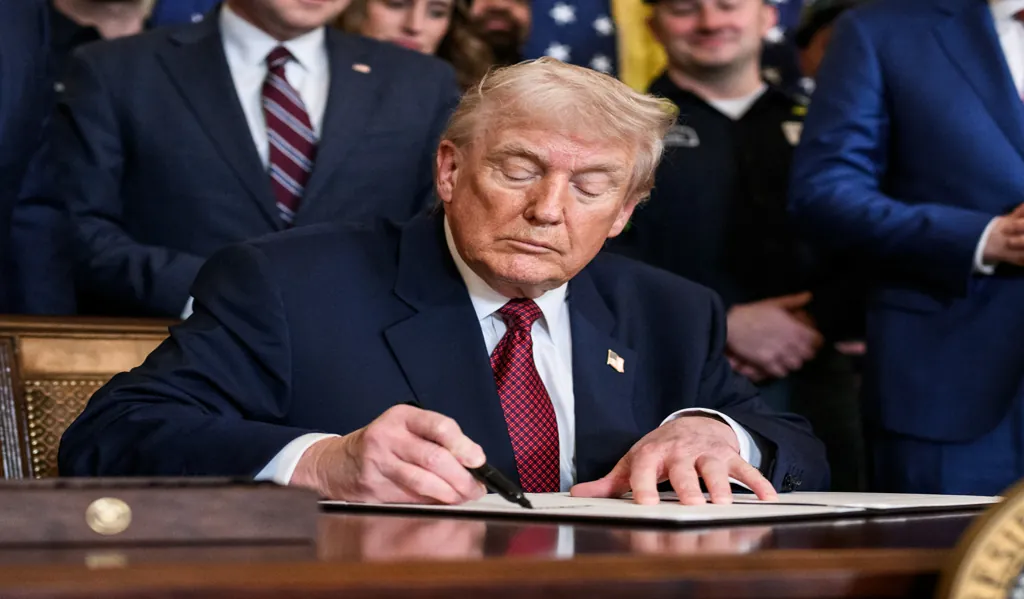
WASHINGTON – President Donald Trump signed two executive orders Thursday aimed at restricting birthright citizenship, reviving a key immigration policy after the U.S. Supreme Court blocked a broader version of the initiative earlier this year.
The new actions seek to narrow the scope of automatic U.S. citizenship at birth while introducing additional measures targeting so-called birth tourism. The administration said the revised approach is intended to address specific categories that it believes fall outside existing constitutional protections.
The updated executive order is significantly narrower than the administration’s earlier policy. Instead of broadly denying citizenship to children born in the United States to parents who are in the country unlawfully or temporarily, the new directive applies to more limited circumstances, including children born to individuals connected to foreign embassies or certain international organizations, people designated as “alien enemies,” and cases involving parents who allegedly obtained U.S. citizenship through fraud.

A second executive order seeks to strengthen restrictions on birth tourism by directing federal agencies to tighten oversight of visitor visas used by foreign nationals who travel to the United States primarily to give birth.
Speaking Thursday, Trump acknowledged the administration’s earlier legal setback while arguing that the revised policy is consistent with constitutional requirements.
“I thought we were going to win it at the Supreme Court. Unfortunately, we had a bad decision, very unfair decision. Our country suffers because of it and we’re ending it a different way,” Trump said.
Administration Adopts Narrower Legal Approach
The latest executive actions follow a Supreme Court decision in June that rejected the administration’s previous effort to end automatic citizenship for children born in the United States to parents who were in the country unlawfully or on temporary visas.
According to The Associated Press, that earlier executive order never took effect after multiple federal courts issued injunctions blocking its enforcement.



The revised policy appears designed to address a narrower set of legal circumstances in an effort to withstand future court challenges, though constitutional scholars expect the new orders to face immediate litigation.
Birth Tourism Remains a Policy Priority
The second executive order focuses on what the administration describes as birth tourism, the practice of foreign nationals traveling to the United States to give birth so their children obtain U.S. citizenship.
According to the Migration Policy Institute, obtaining a U.S. visa by concealing plans to give birth in the country is already considered visa fraud and may result in denial of entry or other immigration penalties.
Previous administrations have also prosecuted organizations that arranged birth tourism services and helped clients conceal pregnancies during the visa application process or upon arrival in the United States.
The institute estimates that approximately 26,000 births each year are associated with birth tourism, compared with roughly 3.5 million births nationwide. It also notes that no official federal estimate exists.
Constitutional Questions Likely to Return to Court
Birthright citizenship remains one of the most contested elements of Trump’s immigration agenda.
The administration argues that automatic citizenship encourages unlawful immigration and that citizenship should be reserved for individuals with stronger legal ties to the United States.
Immigration advocates and many constitutional scholars argue that the Citizenship Clause of the 14th Amendment guarantees citizenship to nearly all individuals born on U.S. soil, subject only to limited exceptions.
Trump’s original executive order, signed on the first day of his second term, immediately prompted multiple lawsuits challenging its constitutionality.
In June, the Supreme Court rejected the administration’s earlier policy by a 6-3 vote. According to The Associated Press, five justices concluded that birthright citizenship is protected by the Constitution, while Justice Brett Kavanaugh wrote separately that federal law independently guarantees birthright citizenship even though he joined the majority in rejecting the administration’s order.
The American Civil Liberties Union said Thursday it expects the revised executive orders to face similar constitutional challenges.
“The Supreme Court already decided this issue: Birthright citizenship is guaranteed by the Constitution. No additional executive order can change the meaning of the Constitution. Any executive order that tries to rewrite birthright citizenship will meet the same fate as the last one,” Cody Wofsy, deputy director of the ACLU’s Immigrants’ Rights Project, said in a statement.
The new executive orders are expected to face immediate legal scrutiny, with federal courts likely to determine whether the administration’s narrower approach complies with constitutional and statutory protections governing U.S. citizenship.
This report is based on reporting by The Associated Press.