Updated – February 23, 2026
DETROIT (Journos News) – For many people, tattoos mark a moment: a relationship, a loss, a belief, a turning point. But as lives evolve, so can feelings about permanent ink. What once felt essential can begin to feel distant. Removing a tattoo, however, is rarely simple. It typically requires multiple medical-grade laser sessions, significant expense, and a tolerance for discomfort that professionals describe as greater than the original tattooing process.
The rising normalization of tattoos has coincided with a steady demand for removal. Clinics across the United States report that clients seek erasure for reasons ranging from personal reinvention to professional considerations. The process is grounded in decades of dermatological science, yet it remains physically demanding and medically nuanced.

Understanding how tattoo removal works — and why it is often more complicated than getting inked — reveals much about both human biology and evolving social attitudes toward body art.
Tattoos Are Ancient — And So Are Attempts to Remove Them
Archaeological evidence suggests tattooing dates back thousands of years. The preserved remains of Ötzi the Iceman, a Neolithic man discovered in the Italian Alps and dated to around 3,000 B.C., bore multiple tattoos. Ancient Egyptian mummies and other cultural remains around the world also show evidence of tattoo practices.
Methods of removing tattoos have likely existed nearly as long. Historically, techniques included scraping, dermabrasion, or chemical treatments — procedures that were often crude and carried high risks of scarring and infection.
Modern laser tattoo removal began to take shape in the 1960s, when dermatologist Leon Goldman experimented with early laser applications on pigmented skin. Over time, advances in laser physics and dermatology led to more targeted technologies capable of breaking down tattoo ink with greater precision.
Today’s standard method relies on short bursts of high-intensity light that fragment ink particles beneath the skin. But while the science has advanced, the experience is rarely described as comfortable.




Why People Change Their Minds
Tattoos are widely accepted in contemporary culture. A 2023 survey by the Pew Research Center found that roughly one-third of U.S. adults have at least one tattoo. Among them, about a quarter say they regret getting one.
Commemoration remains one of the most common motivations for first tattoos — honoring loved ones, life milestones, or personal convictions. Yet the same emotional intensity that leads someone to get a tattoo can later prompt reconsideration. Relationships end. Beliefs shift. A design chosen at one stage of life may not reflect another.
Industry professionals say motivations for removal vary widely. Some clients seek to fade older work before adding new designs. Others describe boredom or a desire for aesthetic change rather than regret. Still others want tattoos removed for professional image reasons or to distance themselves from a past chapter.
This suggests that tattoo removal is not always about disliking the art itself. Often, it reflects broader personal evolution — an attempt to align one’s outward appearance with a current identity.
How Laser Removal Works
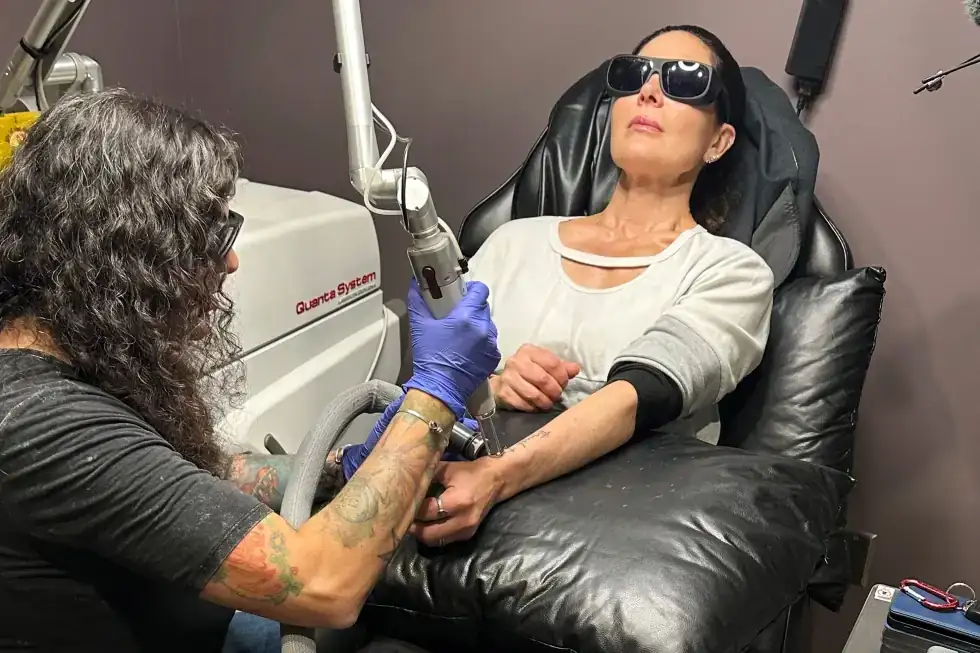
Most clinics use what is commonly called a Q-switched laser. These devices emit energy in extremely short, high-intensity pulses. The laser light targets pigment in the tattoo ink, heating and shattering it into microscopic particles.
Once fragmented, these particles are gradually cleared by the body’s immune system and expelled through natural metabolic processes. The fading is therefore incremental. Unlike tattooing, which deposits pigment in a single session, removal relies on the body’s capacity to process broken-down ink over weeks and months.
This biological dependency explains why removal is not immediate. Sessions are spaced apart — often six to eight weeks — to allow the skin to heal and the immune system to clear debris. Most tattoos require eight to twelve treatments, though darker inks, dense designs, and certain pigment colors may need more.
Color also matters. Black ink, which absorbs all laser wavelengths, is generally the easiest to treat. Greens, blues, and certain reds can be more resistant. Advances in multi-wavelength lasers have improved outcomes, but complete removal is not guaranteed.
Why It Hurts More Than Getting Tattooed
Clients frequently describe laser removal as more painful than the initial tattoo application. Professionals compare the sensation to repeated snaps of a rubber band combined with heat. The bursts are brief — often lasting under a minute per treatment area — but intense.
The difference in pain perception likely stems from the nature of the procedure. Tattooing involves needles depositing ink in rhythmic motion, while laser removal delivers concentrated thermal energy directly to pigment under the skin. The heat creates a rapid mechanical reaction within the ink particles, which can trigger sharp discomfort.
Topical numbing creams and cooling systems are often used to mitigate pain. Still, many clients rate the experience high on the discomfort scale. Temporary redness, swelling, and blistering are common after treatment, resembling a sunburn. These symptoms usually subside within days.
The Cost of Erasure
Tattoo removal is typically more expensive than tattoo application. Clinics often charge per session, with pricing based on the size of the tattoo and the technology used. Even small tattoos may cost hundreds of dollars across multiple sessions; larger pieces can reach into the thousands over time.
Industry operators emphasize that much of the cost reflects the equipment itself. Medical-grade laser systems can cost tens of thousands of dollars. Proper training is also essential. Incorrect settings or technique can cause burns, scarring, or permanent pigment changes in surrounding skin.
This economic structure means that removing a tattoo is not simply a reversal of getting one. It is a multi-stage medical procedure requiring specialized devices and expertise.
Medical Risks and Limitations
Laser tattoo removal is considered generally safe when performed by trained professionals, but it is not risk-free. The U.S. Food and Drug Administration notes potential side effects including temporary scarring, infection, blistering, and changes in skin pigmentation. In some cases, treated areas may become lighter than surrounding skin (hypopigmentation) or darker (hyperpigmentation).
Certain medical conditions may complicate the process. People with uncontrolled diabetes, autoimmune disorders, immune deficiencies, or those taking blood-thinning medications may face higher risks of complications. Clinics typically require health screenings and consent forms to ensure clients understand these considerations.
It also remains possible that faint traces of a tattoo persist even after extensive treatment. Complete removal depends on factors including ink composition, depth, age of the tattoo, and individual immune response. Some pigments contain metallic compounds or uncommon dyes that respond unpredictably to lasers.
These uncertainties highlight an important distinction: laser removal reduces and often significantly fades tattoos, but absolute erasure cannot be universally promised.
A Reflection of Changing Identity
The growing visibility of tattoo removal clinics suggests that permanence, once central to tattoo culture, is being reconsidered. Tattoos still carry deep personal meaning for many. Yet the availability of removal technology offers a form of reversibility in a practice historically defined by permanence.
That shift may reflect broader societal patterns. As careers, relationships, and personal identities become more fluid, the desire for adaptability extends to appearance. Laser removal does not erase the past, but it can alter how that past is displayed.
The science behind tattoo removal continues to evolve, with research focused on reducing pain, minimizing side effects, and improving ink clearance efficiency. But even with modern advancements, the process remains a reminder that altering the body — whether adding ink or removing it — carries both physical and financial costs.
For those considering removal, the decision often mirrors the one that led to the tattoo itself: deeply personal, shaped by experience, and tied to a particular moment in time. The difference is that undoing that moment usually requires patience, resilience, and an acceptance that erasing something permanent is rarely simple.
Source: AP News – If you want that tattoo erased it’s going to hurt and it’s going to cost you