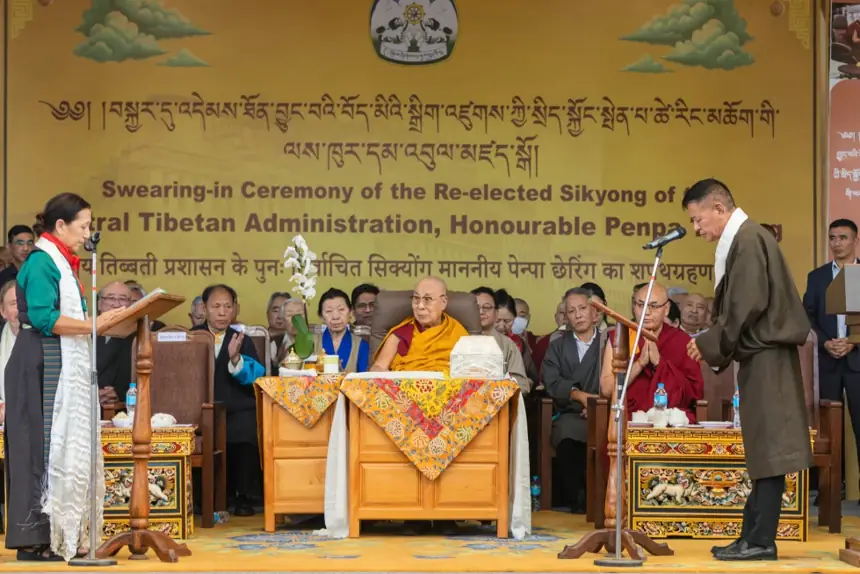
Penpa Tsering was sworn in for a second consecutive term as the leader of Tibet’s government-in-exile on Wednesday in Dharamshala, India, reinforcing the Tibetan exile administration’s commitment to dialogue with China despite years of stalled negotiations.
Tsering, 58, secured another five-year term earlier this year in elections held among Tibetans living in India and abroad, according to Associated Press reporting. He has led the Central Tibetan Administration since 2021 after previously serving in the Tibetan Parliament-in-Exile and as its speaker.
The inauguration ceremony took place in the presence of the Dalai Lama, the Tibetan spiritual leader, at the headquarters of the exile administration in Dharamshala. Monks in ceremonial robes escorted the Dalai Lama to the venue as prayers and traditional instruments accompanied the proceedings, AP reported.

Exile Administration Reaffirms ‘Middle Way’ Approach
During his swearing-in speech, Tsering said the Central Tibetan Administration would continue pursuing the “Middle Way Policy” promoted by the Dalai Lama, which advocates nonviolence and dialogue with Beijing rather than outright independence.
“Until a resolution is achieved, we will continue the back-channel communications with caution and steadiness with the Chinese government,” Tsering said during the ceremony, according to AP.
The Tibetan government-in-exile was established in 1959 after the Dalai Lama fled Tibet following a failed uprising against Chinese rule. Based in northern India, the administration now operates executive, legislative, and judicial branches for Tibetans living in exile.
The latest vote marked the fourth direct election of the Tibetan exile leadership since the Dalai Lama formally relinquished political authority within the administration in 2011.
China Rejects Exile Administration’s Legitimacy
Beijing continues to reject the legitimacy of the Central Tibetan Administration and has not held formal dialogue with representatives of the Dalai Lama since 2010, according to AP reporting.
■ Related News


China maintains that Tibet has been part of its territory since the 13th century and says the Communist Party has governed the Himalayan region since 1951. Many Tibetans, however, argue that Tibet functioned independently for much of its history and accuse Beijing of suppressing Tibetan cultural and religious identity.
Days before the ceremony, Yu Jing, spokesperson for the Chinese Embassy in India, dismissed the exile administration as lacking international recognition and authority to represent Tibetans or oversee the future reincarnation process of the Dalai Lama.
The issue of succession remains politically sensitive. On his 90th birthday last year, the Dalai Lama said Chinese authorities would have no role in identifying his successor and insisted the institution of the Dalai Lama would continue after his death.
India officially recognizes Tibet as part of China but continues to host the Tibetan exile administration and thousands of Tibetan refugees, placing New Delhi in a delicate diplomatic position between humanitarian support and relations with Beijing.