As the Year of the Horse begins, Lunar New Year celebrations across Asia and beyond highlight not only ritual continuity but also shifting cultural and geopolitical signals — particularly China’s effort to align technological ambition with national tradition.
The Lunar New Year is often described as a festival of renewal. Yet in 2026, as millions marked the arrival of the Year of the Horse, the celebration carried a second narrative: how ancient ritual and modern state priorities now share the same stage.
From incense-filled temples in Beijing and Hong Kong to fireworks over Hanoi and dragon dances in Buenos Aires, the holiday reaffirmed its status as the most significant cultural event in the Chinese calendar. But the appearance of humanoid robots during China’s nationally televised gala pointed to a deeper shift: a festival once centered exclusively on heritage now also serves as a showcase for technological power and soft influence.

The contrast does not suggest cultural replacement. Rather, it raises questions about how tradition is being curated, reframed and projected — domestically and internationally.
Ritual continuity in Beijing and Hong Kong
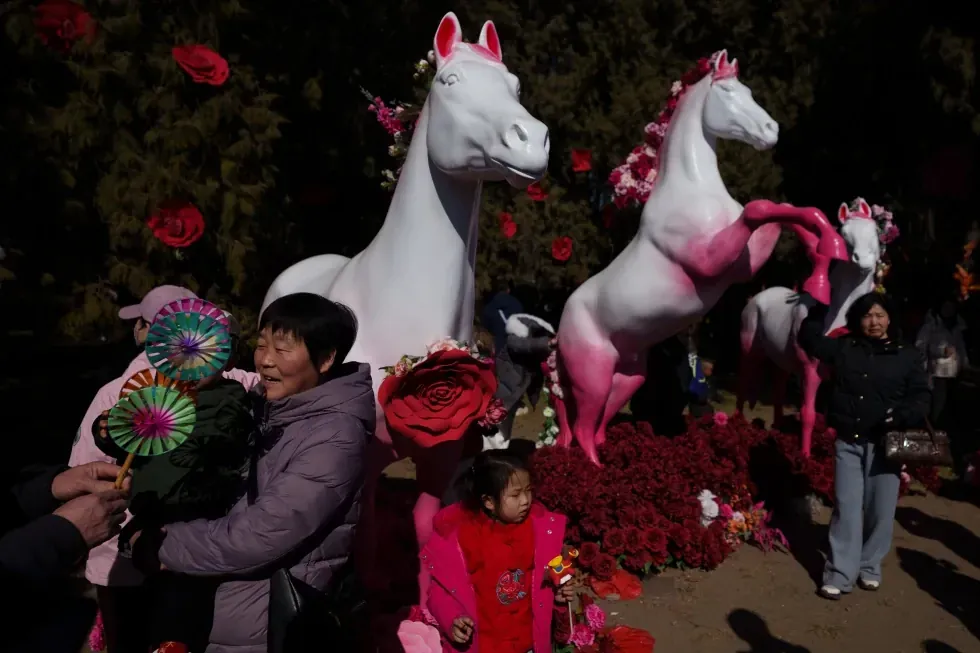
In Beijing, thousands crowded the historic Temple of Earth, browsing stalls selling snacks and festival trinkets. Families described a return of energy that some felt had faded in recent years. Temple fairs, once disrupted by pandemic restrictions and urban modernization, appeared resurgent.
Elsewhere, worshippers lined up at midnight temples in Hong Kong, bowing before incense burners in gestures unchanged for generations. The ritual rhythm — light incense, bow three times, plant sticks upright — remains central to how many participants frame the new year: as an act of spiritual recalibration rather than spectacle.
Such scenes underscore that Lunar New Year’s core meaning continues to revolve around family, fortune and renewal. Even as China modernizes at speed, the endurance of these rituals suggests that cultural continuity remains politically and socially valuable.
The Year of the Horse itself carries symbolic weight in the Chinese zodiac. Associated with energy, independence and momentum, it is often invoked as a signifier of drive and forward movement — imagery that aligns neatly with narratives of national advancement.

Robots on the gala stage
The most striking juxtaposition came during the annual Spring Festival Gala broadcast by China Central Television, widely regarded as the world’s most-watched television program.
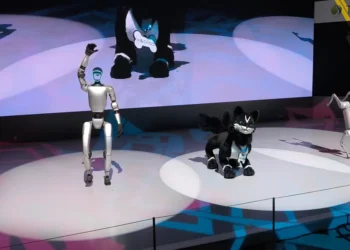
This year’s performance featured humanoid robots developed by Unitree Robotics sharing the stage with children in a choreographed martial arts sequence. The robots executed synchronized movements and brandished swords, demonstrating improvements in balance, coordination and AI-enabled responsiveness.
The spectacle served several functions. At the surface level, it offered novelty. At a strategic level, it illustrated China’s push to lead in advanced robotics — a sector identified in national industrial strategies as key to economic upgrading and global competitiveness.
Humanoid robotics remains a technically demanding field. While companies in the United States, Japan and South Korea are also racing to refine AI-powered machines, China has invested heavily in domestic supply chains and commercialization pathways. Featuring such technology during a culturally sacred broadcast embeds innovation within a narrative of national progress rather than presenting it as purely industrial policy.
Audience reactions reflected generational divides. Some viewers praised the display as inspirational for young people. Others expressed nostalgia for earlier galas dominated by traditional dance, opera and comedy sketches.
The tension is instructive. The gala is not merely entertainment; it is a cultural barometer. Integrating robots into its programming suggests that technological achievement is becoming part of China’s symbolic repertoire — not separate from tradition, but increasingly intertwined with it.
Celebration beyond mainland China
The blending of ritual and modernity was visible beyond China’s borders, though often without the same overt technological framing.
In Taiwan, temple bells rang 108 times at Taipei’s Baoan Temple, marking an auspicious cycle rooted in Buddhist cosmology. Worshippers offered flowers and incense in ceremonies emphasizing spiritual cleansing.
In Vietnam, where the festival is known as Tet, fireworks and music concerts illuminated city skylines. The celebration in Hanoi featured synchronized light displays across bridges and high-rises, signaling urban modernity while retaining traditional symbolism.
In New York, crowds gathered in New York City’s Chinatown for the annual Firecracker Ceremony in Sara D. Roosevelt Park. Lion dances and cascading firecrackers echoed customs transported by immigrant communities generations ago.
Meanwhile in Moscow, Lunar New Year festivities unfolded amid warming political ties between China and Russia. The symbolism there carried diplomatic undertones. As relations deepen between Beijing and Moscow, cultural events become low-cost expressions of alignment — reinforcing people-to-people connections even as geopolitical tensions elsewhere intensify.
In Buenos Aires, home to one of Latin America’s most dynamic Chinese immigrant communities, thousands gathered for dragon dances and martial arts demonstrations. Such diasporic celebrations demonstrate how Lunar New Year now functions as both ethnic heritage and global cultural export.
Technology as cultural messaging
The integration of robotics into Spring Festival celebrations can be read as a form of soft power signaling.
China has long used high-profile events — from Olympic ceremonies to space launches — to communicate technological capability. Embedding humanoid robots into the Lunar New Year gala extends that approach into the realm of everyday culture. The message is subtle but deliberate: innovation is not an external project; it is part of the national story.
This strategy aligns with broader policy frameworks emphasizing high-tech self-sufficiency and AI development. While robotics demonstrations during a festive broadcast do not equate to industrial dominance, they normalize the presence of advanced machines in public life.
At the same time, the mixed audience response suggests limits. Cultural legitimacy depends not only on technological sophistication but also on emotional resonance. For some viewers, robots on stage symbolized future promise. For others, they diluted a sense of warmth and nostalgia.
That divide reflects a broader societal negotiation. Rapid modernization can generate pride and unease simultaneously. Lunar New Year, as the country’s most tradition-bound holiday, provides a visible platform where that negotiation plays out.
The geopolitical subtext
International celebrations of the Lunar New Year also carry strategic undertones.
In Russia, expanded festivities coincide with strengthening economic and political ties between Moscow and Beijing. Cultural diplomacy serves as reinforcement, particularly at a time when many European governments remain critical of Russia over the war in Ukraine.
In Southeast Asia, where countries balance economic dependence on China with security partnerships elsewhere, Lunar New Year remains primarily cultural rather than geopolitical. Yet its prominence reflects China’s enduring civilizational influence across the region.
In Western capitals such as New York, the holiday illustrates the entrenchment of Asian diaspora communities within national cultural calendars. Public recognition by municipal authorities signals multicultural integration while also reinforcing transnational connections.
These global observances suggest that Lunar New Year has evolved from a regional festival into a worldwide cultural marker — one that intersects with migration, trade and diplomacy.
What the Year of the Horse represents
The symbolism of the Horse — energy, resilience and movement — resonates in 2026 amid economic uncertainty and technological competition.
China faces structural economic challenges, including slower growth and demographic pressures. At the same time, it seeks leadership in frontier industries such as artificial intelligence and robotics. Positioning advanced machines within Lunar New Year programming subtly connects the zodiac’s themes of dynamism with national policy objectives.
Yet the festival’s enduring core remains familial and spiritual. Temple crowds in Beijing and Taipei, incense smoke in Hong Kong and firecrackers in Manhattan all attest to a cultural continuity that predates modern states and industrial strategies.
The coexistence of prayer and programming, incense and AI, suggests that the Year of the Horse begins not with a rupture from tradition but with its adaptation. Technology has entered the ritual landscape, but it has not displaced it.
Whether that integration deepens or provokes further cultural debate will depend on how audiences respond in years to come. For now, Lunar New Year 2026 presents a portrait of a society — and a diaspora — negotiating identity in an era defined as much by algorithms as by ancestral rites.
Source: AP News – Lunar New Year prayers, robots and festivities usher in the Year of the Horse