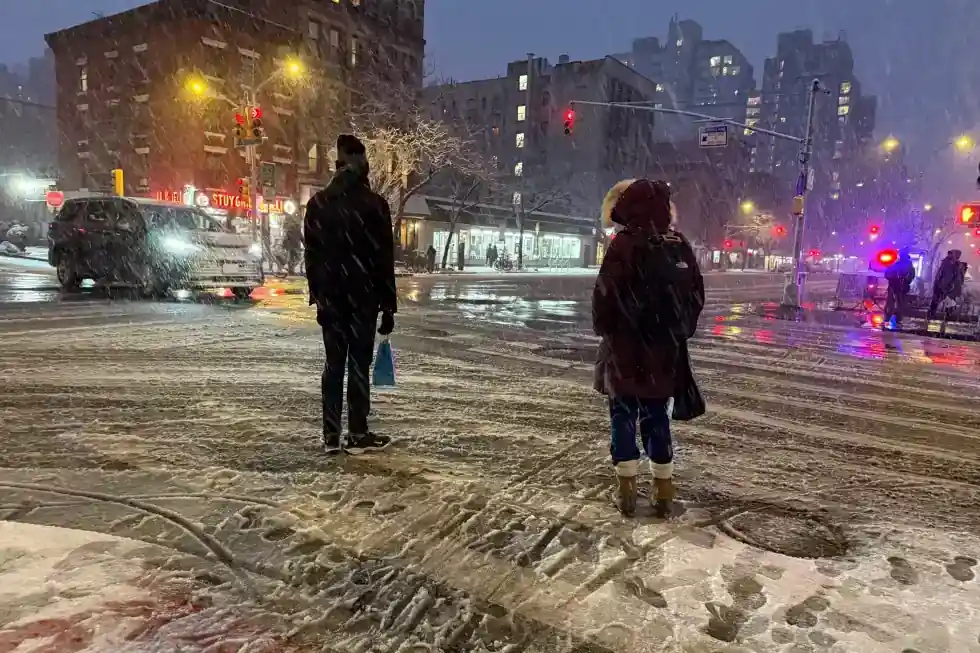
NEW YORK (Journos News) – A powerful winter storm has triggered sweeping blizzard warnings along the U.S. East Coast, halting travel, grounding thousands of flights and prompting emergency declarations across several states. The storm, described by forecasters as one of the most significant in recent years, is expected to bring up to two feet of snow to parts of the Northeast, along with damaging winds and near-whiteout conditions.
The East Coast blizzard warnings stretch from Maryland to Massachusetts, with officials urging residents to remain indoors as heavy snowfall and strong gusts intensify. Major metropolitan areas, including New York City and Boston, prepared for prolonged disruptions into Monday.
Authorities across the region implemented emergency measures as the storm moved northward Sunday, underscoring the scale of impact in one of the country’s most densely populated corridors.

States declare emergencies as storm intensifies
The National Weather Service issued blizzard warnings for New York City, Long Island and Boston, as well as coastal communities in Delaware, Maryland, New Jersey, Connecticut, Rhode Island and Massachusetts. Blizzard warnings are reserved for storms expected to produce sustained winds or frequent gusts of at least 35 mph (56 kph) combined with considerable falling or blowing snow, reducing visibility to a quarter-mile (400 meters) or less for at least three hours.
States including New York, New Jersey, Delaware, Rhode Island, Connecticut and Massachusetts declared states of emergency as crews mobilized snowplows, emergency responders and utility teams.
In New York City, Mayor Zohran Mamdani announced a ban on non-emergency travel from 9 p.m. Sunday through noon Monday. Officials warned residents via mobile emergency alerts to avoid roads because of “dangerous blizzard conditions.” Travel restrictions were also planned in parts of New Jersey, Pennsylvania and Rhode Island.
City schools in New York canceled in-person and virtual classes Monday, marking what the mayor described as the city’s first traditional “snow day” in several years. Municipal agencies deployed plow fleets and recruited additional workers to begin clearing streets overnight, while outreach teams sought to move homeless residents into shelters and warming centers.
Flights grounded and public life paused
Airports across the storm’s projected path reported widespread cancellations. By Sunday afternoon, more than 3,500 flights within, into or out of the United States had been canceled, according to tracking service FlightAware, with thousands more delayed. Major airports serving New York City and Boston were among the hardest hit.
■ Related News



Airlines preemptively reduced schedules in anticipation of deteriorating conditions. Even app-based delivery services paused operations in New York City overnight, reflecting concern over hazardous travel.
Cultural institutions were also affected. Broadway performances were canceled Sunday evening, and landmarks such as Arlington National Cemetery in the Washington, D.C., area announced closures for Monday.
The breadth of suspensions illustrates how quickly severe winter weather can immobilize large urban economies, particularly when high winds accompany heavy snowfall.
Heaviest snow expected overnight
Forecasters said snowfall rates could reach as much as 2 inches (5 centimeters) per hour in some areas overnight Sunday into Monday before tapering off by Monday afternoon. Total accumulations of 1 to 2 feet (30 to 60 centimeters) are possible in several locations.
Meteorologists warned that the combination of heavy, wet snow and powerful wind gusts could snap tree limbs and damage power lines, raising the risk of prolonged power outages. Coastal areas southeast of the Boston-Providence corridor were cautioned about the potential for especially destructive conditions.
Weather officials also indicated the storm could meet the criteria for a “bomb cyclone,” a term used when a storm’s central pressure drops at least 24 millibars within 24 hours. Such rapid intensification can significantly strengthen winds and exacerbate snowfall.
While the technical classification may draw attention, forecasters emphasized that residents should focus on practical safety measures: limiting travel, preparing for possible outages and heeding local advisories.
Businesses brace for extended cleanup
Private contractors and municipalities prepared for days of snow removal once the storm passes. On Long Island, snow management companies serviced heavy equipment, stocked supplies and planned round-the-clock shifts to clear commercial parking lots and industrial sites.
Business owners said the scale of projected snowfall could require continuous operations for several days, depending on drifting and subsequent refreezing. In dense metropolitan regions, the cleanup effort often extends well beyond the final flakes, as plows clear secondary roads and crews remove accumulated snow from sidewalks and transit hubs.
For residents across the Northeast, the storm represents a stark return to large-scale winter disruption after several relatively milder seasons. Emergency officials reiterated that the most dangerous period was likely to occur overnight, when visibility would be lowest and wind gusts strongest.
As snow continued to blanket highways and neighborhoods, authorities maintained a consistent message: stay indoors if possible and allow emergency and utility crews space to operate.
Source: AP News – Blizzard warnings cascade across East Coast as winter storm hits