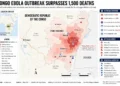
KINSHASA, Democratic Republic of Congo — Health authorities in the Democratic Republic of Congo reported a sharp rise in Ebola infections, with confirmed cases reaching 782 and the death toll climbing to 181 as officials struggle to contain an outbreak centered in the country’s conflict-affected east.
The Congolese Ministry of Health announced the updated figures in a statement posted Sunday, highlighting the continued spread of the virus in several provinces and warning that the actual number of infections may be higher than officially recorded.
According to the ministry, 56 people have recovered from the disease, while the outbreak currently has a fatality rate of approximately 23%.

Contact Tracing Challenges Raise Concerns
Health officials said surveillance efforts remain complicated by low contact-tracing coverage, which has fallen to 56%, significantly below levels reported a week earlier.
The outbreak was officially confirmed on May 15, but authorities believe transmission may have begun several weeks before the disease was identified, increasing concerns that additional infections could have gone undetected.
Public health experts consider contact tracing one of the most important tools for containing Ebola outbreaks because it allows authorities to identify and monitor individuals who may have been exposed to the virus.
The reduced tracing rate has heightened concerns about the ability to fully track chains of transmission.
Rare Virus Strain Complicates Response
The current outbreak is linked to the Bundibugyo strain of the Ebola virus, a less common variant for which no approved vaccine or specific treatment currently exists.
■ Related News


That distinguishes the outbreak from several previous Ebola emergencies in Congo that involved the Zaire strain, for which vaccines and treatments have been developed and deployed.
The absence of approved medical countermeasures for the Bundibugyo virus has added urgency to containment efforts focused on surveillance, isolation of cases, and public health interventions.
Conflict-Affected Region Remains Epicenter
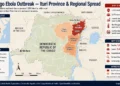
More than 90% of confirmed infections have been recorded in Ituri province, a region that has experienced years of armed conflict and humanitarian instability.
Cases have also been reported in neighboring North Kivu and South Kivu provinces. Authorities said infections have crossed the border into Uganda, underscoring the regional dimension of the outbreak.
The United Nations humanitarian office has reported that nearly one million people have been displaced by violence in Ituri, creating major obstacles for health workers attempting to locate contacts and monitor potential cases.
Frequent population movements, remote communities, limited transportation infrastructure, and dense forest terrain have made outbreak response operations particularly difficult.
Security and Community Resistance Affect Health Efforts
Health officials continue to face additional challenges beyond geography and displacement.
The ministry said attacks on healthcare workers, skepticism among some local residents, and ongoing insecurity in parts of eastern Congo have complicated efforts to slow transmission.
Thousands of artisanal miners also move regularly between remote mining sites throughout the region, making it more difficult for authorities to track possible exposures and identify emerging clusters of infection.
The combination of conflict, migration, and limited access to affected communities has long complicated disease-control operations in eastern Congo.
International Attention on Containment Measures
The outbreak has drawn international attention amid broader concerns about cross-border transmission and preparedness efforts.
Last month, U.S. officials announced plans to send Americans exposed to Ebola while overseas to a proposed quarantine facility in Kenya rather than transporting them directly to the United States.
The planned center at Laikipia Air Base was expected to accommodate up to 50 quarantine beds. However, the proposal sparked protests in Kenya and was subsequently halted following court action.
As health authorities continue to monitor the spread of the virus, officials in Congo face mounting pressure to improve surveillance and containment efforts in one of the country’s most challenging humanitarian environments.
Tags: Democratic Republic of Congo, Ebola, Ituri Province, Uganda, Public Health