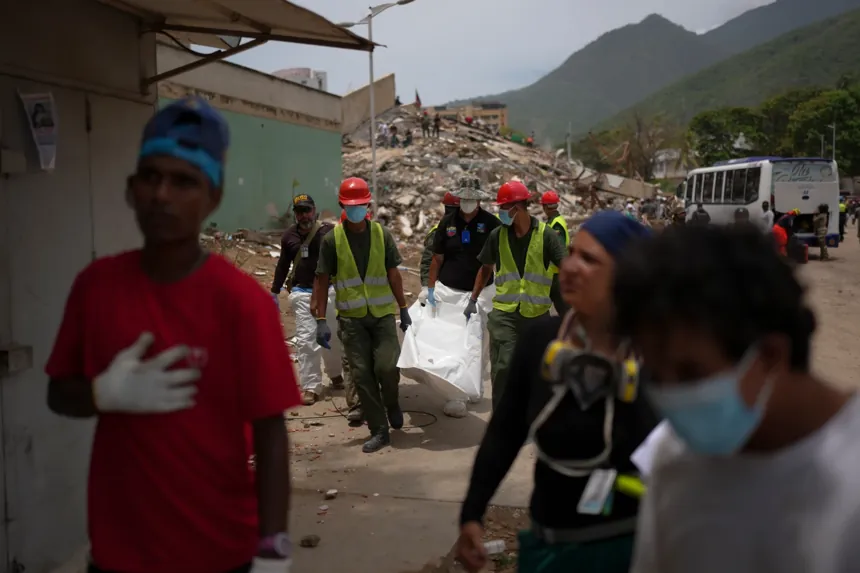
LA GUAIRA, Venezuela – Families across Venezuela’s coastal state of La Guaira are rushing to identify relatives killed in the country’s devastating June 24 earthquakes as authorities face mounting challenges in recovering, identifying and preserving the growing number of victims.
According to the Associated Press, at least 2,295 people have died following the twin earthquakes, while thousands more remain missing. The scale of the disaster has overwhelmed hospitals, forensic services and local authorities responsible for managing the dead, leaving many families navigating an increasingly difficult process to recover the bodies of loved ones.
Among them is Rosa López, who accompanied her daughter in the search for her missing husband after the disaster.

López, a former nurse, said she was confronted with rows of bodies wrapped in blankets and sheets awaiting identification, a scene she described as unlike anything she had experienced during her medical career.
Families Face Difficult Decisions
López’s 25-year-old son-in-law, José Antonio Toledo, was found beneath the building where he had been working as a security guard when the earthquakes struck.
His body was initially taken to a local hospital, but the facility lacked space to receive additional victims. Officials later transferred his remains to another location before they were eventually moved to an open parking area being used to hold bodies awaiting identification.
A forensic doctor later helped the family locate Toledo’s body.
After identifying him, relatives discovered they could not afford the approximately $450 required for funeral services. Later that night, local officials informed them that a cemetery plot had become available at no cost, allowing the family to bury him before the opportunity expired.
López said the burial spared her son-in-law from the possibility of being placed in a mass grave, a concern shared by many families as the number of fatalities continues to increase.
Recovery Effort Expected to Continue for Months
Forensic technician Joel Mirabal said recovery operations have continued without interruption since the earthquakes struck.
He estimated that relatives or neighbors are available to identify victims in roughly 60% to 70% of recoveries. In many cases, identification depends on tattoos, scars or clothing because bodies have been severely damaged.
Victims who cannot be immediately identified are transported to forensic specialists working at the Port of La Guaira, where refrigerated shipping containers donated by private companies are being used to preserve remains.
Mirabal said authorities expect the number of recovered bodies to continue rising as rescue teams remove additional debris from collapsed buildings. He added that forensic crews anticipate recovery operations could continue for as long as three months.
He also noted that many recoveries have been made possible through the efforts of local residents who have joined emergency personnel in searching damaged neighborhoods.
Long Waits Outside Makeshift Morgues
Outside the Port of La Guaira, families continue gathering each day in hopes of identifying loved ones as authorities transport newly recovered victims from across the disaster zone.
Funeral home vehicles and private cars formed long lines outside temporary morgue facilities while relatives waited for officials to complete identification procedures.
Among those waiting was Robert Rodríguez, whose family searched for Rafael Alvarado, his son-in-law. Alvarado died after becoming trapped inside the grocery store where he worked.
Rodríguez said relatives located Alvarado beneath the rubble before his body was transferred to the port for formal identification.
The family plans to cremate his remains and scatter his ashes on Isla de Margarita, the Venezuelan island where he had lived.
Recovery Challenges Continue
As search and recovery efforts continue across La Guaira, authorities remain focused on locating thousands of people still unaccounted for while processing an increasing number of fatalities.
The disaster has placed extraordinary pressure on forensic teams, hospitals and emergency services as Venezuela confronts one of the deadliest natural disasters in its recent history.
Tags: Venezuela, La Guaira, Earthquake, Disaster Recovery, Missing Persons, Forensic Investigation, Humanitarian Crisis, José Antonio Toledo, Emergency Response, Search and Rescue, Natural Disaster, Americas