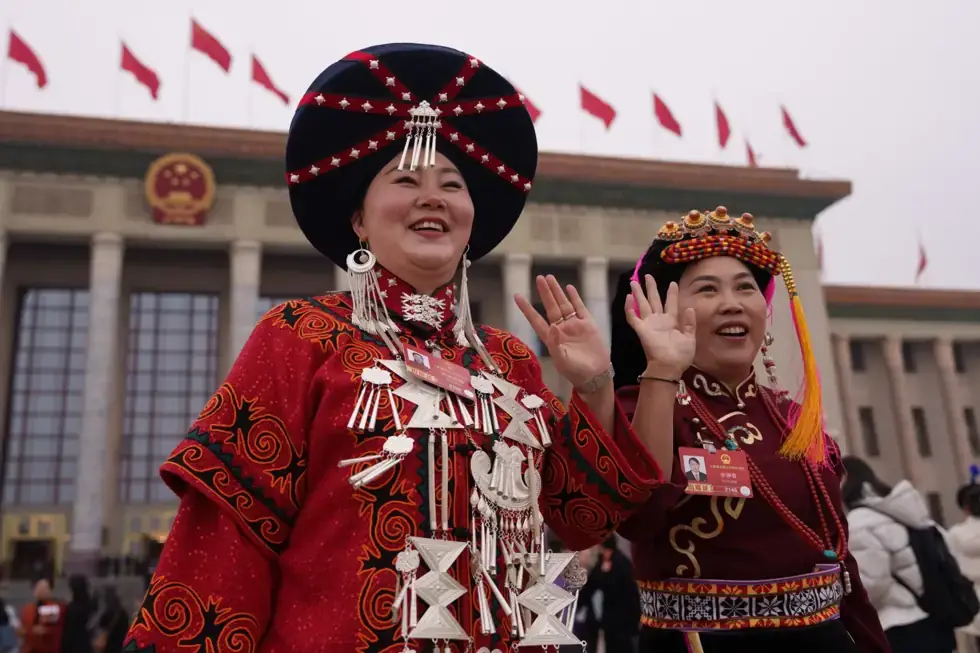
China is preparing to approve a sweeping ethnic unity law aimed at strengthening national cohesion, a move that government officials say will foster shared identity but which critics argue could accelerate assimilation policies affecting ethnic minority communities.
The legislation, expected to pass through the National People’s Congress in Beijing, forms part of a broader push by Chinese authorities to reinforce what they describe as a unified national consciousness. Analysts say the measure reflects evolving policy priorities under Chinese President Xi Jinping, whose administration has emphasized integration and ideological unity across the country’s diverse ethnic regions.
Officials say the law is intended to promote cooperation and shared civic identity among China’s 56 recognized ethnic groups. Yet scholars and human rights observers warn that the proposal could formalize policies that weaken linguistic and cultural autonomy for minorities, particularly in regions such as Xinjiang and Tibet.

Integration Policies Gain Legislative Backing
The proposed legislation requires government agencies, public institutions, and private organizations to promote what officials describe as a “common consciousness of the Chinese nation.” Delegates introducing the proposal to the legislature say it seeks to strengthen solidarity and national cohesion across all sectors of society.
According to reporting by The Associated Press, the law would require state bodies, businesses, and social organizations to actively support policies promoting ethnic unity, including participation by groups linked to the ruling Communist Party.
China’s population of about 1.4 billion is predominantly Han Chinese, while 55 officially recognized minority groups account for roughly nine percent of the population. Existing legal provisions in China’s constitution grant minority groups the right to use their own languages and exercise limited self-governance in designated autonomous regions.
However, analysts say the new legislation may take precedence in shaping future policy implementation.
James Leibold, a scholar of Chinese ethnic policy at La Trobe University, told reporters that the measure represents the culmination of a significant shift in Beijing’s approach toward ethnic governance.
■ Related News




Language Policy at the Center of Debate
One of the most debated provisions concerns education. The draft law mandates the teaching of Mandarin Chinese from preschool through the end of compulsory schooling.
Mandarin is already the primary language used in schools across many minority regions, including Inner Mongolia, Xinjiang and Tibet. The legislation would formalize that policy nationwide, effectively preventing minority languages from serving as the main medium of instruction.
Until recently, some regions maintained greater flexibility. For example, schools in Inner Mongolia historically taught large portions of the curriculum in Mongolian. In 2020, however, authorities replaced several Mongolian-language textbooks with Mandarin-language materials, a move that sparked protests among local communities and prompted a government crackdown.
Students in the region now typically study Mongolian as a separate subject rather than as the primary language of instruction.
Concerns Over Community Integration Measures
The law also references the creation of “mutually embedded community environments,” a concept scholars say could encourage demographic mixing by promoting migration between majority and minority populations.
Minglang Zhou, a professor at the University of Maryland who studies bilingual education policies, said the language may signal efforts to reduce concentrations of minority communities in specific regions.
Chinese authorities have long argued that integration policies are designed to promote economic development and improve living standards in remote or underdeveloped areas. Critics, however, say such measures risk diluting minority cultures and identities.
Legal Reach Beyond China’s Borders
Another provision establishes potential legal consequences for individuals or organizations outside China if their actions are deemed to undermine ethnic unity policies.
Legal scholars say the clause resembles provisions contained in the Hong Kong National Security Law enacted in 2020, which allows Chinese authorities to pursue cases involving individuals abroad for alleged offenses related to national security.
Rayhan Asat, a legal scholar affiliated with Harvard University, said the law could create additional tools for authorities to prosecute alleged violations tied to ethnic policy debates.
Asat has publicly advocated for the release of her brother, an Uyghur entrepreneur imprisoned in Xinjiang, and has argued that policies targeting ethnic identity remain a major concern among rights groups.
International Scrutiny Likely to Continue
China’s policies toward ethnic minorities—particularly the treatment of Uyghurs in Xinjiang—have drawn sustained scrutiny from governments, international organizations, and human rights groups in recent years.
Beijing has rejected allegations of systematic abuses, saying its policies are aimed at countering extremism, promoting stability, and improving economic development in minority regions.
As the legislation moves toward approval, analysts say the new law could further shape China’s governance model for ethnic regions while intensifying international debate over the balance between national integration and cultural autonomy.