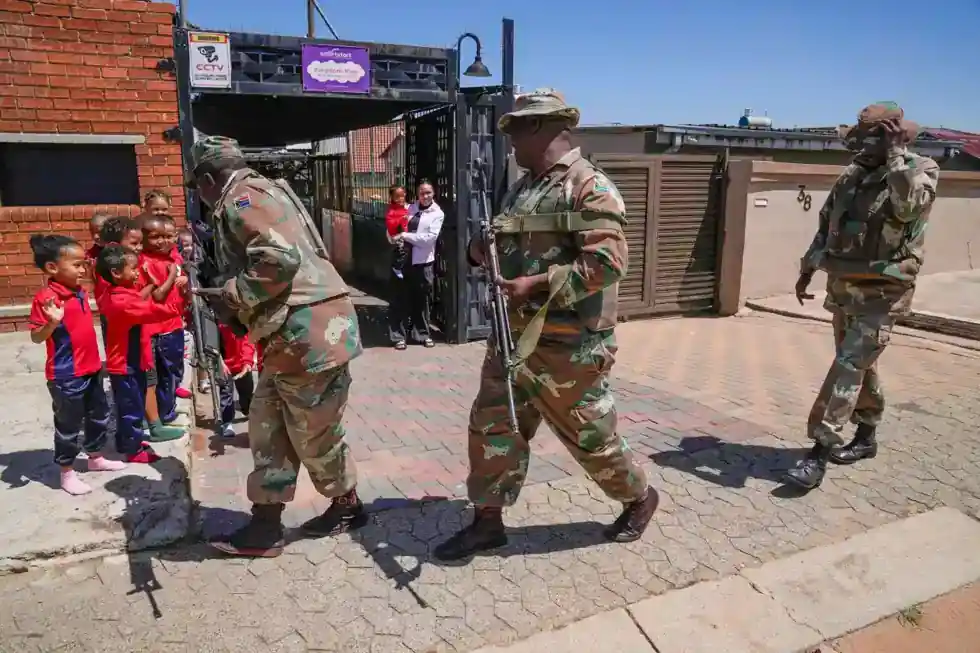
Soldiers were deployed across parts of Johannesburg on Wednesday as the government of South Africa intensified efforts to combat organized crime, signaling a significant escalation in the country’s security strategy.
The move follows a decision by President Cyril Ramaphosa to authorize military support for police operations targeting gang violence and illegal mining networks, which authorities say have increasingly undermined public safety and economic stability.
Security forces entered several neighborhoods, including Riverlea and Westbury, where armored vehicles and soldiers moved through residential streets and apartment complexes. The deployment marks the first large-scale military presence in the city since Ramaphosa announced in February that organized crime posed one of the most serious threats to the country’s democracy and development.

Security Crackdown Targets Organized Crime Networks
The operation is expected to involve approximately 550 soldiers in Gauteng, the country’s economic hub and home to Johannesburg. The troops are operating under the command of the South African Police Service, according to details submitted to parliament.
Authorities say the deployment will focus on dismantling organized criminal groups responsible for illegal mining operations and persistent gang violence in urban communities.
Reporting from The Associated Press indicates that the military support had originally been scheduled to begin on March 1 but was delayed while troops underwent operational preparation.
Residents in the affected communities described frequent shootings and gang activity that have created a climate of fear. Some said the visible presence of soldiers offered reassurance that authorities were taking stronger steps to restore security.
Wider National Operation Planned
The Johannesburg deployment represents only the first phase of a broader national plan. Government officials say additional military support may extend to five of South Africa’s nine provinces.
■ Related News


Authorities plan to concentrate anti-illegal mining operations in North West Province and Free State, while gang violence will remain a priority in Western Cape and Eastern Cape.
Police officials told lawmakers that certain deployments could extend for more than a year depending on operational needs.
The government has increasingly linked organized crime with economic disruption, particularly in the mining sector where illegal extraction networks have grown in recent years.
Rising Crime Rates Intensify Political Pressure
South Africa continues to grapple with some of the highest violent crime rates globally. Police statistics show 6,351 homicides between October and December 2025 — averaging nearly 70 killings per day in a country of about 62 million people.
The scale of violence has fueled mounting pressure on authorities to deliver stronger security measures, particularly in urban areas where gang activity and armed robberies remain common.
Political debate has intensified around the role of the military in domestic security. While many residents and local officials have welcomed the intervention, some opposition parties argue that relying on the army highlights shortcomings within the national policing system.
Historical Sensitivities Surround Military Deployment
The use of soldiers in civilian areas carries historical sensitivity in South Africa. During the apartheid era, military forces were often deployed to suppress protests and maintain strict racial segregation.
That legacy has made modern governments cautious about domestic deployments.
Ramaphosa acknowledged those concerns in remarks delivered during his annual address to parliament, saying the decision to mobilize the military had been taken only after careful consideration.
However, the president argued that the scale of organized crime now threatens both community safety and the authority of the state, making stronger security intervention necessary.
South Africa has previously deployed troops internally, including during the 2021 South Africa unrest, when widespread riots and looting following the imprisonment of former president Jacob Zuma left more than 350 people dead.
Strategic Stakes for Government Stability
The current deployment reflects a broader challenge confronting South Africa’s leadership: restoring public confidence in state institutions while containing criminal networks that operate across provincial borders.
Analysts say the success or failure of the operation could influence both public trust in the government and the country’s economic outlook, particularly in sectors affected by illegal mining and organized violence.
With the first troops now on the streets of Johannesburg, authorities face the immediate task of stabilizing neighborhoods where residents say gunfire and gang activity have become part of daily life.
How long the military presence remains — and whether it reduces crime — may shape the next phase of South Africa’s security policy.