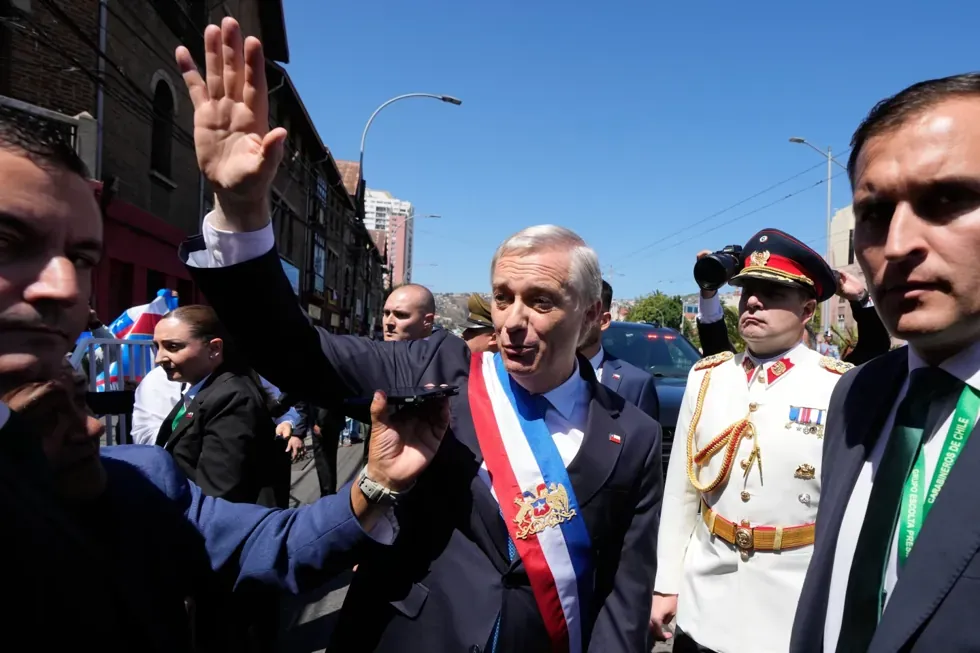
Far-right leader José Antonio Kast was sworn in as Chile’s president on Wednesday, marking the country’s most pronounced political shift toward the right since the end of military rule in 1990. The inauguration signals a significant political transition in the South American nation and could reshape Chile’s domestic agenda and diplomatic alignment in the region.
Kast assumed office during a ceremony at the National Congress in the coastal city of Valparaíso after winning a decisive victory in the 2025 presidential election. His rise to power reflects growing voter concern over public security, immigration and economic stability, issues that dominated the campaign and contributed to a broader regional shift in political leadership.
Regional Leaders Gather as Chile Signals Policy Reset
Several prominent international figures attended the inauguration, underscoring Chile’s continuing role in regional diplomacy. Among them were Javier Milei of Argentina, José Raúl Mulino of Panama, and Daniel Noboa of Ecuador. Representing Europe, King Felipe VI of Spain was also present.

However, some regional leaders were notably absent, including Luiz Inácio Lula da Silva of Brazil and Nayib Bukele of El Salvador. The United States sent a smaller delegation led by Deputy Secretary of State Christopher Landau, reflecting the evolving dynamics between Santiago and Washington.
During the ceremony, newly appointed Senate President Paulina Núñez placed the presidential sash on Kast before the incoming Cabinet took the oath of office. Among the key appointments were José Francisco Pérez Mackenna as foreign minister, María Trinidad Steinert as security minister, and Fernando Rabat as minister of justice and human rights.
Political Transition Follows Turbulent Presidency
Kast replaces outgoing President Gabriel Boric, who entered office in 2022 as Chile’s youngest leader but leaves with historically low approval ratings. According to a survey published this week by the polling firm Cadem, more than half of respondents viewed Boric’s administration as the weakest since Chile returned to democracy.
Analysts say widespread frustration over rising organized crime and unmet expectations for social reform eroded support for Boric’s left-wing government. That dissatisfaction helped propel Kast, a long-time conservative figure in Chilean politics, to a landslide victory against government-backed communist candidate Jeannette Jara in December’s election.
Foreign Policy Signals Shift Toward Washington
The political transition also comes amid shifting geopolitical alignments across Latin America. Several countries in the region have recently elected conservative leaders, a trend that some observers link to changing domestic priorities and renewed engagement with the United States.
■ Related News


Kast has made gestures suggesting closer ties with Washington, including praise for the U.S. operation that led to the capture of former Venezuelan leader Nicolás Maduro. According to reporting by The Associated Press, the new president also ended a transition dispute with Boric related to a proposed submarine cable project connecting Chile with China—a plan that had drawn criticism from U.S. officials.
The dispute highlighted growing tensions between Santiago and Washington during Boric’s presidency, particularly after the Chilean leader publicly criticized the leadership style of U.S. President Donald Trump. Trump had previously signaled support for Kast and recently invited him to the “Shield of the Americas” summit in Miami alongside other conservative leaders from the region.
Security and Immigration Agenda at the Forefront
Kast’s campaign centered heavily on promises to restore security and tighten immigration controls. Rising crime rates and the expansion of transnational criminal networks have become major public concerns in Chile in recent years.
The president has pledged tougher law-enforcement measures, including expanded deportations of undocumented migrants and new border barriers in areas with high levels of illegal crossings. Kast has also cited the security policies of El Salvador’s president, Nayib Bukele, as a model, having toured the country’s large-scale prison complex during the campaign.
These proposals mark a sharp departure from the approach of Boric’s administration, which emphasized social reform and human-rights-focused policies.
Early Governing Test Looms
Despite the decisive election victory, Kast will confront a fragmented political landscape. Chile’s divided Congress could complicate efforts to pass major legislation tied to the administration’s security and immigration agenda.
Analysts say the government’s first months in office will be crucial. Mariano Machado of risk-analysis firm Verisk Maplecroft told The Associated Press that the administration’s ability to define clear priorities early on will likely determine whether political institutions align with the government’s program or resist it.
If the new administration demonstrates momentum within its first 100 days, Machado suggested, the broader political establishment may be more inclined to cooperate. Failure to establish direction quickly, however, could create obstacles to advancing Kast’s policy agenda.