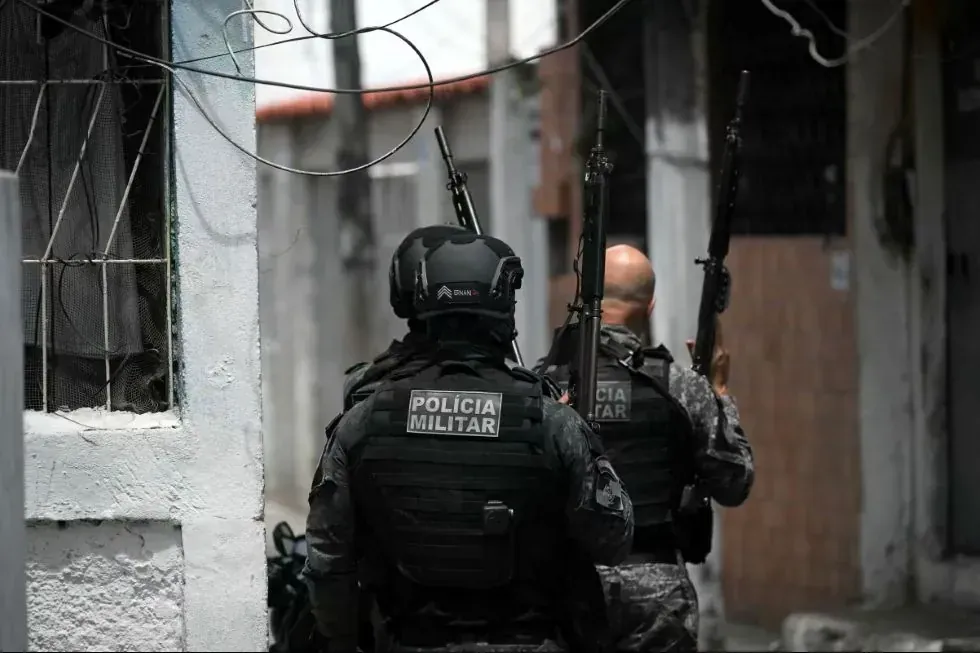
RIO DE JANEIRO, Brazil — Armored vehicles thundered through narrow alleyways. Rifle fire cracked through heavy crossfire. Helicopters and drones swooped overhead. Soldiers in full military gear engaged in brutal combat. Bloodied streets bore witness to the toll.
This was not a war zone in a distant country. It was Rio de Janeiro on October 28, when Brazilian authorities launched “Operation Containment” against the Comando Vermelho (CV), or Red Command — one of South America’s most notorious criminal organizations.
A Violent Crackdown
The operation involved 2,500 police officers, soldiers, and snipers, targeting the Complexo da Penha and Complexo do Alemão favelas, home to roughly 110,000 residents. Authorities reported at least 117 suspected gang members and four police officers killed, with about 100 arrests, alongside the seizure of 118 weapons, including 91 rifles and 14 explosives, and roughly one ton of drugs.

The raid followed a year-long investigation into the Red Command and aimed to curb its territorial expansion, rising violence, and growing influence in Rio’s hillside communities.
Officials described the operation as a success, but human rights organizations sharply criticized the high death toll, which early reports suggested could reach 132. The operation highlighted a longstanding debate in Brazil: how best to confront entrenched criminal networks without harming civilians.
Life Under Crossfire
“It’s not the first time we see blood being spilled for a ‘greater good,’” said Thainã de Medeiros, a longtime resident of Complexo da Penha and community organizer. “But this ‘good’ never comes.”
Residents live under constant threat. “You see people carrying rifles on every corner, grenades and pistols by the doors. No one feels safe,” he added.
Gangs in Rio also regulate economic life. Rafael Alcadipani of the Brazilian Forum on Public Security noted, “Internet companies, for instance, need to pay fees to operate in the area. They issue building permits — not the government.”



This reality has deepened the challenge for authorities, as state withdrawal allows gangs to consolidate power, infiltrate politics, and extend influence through violence, vote-buying, and candidate funding.
A Controversial Justification
Lawmakers such as Luiz Lima, a congressman representing Rio, defended the October 28 raid as necessary. “What happened that day — 117 criminals killed — happens every day in Brazil,” he said, citing the country’s 38,000 homicides in 2022, averaging 106 deaths per day.
Lima emphasized the social costs of gang control, including extortion, rape, and the targeting of local businesses.
Human rights advocates offered a starkly different view. Daniela Fichino, deputy director at Global Justice, criticized “a state policy that defines an entire population as disposable.” She argued that the military-style operations perpetuate cycles of violence while leaving communities traumatized.
Historical Roots of the Red Command
The Red Command was founded in 1979 inside Cândido Mendes Penitentiary, an island prison where common criminals and political prisoners were locked together during Brazil’s military dictatorship (1964–1985).
Initially an informal alliance for protection, it evolved into an organized crime network. Founder William da Silva Lima spent decades in prison, negotiating with authorities and coordinating criminal activities.
By 1985, the Red Command controlled 70% of Rio’s drug-selling points, sparking deadly turf wars with rival gangs.
Rival Factions: The PCC
Brazil’s largest criminal faction, the Primeiro Comando da Capital (PCC), was created in 1993 in São Paulo’s Taubaté Penitentiary. Its founders were survivors of the Carandiru massacre, where police killed 111 inmates.
The PCC rapidly expanded, orchestrating 29 simultaneous prison uprisings in 2001 involving 27,000 prisoners, leaving 16 dead and 77 injured. Initially focused on prison control, the PCC later became a major player in the drug trade, securing cocaine from Bolivia and managing transport to Europe, Africa, and beyond.
From Collaboration to Conflict
The Red Command and PCC were initially not enemies. However, competition over northern Brazil’s riverine supply routes triggered violence, prison riots, and massacres. “It was a territorial war,” said Christino, a São Paulo criminal prosecutor.
Today, gangs clash over highways, rivers, and prisons while expanding into other illicit industries, including gold, fuel, alcohol, and cigarette smuggling. A 2025 study by the Brazilian Forum on Public Security estimated that the Red Command and PCC generated 146.8 billion reais ($27 billion) in 2022 from these trades — far surpassing cocaine profits, estimated at 15 billion reais ($2.8 billion).
Financial and Corporate Networks
Both organizations also launder money and invest in legitimate businesses such as construction, transport, fuel distribution, and crypto markets, embedding themselves further into Brazil’s formal economy. Investigations reveal layered structures where cell bosses, logistics managers, and financial operatives manage local and transnational revenue streams.
Command Centers Behind Bars
Even in prisons, gang leaders continue to issue orders through encrypted messages, letters, or intermediaries. While high-risk inmates are isolated, Christino explained: “Cellphones still get in, and when they don’t, messages travel through lawyers or visitors. There’s always a way.”
The Federal District’s Secretariat of Penitentiary Administration confirmed that intelligence units coordinate with security forces to monitor faction-linked inmates and attempt to isolate leaders. Yet, prisons remain the backbone of Brazil’s criminal networks, making eradication nearly impossible.
Maps and Territorial Control
Visual analyses of Rio’s favelas show Red Command dominance along the northern slopes, while the PCC and other factions control southern and western corridors, including crucial highway access points. River routes in northern Brazil allow the transport of cocaine and smuggled goods, making territorial disputes especially deadly.
Gang hierarchies are also highly structured: local captains oversee neighborhoods, reporting to regional bosses, who in turn answer to imprisoned faction leaders. Communication flows through encrypted apps and trusted intermediaries, making law enforcement infiltration challenging.
A Cycle Without End
“The state’s militarized response only strengthens the factions,” said Alcadipani. “Each operation kills dozens, but the leadership remains. For every man who dies, another fills the gap. What we have now is reactive — a war without an endgame.”
Community programs have also suffered. Medeiros described how initiatives with UNICEF to help favela youth enter the job market had to be canceled due to the raid, leaving the community reeling.
“Honestly, I thought today I’d be finalizing the details for that beautiful day,” he said. “Instead, we were cleaning bodies from the streets. And now, we’re bracing for what’s next.”
Conclusion: Structural Challenges Remain
Brazil’s criminal networks illustrate the intersection of poverty, state absence, and organized crime. Militarized raids, while temporarily disrupting gang operations, fail to address the systemic issues that allow these organizations to thrive. From prison control to transnational cocaine trafficking and corporate money laundering, the Red Command and PCC remain resilient, adaptive, and extremely profitable.
Experts argue that sustainable solutions will require community engagement, economic opportunities, and long-term policing strategies, rather than repeated lethal raids that only provide temporary disruption.
The deadly October 28 raid serves as a stark reminder: Brazil’s war on crime is as much about economics and politics as it is about bullets and barricades.
Source: CNN – Behind Rio’s deadly raid: Brazil’s billion-dollar criminal networks