TOKYO — Asian stock markets mostly moved lower on Tuesday as renewed military activity involving the United States and Iran raised concerns about the durability of a recently announced ceasefire and renewed worries over global energy supplies.
Market data showed declines across several major regional benchmarks, reflecting investor caution as geopolitical tensions threatened to disrupt oil shipments and sustain higher energy prices. The developments come despite record-setting performances on Wall Street during the previous trading session.
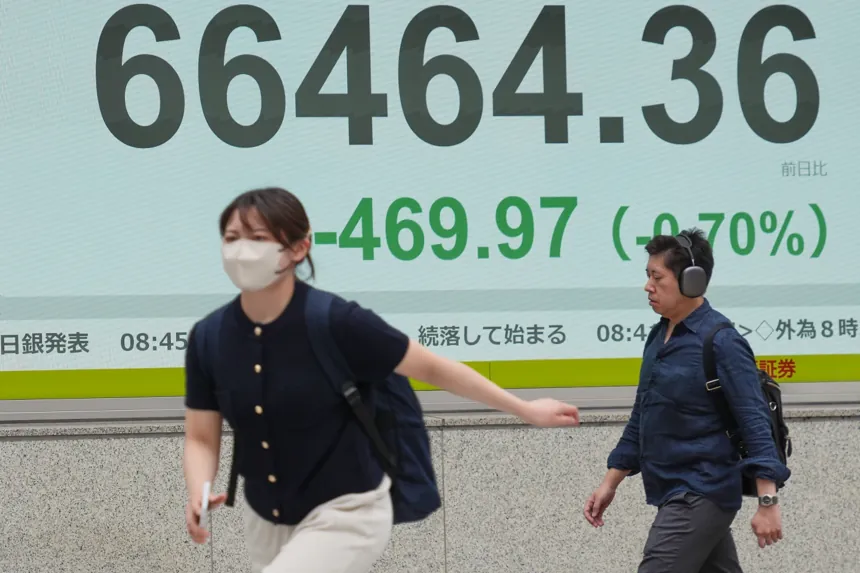
Japan’s Nikkei 225 fell 1.6% to 65,833.49, while South Korea’s Kospi dropped 1.7% to 8,642.82. Australia’s S&P/ASX 200 declined 0.4% to 8,692.20.

Elsewhere, Hong Kong’s Hang Seng Index advanced 1.2% to 25,698.75, while mainland China’s Shanghai Composite edged down less than 0.1% to 4,056.56.
Oil Supply Concerns Remain a Key Market Focus
Energy markets remained central to investor attention as uncertainty persisted over whether Washington and Tehran could reach an agreement that would allow oil shipments to resume through the Strait of Hormuz.
In Asian trading, U.S. benchmark crude oil fell 39 cents to $91.77 per barrel, while Brent crude, the international benchmark, slipped 28 cents to $94.70 per barrel. Despite the modest decline, both benchmarks remained significantly higher than levels recorded before the conflict escalated.
The elevated price environment has increased concerns about inflationary pressures and higher operating costs for businesses that rely heavily on fuel.
Stephen Innes, an analyst cited in the Associated Press report, said crude supply shortages were already affecting refining operations in Asia and Europe, leading refiners to reduce production levels. He noted that pressure was extending beyond crude inventories into refined products such as gasoline, diesel, jet fuel, liquefied petroleum gas and naphtha.



Geopolitical Developments Influence Market Mood
The latest market weakness followed reports of renewed military exchanges between the United States and Iran.
The United States said it struck Iranian radar and drone facilities after Iran downed an American drone. Tehran, meanwhile, said it launched missiles targeting U.S. soldiers in Kuwait, although U.S. officials stated the missiles were intercepted.
At the same time, U.S. President Donald Trump said Israel and Hezbollah had agreed to reduce hostilities following discussions with Israeli Prime Minister Benjamin Netanyahu and communications conducted through mediators.
The developments have left investors assessing whether broader regional tensions could further affect energy markets and global economic conditions.
Wall Street Continues Record Run
Despite geopolitical uncertainty, U.S. markets ended Monday at new highs.
Market data showed the S&P 500 gained 0.3% to close at 7,599.96, while the Dow Jones Industrial Average rose 0.1% to 51,078.88. The Nasdaq Composite advanced 0.4% to 27,086.81.
Technology shares continued to provide support for U.S. equities. Nvidia rose 6.2% after Chief Executive Officer Jensen Huang announced product updates during a company conference.
As one of the largest companies by market value, Nvidia’s performance continues to have a significant influence on broader market indexes.
Bond and Currency Markets
U.S. Treasury yields remained relatively stable despite the geopolitical uncertainty.
The yield on the 10-year Treasury note briefly approached 4.52% before settling at 4.46%, compared with 4.45% at the end of the previous week.
Currency markets showed limited movement. The U.S. dollar rose slightly to 159.70 Japanese yen from 159.66 yen, while the euro remained unchanged at $1.1631.
Investors are expected to continue monitoring developments in the Middle East closely, particularly any progress toward reopening the Strait of Hormuz, a critical route for global oil shipments. The outcome could have significant implications for energy prices, inflation trends and broader market sentiment.