Who Will Control the Chips Behind the AI Revolution?
Subheadline: AI’s future depends on a semiconductor chain spread across countries, companies and technologies that no single power currently controls.
Standfirst: Nvidia may dominate the AI accelerator market, but the chips behind the AI revolution depend on a far larger ecosystem spanning Taiwan’s foundries, Dutch lithography, advanced memory, packaging, American design software and increasingly contested global supply chains.
The artificial intelligence revolution is often described as a race between models.

That description misses the machinery underneath.
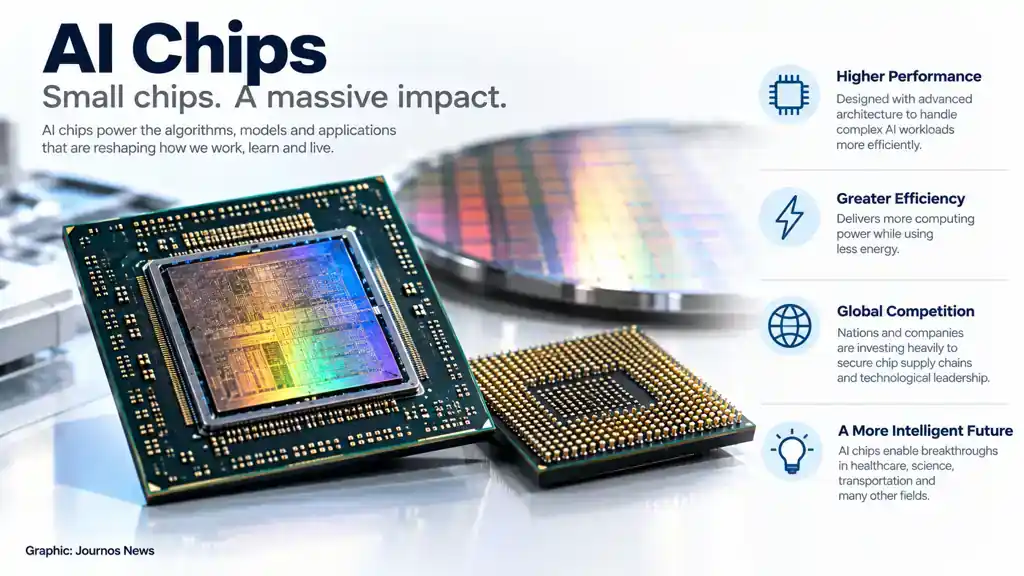
Every major AI system ultimately depends on semiconductors: processors that perform calculations, memory that feeds them data, networking chips that connect thousands of processors, packaging technologies that bring those components together, and manufacturing equipment capable of producing transistors at extraordinary densities.
The competition to control that infrastructure has become one of the defining industrial and geopolitical contests of the 2020s.
And there is no single answer to the question of who controls it.
Nvidia has established an extraordinary position in AI computing. Taiwan dominates advanced semiconductor manufacturing. ASML of the Netherlands controls the world’s most advanced extreme-ultraviolet lithography technology. American companies retain major positions in chip design, electronic-design automation, cloud computing and semiconductor equipment. South Korea is indispensable to advanced memory. China is investing heavily to reduce its dependence on foreign technology.




The result is a supply chain in which power is distributed—but unevenly.
The Semiconductor Industry Association says 100% of the world’s semiconductor manufacturing capacity below 10 nanometers is currently concentrated in Taiwan and South Korea, with Taiwan accounting for 92% and South Korea 8%. Taiwan’s government separately says its companies produce more than 90% of the world’s most advanced semiconductors.
At the same time, ASML says AI-related investment is driving demand for advanced logic and memory and that its customers are accelerating capacity expansion. The company is increasing planned 2027 production capacity for its lower-numerical-aperture EUV systems by 30% from its 2026 capacity of about 65 systems.
The strategic question is therefore becoming more complicated than who makes the best AI chip.
It is becoming:
Who controls the critical layers required to make, connect, supply and scale those chips?
AI begins with a chip—but not just one
The processor inside an AI server is only one component of the computing system.
Modern AI factories require accelerators, CPUs, high-bandwidth memory, networking hardware, storage, optical interconnects, power systems and sophisticated packaging.
Nvidia’s current platforms illustrate how far the industry has moved from the idea of a standalone graphics processor.
The company’s Vera Rubin platform combines GPUs with CPUs, networking chips, data-processing units and switches into rack-scale systems designed to operate as a single AI computing platform. Nvidia says its Rubin systems are intended to support large-scale training and inference, while cloud providers and AI companies deploy them as integrated infrastructure.
That matters because control is increasingly exercised at the system level.
A company may design the central accelerator, but another company may manufacture it. A third may supply the memory. A fourth may provide the lithography machine. Another may provide the software used to design the chip.
The AI semiconductor industry is therefore less like a single race and more like a chain of interdependent bottlenecks.
Control over one bottleneck can influence the entire system.
Nvidia controls an important layer of the stack
Nvidia occupies one of the most strategically important positions because its influence extends beyond the physical GPU.
Its data-center business generated $62.3 billion in quarterly revenue in the fourth quarter of fiscal 2026, while full-year data-center revenue reached $193.7 billion, according to the company’s financial results.
The company’s importance comes from the combination of hardware, networking and software.
Its CUDA software ecosystem has become deeply integrated into AI development, while its GPUs and networking products are deployed in large clusters operated by cloud companies and AI laboratories.
The company’s newer Rubin platform represents another step in that strategy: rather than simply selling processors, Nvidia is increasingly providing an architecture for complete AI factories.
That creates an important distinction.
Nvidia does not control the semiconductor supply chain by itself.
It controls an influential design and computing-platform layer within it.
The physical production of many of those advanced processors depends on other companies.
That dependence leads directly to Taiwan.
Taiwan is the manufacturing center of the AI era
Taiwan Semiconductor Manufacturing Co., or TSMC, operates the world’s most important advanced contract-manufacturing network.
The company’s business model is different from Nvidia’s.
Nvidia primarily designs processors and platforms. TSMC manufactures chips designed by customers.
That separation helped create the modern fabless semiconductor industry, allowing companies to specialize in chip architecture without owning the enormous factories required to produce them.
The model has become especially important for AI.
TSMC says its newest process technologies are being developed specifically to meet rising computing requirements from AI and high-performance computing. Its 2026 technology roadmap includes increasingly advanced process nodes as well as advanced packaging technologies designed to combine more silicon within a single system.
Advanced packaging is becoming increasingly important because simply making transistors smaller is no longer sufficient.
AI processors require enormous quantities of data to move between computing and memory components.
TSMC is therefore expanding its CoWoS advanced-packaging technology, including larger package sizes designed to integrate more silicon for AI and high-performance computing.
This creates a second Taiwanese advantage.
Taiwan is not important only because it manufactures advanced chips.
Its ecosystem combines foundries, packaging, testing, equipment suppliers, component manufacturers and the specialized engineering workforce required to operate them.
Taiwan’s government says the country’s semiconductor industry produces more than 90% of the world’s most advanced chips and that Taiwanese companies produced roughly 90% of global AI servers in 2025.
That concentration is strategically powerful—and strategically vulnerable.
The Taiwan bottleneck
The semiconductor industry’s geographic concentration creates a problem that no individual company can solve.
The SIA estimates that approximately 75% of global semiconductor manufacturing capacity is concentrated in China and East Asia. It identifies more than 50 points in the semiconductor value chain where one region holds more than 65% of the global market.
Advanced production is even more concentrated.
A disruption affecting Taiwan could therefore affect companies that have no physical presence there but depend on Taiwanese manufacturing.
That does not mean every disruption would automatically halt global AI development.
Companies maintain inventories, alternative suppliers exist, and manufacturing is gradually being diversified.
But rebuilding advanced semiconductor capacity is not comparable to constructing an ordinary factory.
It requires specialized equipment, clean rooms, chemical supplies, engineering expertise, process knowledge, supplier networks and years of yield optimization.
That is why governments increasingly view semiconductor manufacturing as strategic infrastructure.
ASML controls another critical bottleneck
If TSMC represents a crucial manufacturing layer, ASML represents an equally important equipment layer.
ASML is the world’s leading supplier of extreme-ultraviolet lithography systems used to manufacture the most advanced semiconductor devices.
EUV machines project extraordinarily precise patterns onto silicon wafers. The technology allows manufacturers to create extremely small structures that would otherwise require more complicated manufacturing techniques.
ASML’s next-generation High-NA EUV systems are now becoming part of the industry’s future production roadmap.
In September 2026, ASML and TSMC announced an initiative to move toward 12-inch photomasks for High-NA EUV, with a pilot line targeted for 2031 and full lithography-system readiness for advanced-node production targeted for 2033. TSMC says it intends to use High-NA technology for high-volume advanced-node manufacturing beginning in 2030.
Samsung has also announced plans to introduce ASML High-NA EUV into future DRAM high-volume manufacturing by 2028.
This illustrates why the semiconductor contest cannot be reduced to a competition between the United States and China.
A Dutch company controls technology that both American and Asian chipmakers need.
The Netherlands therefore occupies a strategic position far larger than the size of its domestic semiconductor market might suggest.
Memory has become a second AI bottleneck
AI chips require more than computational power.
They need memory capable of moving enormous amounts of data quickly.
High-bandwidth memory, or HBM, has consequently become one of the most strategically important components in AI infrastructure.
South Korean companies Samsung Electronics and SK Hynix are major participants in the advanced-memory market, while other suppliers are investing heavily to expand capacity.
The growing importance of memory changes the balance of the semiconductor industry.
For decades, public attention focused primarily on processor performance.
AI has made the connection between processors and memory equally important.
An extremely powerful accelerator can still be constrained if data cannot reach it quickly enough.
That is why semiconductor companies are simultaneously pursuing smaller transistors, larger packages, faster memory and more efficient interconnects.
The AI semiconductor race is becoming a race to optimize the entire computing system.
America controls important parts of the architecture
The United States retains major strengths across the semiconductor value chain.
American companies are prominent in chip design, semiconductor equipment, electronic-design automation, computing architecture and cloud infrastructure.
The Semiconductor Industry Association says U.S.-headquartered semiconductor companies generated $425 billion in semiconductor sales in 2025, representing 53.4% of global market share.
The United States is also trying to expand domestic manufacturing.
The CHIPS and Science Act established incentives for semiconductor manufacturing and research. In July 2026, the Commerce Department announced $874 million in proposed incentives for seven companies working on integrated photonics, compute architectures, advanced packaging, substrates, materials and memory for advanced computing and AI systems.
The strategy is significant because manufacturing capacity alone does not create semiconductor independence.
The United States is investing in the surrounding ecosystem as well.
That includes packaging, photonics, materials, memory and research.
The country’s policy challenge is therefore not simply bringing more factories onto American soil.
It is recreating enough of the supporting industrial ecosystem to make domestic production sustainable.
TSMC is also moving closer to America
The largest example is TSMC itself.
In July 2026, the U.S. Department of Commerce announced that TSMC planned an additional $100 billion investment in the United States, bringing its announced U.S. investment to $265 billion and expanding the planned Arizona manufacturing and packaging footprint to 12 facilities.
That investment does not mean Taiwan’s semiconductor ecosystem is moving wholesale to the United States.
Taiwan’s own government has emphasized the continuing importance of its domestic advanced manufacturing ecosystem. Officials have also said that the country’s most advanced technologies will remain in Taiwan.
Instead, the emerging model is diversification.
Some manufacturing capacity is being built outside Taiwan while Taiwan retains a central role.
That distinction matters.
The objective is not necessarily to replace Taiwan.
It is to reduce the consequences of a disruption in Taiwan.
China is pursuing a different strategy
China’s semiconductor strategy is built around reducing dependence.
U.S. export controls have restricted Chinese access to some advanced processors and semiconductor manufacturing equipment since 2022, with subsequent rules expanding restrictions. The U.S. Government Accountability Office has described the controls as part of Washington’s effort to prevent advanced semiconductor technology from being used in ways that could threaten national security.
The restrictions have affected both finished chips and the machinery used to produce them.
In January 2026, however, the U.S. Commerce Department revised its licensing policy so that applications to export Nvidia H200, AMD MI325X and similar chips to China could be reviewed case by case if specified security requirements are met.
The policy demonstrates the difficulty of using semiconductor controls as a long-term strategy.
Restricting access can slow a competitor’s progress.
But it can also strengthen incentives for that competitor to develop domestic alternatives.
China’s government has explicitly made semiconductor self-reliance a strategic objective. Its 2026–2030 planning documents call for breakthroughs across the full chain of integrated circuits and other core technologies.
A separate 2026 AI action plan calls for secure and reliable supplies of key AI technologies and specifically emphasizes coordinated development of AI-chip hardware and software.
The objective is not simply to produce a Chinese equivalent of one foreign GPU.
It is to build a domestic ecosystem.
Export controls have become industrial policy
This is where semiconductors become geopolitics.
The United States is attempting to restrict China’s access to some advanced technology while simultaneously expanding domestic production.
China is attempting to develop alternatives while protecting its own supply chains and expanding domestic capabilities.
Europe is attempting to reduce strategic dependencies.
Taiwan is strengthening its domestic ecosystem while expanding investment abroad.
Japan and South Korea are protecting their own positions while remaining integrated into the broader allied semiconductor network.
The Netherlands is doing the same with lithography.
The result is not a clean division into two independent semiconductor blocs.
It is a process of selective decoupling.
Some technologies are being restricted for security reasons. Others continue to cross borders because the industry remains economically interdependent.
Europe does not want to become a spectator
The European Union has recognized that its dependence on external suppliers creates a strategic vulnerability.
In June 2026, the European Commission proposed a Chips Act 2.0 aimed at strengthening Europe’s semiconductor industry, reducing strategic dependencies and supporting advanced chip production.
The Commission says the global semiconductor market could reach €1.37 trillion by 2030 and estimates that AI-related components could account for about 70% of the market’s growth.
Europe has strengths of its own.
ASML is the most obvious example.
The continent also has important semiconductor equipment, research, materials and industrial companies.
But Europe remains dependent on foreign suppliers in important parts of advanced chip manufacturing and design.
Its strategy is therefore less about achieving complete self-sufficiency and more about ensuring that it cannot be excluded from strategically important parts of the value chain.
No country can easily become semiconductor-independent
There is an important economic reason why complete national self-sufficiency remains difficult.
The semiconductor industry was built around specialization.
Designers became separate from manufacturers. Manufacturers specialized in particular process technologies. Equipment companies developed highly specialized machinery. Memory producers developed different expertise from logic-chip manufacturers. Packaging became increasingly sophisticated.
The result is an ecosystem in which specialization drives efficiency.
The SIA estimates that rebuilding fully self-sufficient regional semiconductor supply chains would require at least $1 trillion in additional upfront investment and could raise semiconductor prices by 35% to 65%.
That does not mean governments will abandon efforts to diversify.
It means the emerging objective is more likely to be strategic resilience than absolute independence.
A country may decide that it does not need to manufacture every component domestically.
It may instead need enough domestic or allied capacity to survive a disruption.
The next battlefield is advanced packaging
One of the least understood parts of the AI hardware race is packaging.
For traditional chips, packaging was often treated as a final manufacturing step.
For modern AI systems, it has become part of the computing architecture.
Large AI accelerators increasingly combine multiple components in tightly integrated packages with high-bandwidth memory.
This allows computing resources and memory to communicate more efficiently.
TSMC’s expansion of CoWoS demonstrates the strategic importance of this transition. The company says it is producing increasingly large CoWoS packages and developing larger versions to accommodate the computing and memory requirements of AI.
The United States is now investing in packaging as part of its semiconductor strategy.
The Commerce Department’s 2026 R&D incentives include projects involving advanced packaging, photonics, substrates and memory.
That is an indication of where the competition is heading.
The future advantage may not belong simply to whoever can make the smallest transistor.
It may belong to whoever can assemble the most powerful and efficient computing system from multiple components.
The AI supply chain is becoming a political supply chain
The semiconductor industry once operated primarily according to commercial efficiency.
Geopolitics has changed that calculation.
Companies now have to consider export restrictions, national-security reviews, government incentives, regional production requirements and the possibility of sudden supply disruption.
Governments, meanwhile, have discovered that semiconductor technology provides leverage.
Control over advanced processors can restrict another country’s AI development.
Control over lithography equipment can restrict its ability to manufacture advanced chips.
Control over memory can constrain AI-system scaling.
Control over manufacturing capacity can influence which companies receive the newest processors.
And control over software ecosystems can determine which hardware developers choose to build around.
Power is distributed across all these layers.
Who actually controls the AI chip supply chain?
The answer depends on which part of the chain is being examined.
Nvidia has major influence over AI accelerators, system architecture and the software ecosystem surrounding them. Its Rubin platform shows how that influence is expanding toward complete AI infrastructure.
TSMC has extraordinary influence over leading-edge manufacturing and advanced packaging, making Taiwan central to the production of many advanced AI processors.
ASML controls an indispensable technology layer in advanced lithography, with its EUV systems forming part of the manufacturing path for leading-edge chips.
Samsung and SK Hynix are central to advanced memory, an increasingly critical component of AI infrastructure.
The United States retains major positions in chip architecture, design, equipment, software and cloud computing while using export controls and industrial policy to influence the global technology environment.
China possesses enormous semiconductor demand and a rapidly expanding domestic ecosystem, while its government is explicitly targeting greater self-reliance.
Europe, Japan and South Korea occupy strategically important positions in equipment, materials, memory, manufacturing and research.
No single player controls all of it.
That may be the most important fact about the AI semiconductor race.
The next decade will be about resilience as much as speed
The AI industry is still operating in a period of extraordinary semiconductor demand.
SIA says global semiconductor sales reached $795.6 billion in 2025 and that WSTS projects global sales of $1.5 trillion in 2026. The association estimates that AI infrastructure could account for a substantial share of future semiconductor investment.
At the same time, semiconductor manufacturers are investing in future generations of process technology.
TSMC is planning future nodes beyond its current leading-edge roadmap. ASML and its customers are preparing for High-NA EUV. Samsung is preparing to apply High-NA technology to advanced memory. The United States is investing in packaging and compute research. China is pursuing domestic alternatives.
The industry is therefore expanding while simultaneously fragmenting.
That combination creates a paradox.
The world needs more semiconductor capacity because AI demand is growing.
But geopolitical competition is making it harder to maintain one fully integrated global production system.
The real contest is over the bottlenecks
The future of AI will not be determined by one company winning a conventional race.
It will depend on which countries and companies can secure enough access to the bottlenecks that cannot easily be replaced.
Advanced manufacturing is one.
Lithography is another.
High-bandwidth memory is another.
Advanced packaging is increasingly important.
So are chip-design tools, networking technology, specialized materials and the engineering talent required to operate the entire system.
This means that the phrase “AI chip race” can be misleading.
There is no single race.
There is a network of races occurring simultaneously.
Nvidia competes to define the computing architecture.
TSMC competes to maintain manufacturing leadership.
ASML advances the equipment needed to shrink transistors.
Samsung and SK Hynix compete in advanced memory.
China seeks to close technological gaps through domestic development.
The United States and its partners seek to maintain technological advantages while reducing supply-chain vulnerabilities.
Europe seeks greater strategic autonomy without abandoning international specialization.
Taiwan seeks to remain indispensable while reducing the risks associated with excessive geographic concentration.
Conclusion
The AI revolution may look digital and weightless from the outside.
Its foundation is physical.
It is built in semiconductor factories, lithography laboratories, memory plants, packaging facilities and enormous data centers.
And those facilities are concentrated in a surprisingly small number of places.
That concentration gives individual companies and countries extraordinary influence.
But it also means no single actor can completely control the AI semiconductor system.
Nvidia cannot manufacture every chip it designs. TSMC cannot produce chips without equipment from companies such as ASML. Advanced processors cannot deliver their full performance without memory and packaging. The United States cannot manufacture the entire semiconductor ecosystem domestically overnight. China cannot simply replace every foreign technology at once.
The strategic contest is therefore moving toward control of critical dependencies.
Who can make the most advanced chips?
Who can manufacture them at scale?
Who controls the machines required to manufacture them?
Who supplies the memory?
Who owns the design software?
Who can package billions of transistors and memory cells into a functioning AI system?
And who can maintain access to all of those components when geopolitics interrupts normal trade?
Those questions will help determine how quickly AI advances, where its infrastructure is built and which governments have leverage over its development.
The companies building the AI models may receive the public attention.
The companies and countries controlling the silicon underneath them may hold much of the strategic power.
Reporting Credit: Taiwan Semiconductor Manufacturing Company (TSMC), for its 2026 advanced-process and advanced-packaging roadmap; ASML, for EUV and High-NA EUV technology developments and customer-capacity data; NVIDIA, for its 2026 AI-computing platform and financial disclosures; U.S. Department of Commerce and Bureau of Industry and Security, for semiconductor export-control policies and CHIPS-related investments; U.S. Government Accountability Office, for assessment of semiconductor export controls; U.S. National Institute of Standards and Technology, for U.S. semiconductor R&D and manufacturing investment records; Taiwan’s Ministry of Economic Affairs and Executive Yuan, for Taiwan’s semiconductor-industry and investment data; China’s State Council and government ministries, for official semiconductor self-reliance and AI-development policies; European Commission, for the EU Chips Act 2.0 and semiconductor strategy; Semiconductor Industry Association, for global semiconductor-market and supply-chain data; Brown University’s Costs of War Project is not used for this article’s core reporting.