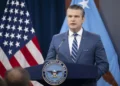

GAZA STRIP, Palestine – Israeli Prime Minister Benjamin Netanyahu has rejected claims that Israel is responsible for worsening conditions in Gaza’s displacement camps. He blamed Hamas as heavy winter rains flooded makeshift shelters and left thousands of Palestinian families exposed to the cold.
In a statement on Tuesday, November 10, Netanyahu said Hamas was responsible for the suffering of Gaza’s population. He accused the group of diverting humanitarian aid for military purposes and refusing to disarm under the ceasefire agreement.
Netanyahu said Israel had allowed more winter supplies into Gaza through a programme coordinated with the United States, the Board of Peace, the United Nations and international aid groups.

According to the Israeli government, the programme included more than 91,000 tents and over 8,200 truckloads of tarpaulins, blankets and winter clothing. It also included vacuum trucks to remove sewage and repairs to water and sanitation systems.
However, Netanyahu provided no evidence in his statement to support his claim that Hamas was systematically diverting humanitarian aid for military use.
He maintained that Hamas’s refusal to disarm remained the main obstacle to Gaza’s reconstruction.
Board of Peace Warns of Immediate Humanitarian Emergency
The dispute intensified after the US-backed Board of Peace issued a statement on November 9. It warned that Gaza faced an immediate humanitarian emergency as floodwater swept through displacement camps.
The board said heavy seasonal rains had flooded tens of thousands of tents and makeshift shelters. The water damaged essential belongings and left families exposed to cold and unsafe conditions.
■ Related News



It also said it had repeatedly asked Israel to approve the entry of materials for temporary shelters, water systems, sanitation and waste management.
The board described the response as insufficient. It urged Israel to speed up deliveries under commitments made through the Sharm el-Sheikh Humanitarian Protocol.
Meanwhile, the United Nations and aid organizations reported that more than 150,000 tents purchased by aid agencies and member states remained outside Gaza, awaiting delivery.
The UN also reported shortages of water pumps, vacuum trucks, engine oil, hoses and heavy machinery. These supplies are needed to remove floodwater and repair damaged infrastructure.
Winter Storm Destroys Thousands of Displacement Shelters
Gaza’s first major winter storm began on November 6 and continued through the weekend. Heavy rain and strong winds flooded displacement sites, damaged tents and disrupted essential services.
A November 9 report from the UN Office for the Coordination of Humanitarian Affairs (OCHA) said more than 26,000 households had reported damage to their shelters or belongings by November 8. The agency warned that the actual number could be higher.
The report said more than 6,000 family shelters had reportedly been destroyed. Another 17,400 had suffered damage.
OCHA also documented the collapse of a sandy hill onto tents near Deir al-Balah. Gaza Civil Defense said the incident killed five displaced Palestinians, including three children and two women.
An infant also reportedly drowned at a displacement site.
The flooding has worsened conditions for an estimated 1.4 million people living in tents or makeshift shelters. Many have little protection against heavy rain and strong winds.
Damaged drainage and sewage systems have created further health risks. Floodwater can mix with sewage and spread contamination and disease.
UN Chief Calls for Immediate Entry of Winter Supplies
UN humanitarian chief Tom Fletcher urged Israel to lift restrictions on winter supplies entering Gaza. He warned that delays and funding shortages were putting Palestinian lives at risk.
In a statement on November 11, Fletcher said the United Nations had repeatedly called for essential winter materials. He added that the organization had already submitted a plan listing the supplies needed.
The plan includes stronger shelters, warm clothing, blankets, bedding and safe heating equipment. It also calls for generators, fuel and machinery to remove floodwater and debris.
Fletcher urged Israel to open all Gaza crossings to humanitarian aid. He also called for international aid groups and commercial markets to operate.
Aid organizations have warned that supplies already inside Gaza cannot meet the scale of the emergency.
OCHA reported that stocks of tents, tarpaulins, blankets and clothing were almost exhausted when the storm struck.
Winter Crisis Highlights Wider Ceasefire Disputes
The disagreement over winter supplies reflects wider problems with the ceasefire between Israel and Hamas. The agreement took effect in October 2025, but both sides continue to dispute its implementation.
Israel says Hamas must disarm and Gaza must be demilitarized before reconstruction can move forward.
Humanitarian organizations, however, say families need emergency shelter, clean water and sanitation now. They argue that aid deliveries should not wait for political and security negotiations to end.
The latest exchange has added pressure to the ceasefire as displaced Palestinians face worsening weather and aid groups struggle to deliver basic supplies.
For families living in damaged tents, the immediate needs are clear: dry shelter, clean water, medical care and protection from the cold.
Primary Sources: Israeli Prime Minister Benjamin Netanyahu — “Statement by PM Netanyahu on Gaza and the Board of Peace,” November 10, 2026, published by the Israeli Ministry of Foreign Affairs: Rejects Israeli responsibility for Gaza’s worsening humanitarian conditions, blames Hamas, alleges diversion of humanitarian supplies and lists the Israeli government’s reported winter preparedness measures. United Nations Office for the Coordination of Humanitarian Affairs — “Humanitarian Situation Report: Heavy Rains in the Gaza Strip,” November 9, 2026: Documents flooding, shelter damage, displacement, casualties, supply shortages and the need for Israeli approval to bring additional equipment and materials into Gaza. United Nations Under-Secretary-General for Humanitarian Affairs Tom Fletcher — “No more delay,” November 11, 2026: Calls for the immediate entry of winter supplies, access through all Gaza crossings and the removal of restrictions affecting humanitarian operations. US-backed Board of Peace — Statement on Gaza Flooding and Winter Supplies, November 9, 2026, reproduced by Anadolu Agency: Describes the flooding as an immediate humanitarian emergency, criticises delays in approving essential materials and calls for the implementation of commitments under the Sharm el-Sheikh Humanitarian Protocol.