TAIZ, Yemen – Taiz is facing a deepening humanitarian emergency as fighting and restrictions on major supply routes disrupt access to food, water, fuel and medical care. Governor Nabil Shamsan has described the situation as famine, while the United Nations warns that shortages are pushing essential services toward collapse.
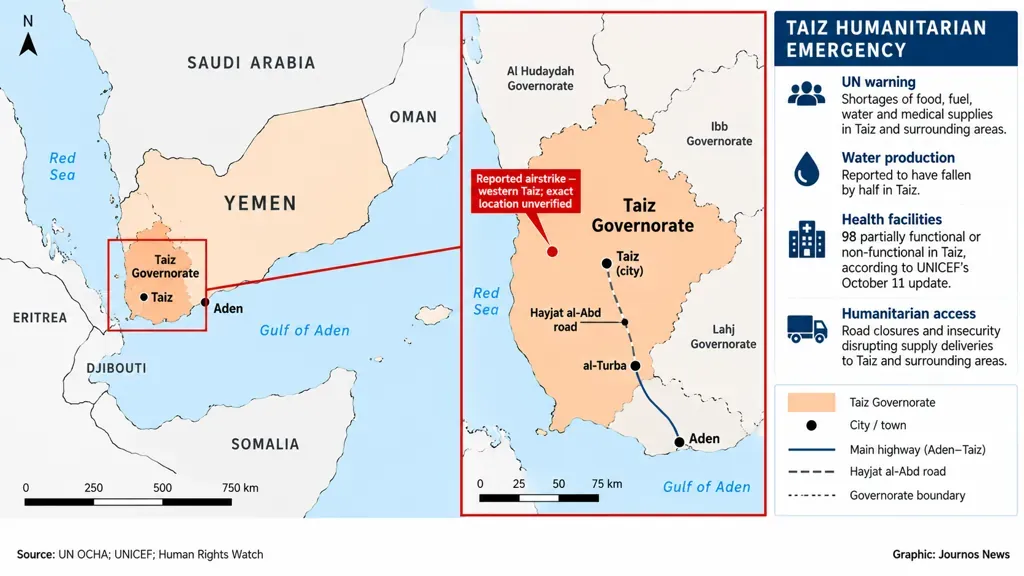
Separately, Yemen’s Houthi-run health ministry says a Saudi airstrike in western Taiz killed at least 13 people on October 29. The reported attack has not been independently verified in the material available for this report. Its precise location, target, circumstances and victims’ identities remain unclear.
The two developments are unfolding during a renewed escalation in Yemen’s conflict. However, there is no established evidence that the reported airstrike caused the humanitarian emergency or was directly connected to the restrictions affecting supply routes.

UN Warns of Critical Shortages Across Taiz
In a statement issued on October 20, UN Humanitarian Coordinator for Yemen Laurent Bukera said road closures and insecurity were preventing vital supplies, including fuel, from entering Taiz and surrounding areas.
He warned that the health system was close to collapse. Hospitals faced shortages of energy and medical oxygen, putting hundreds of patients at risk.
Food and fuel prices had more than doubled, according to Bukera. Water production in the city had fallen by half, while alternative sources were running out. The shortages affected hundreds of thousands of families.
Bukera called on Houthi de facto authorities to allow safe passage for commercial goods, food, medicine and humanitarian assistance. He also urged all parties to protect civilians and civilian infrastructure.
The warning followed a World Food Programme assessment that escalating fighting had cut off life-saving assistance to 800,000 people across affected areas. The figure covers Taiz and other conflict-affected communities; it should not be interpreted as the number of people inside Taiz city alone.




WFP said shifting front lines, blocked roads and insecurity were restricting humanitarian access. It warned that people who depend on food assistance could not receive the support they needed.
On October 23, OCHA, UNICEF and WFP issued a further warning about conditions inside Taiz. OCHA spokesperson Jens Laerke said access roads had been cut and very little fuel, food or other supplies had reached the city.
The agencies described a worsening emergency after fighting disrupted the main routes connecting Taiz with surrounding areas. <Cite refs={[“turn699252search2”]}/>
Governor Describes the City as Already in Famine
Shamsan said Taiz was already experiencing famine, rather than merely approaching it. He made the statement during a briefing near the front line, according to the account of his remarks published on October 29.
The governor said the city had about one million residents and received only a fraction of the water it needed. He also reported that cooking gas supplies had been blocked, forcing some families to burn wood and restaurants to close.
Hospitals were nearly out of oxygen, he said. Wheat flour stocks were also close to exhaustion, adding to concerns about whether households could obtain enough food.
His description reflects the severity of the reported conditions. It does not, by itself, establish a formal famine classification under the Integrated Food Security Phase Classification system.
The IPC uses evidence on food consumption, acute malnutrition and mortality to determine the severity of food insecurity. Phase 5, the highest level, includes the technical classification of famine when the required conditions are met.
The latest IPC-related material located for this report documents severe food insecurity in Yemen. Earlier 2026 assessments identified Emergency-level conditions in parts of Taiz. However, the material reviewed does not establish an official Phase 5 famine classification for Taiz city.
The distinction matters. A local official can describe conditions as famine, but a formal IPC classification requires a separate technical assessment. The absence of a verified Phase 5 classification does not diminish the reported shortages or the risk to residents.
Food, Water and Medical Services Under Pressure
The supply crisis extends beyond food. Fuel shortages threaten water pumping, hospital power and the movement of medical supplies.
Bukera said water production had fallen by half. The UN warning also described shortages of hospital energy and medical oxygen. These problems can affect patients who depend on continuous treatment and facilities that need reliable power to provide emergency care. <
UNICEF’s October 11 flash update documented the wider effects of renewed fighting. It said 98 health facilities in Taiz were partially functional or non-functional. The report also described disruption to civilian movement and the delivery of essential supplies.
UNICEF reported that IOM had recorded more than 200,000 displaced people across the affected areas between September 3 and October 10. Taiz Governorate hosted the largest concentration during the week from October 4 to 10, with 19,950 displaced people recorded in that period. These figures refer to a defined reporting period and should not be confused with the separate estimate of people displaced into Taiz since August.
A UN briefing on the situation also reported that UNICEF had screened more than 168,000 children in Taiz Governorate since the beginning of the year. It identified more than 52,000 cases of acute malnutrition, including over 11,500 cases of severe acute malnutrition.
Those figures show the scale of child nutrition needs across the governorate. They do not mean that every identified child was inside Taiz city or that all cases resulted from the latest escalation. UNICEF had pre-positioned nearly 8,000 cartons of ready-to-use therapeutic food, but warned that insecurity could disrupt replenishment and treatment. <Cite refs={[“turn699252search8”]}/>
The pressure on hospitals is also evident in reports of shortages of medicine, oxygen, fuel and other basic supplies. Humanitarian access is therefore essential not only for food deliveries, but also for medical treatment and the operation of water systems.
Road Restrictions and the Dispute Over Responsibility
Taiz has experienced years of restricted access during Yemen’s conflict. Government-backed forces control the city center, while Houthi forces control surrounding territory and important access roads.
Human Rights Watch said the latest escalation has further restricted the remaining major supply route. In an October 26 assessment, the organization documented an attack on the Hayjat al-Abd road, which connects Aden with Taiz city.
The organization said Houthi forces detonated explosives on the road in the town of al-Turba at about 4 a.m. on October 18, damaging part of the route. Human Rights Watch said it had spoken with eight informed sources and examined satellite imagery, photographs and video connected to two attacks on the road.
It said the damage and restrictions further threatened civilian access to food, water, medicine and fuel. Human Rights Watch also said it had written to the Houthi authorities on October 21 about the attacks but had received no response by the time of its October 26 publication.
In its October 29 assessment, Human Rights Watch said Houthi forces had fully encircled Taiz city during the latest escalation and blocked or attacked the remaining major supply route. It described severe shortages of food, fuel, water, medicine and cooking gas.
The organization also reported that road closures and fuel shortages were preventing some people with chronic illnesses from reaching medical facilities. Its findings included information from medical workers and other people familiar with the situation.
Houthi leader Abdul Malik al-Houthi rejected claims that his forces had imposed a siege. In a televised speech on October 29, he described the allegations as fabricated by Saudi Arabia and said routes remained open for food and humanitarian needs.
He said Houthi forces were restricting weapons supplies to what he called Saudi-backed forces, rather than blocking civilian necessities. His denial directly conflicts with the accounts from the governor, UN officials and Human Rights Watch.
The dispute over responsibility does not change the immediate need for safe access. It does mean that claims about deliberate restrictions, the control of individual routes and the circumstances of specific incidents must be assessed separately.
Reported Saudi Airstrike Kills at Least 13, Houthi Ministry Says
The Houthi-run health ministry said a Saudi airstrike struck western Taiz on October 29, killing at least 13 people.
The reported death toll remains an attributed figure. The information available for this report does not independently establish the precise strike location, the intended target, the identities of those killed or whether the victims were civilians, combatants or a mixture.
Saudi responsibility also remains unverified. No official Saudi confirmation or denial was located in the material reviewed for this report. Independent evidence from medical facilities, witnesses or other organizations is still needed to establish what happened.
The reported airstrike must also be considered separately from the restrictions on food and humanitarian access. The available evidence does not establish that the strike caused the supply crisis or that the two developments resulted from the same military decision.
The distinction is important in a conflict where several armed actors operate across shifting front lines. Responsibility for an airstrike requires evidence about the aircraft, target, location and circumstances. A casualty announcement from a party to the conflict is a starting point for verification, not a complete independent account.
Civilian Deaths and Displacement Figures Need Context
Shamsan reported that 271 people had been killed and 1,129 wounded since the latest offensive began earlier in October. He also alleged that attacks had obstructed rescue operations and that ambulances had come under fire.
Those figures and allegations remain attributed to the governor. The available material does not establish an independently verified casualty count covering the same period and geographic area.
The displacement figures also require careful definition. The UN migration agency was cited as estimating that Taiz had received about 124,000 displaced people since August. That figure concerns people displaced into Taiz, not necessarily residents of Taiz city alone.
UNICEF’s October 11 update recorded more than 200,000 displaced people across affected areas between September 3 and October 10. Its reporting identified Taiz Governorate as a major destination during the specified week. These figures have different geographical and time boundaries and should not be added together.
The displacement has increased pressure on communities already facing shortages. Families arriving from other areas need shelter, food, water and healthcare. The loss of access routes also makes it harder for people to leave dangerous areas or reach medical facilities.
Starvation as a Method of Warfare Is Prohibited
International humanitarian law protects civilians during armed conflict. Parties must distinguish civilians from combatants and take precautions to limit harm to civilian populations.
The law also prohibits using starvation of civilians as a method of warfare. Parties must allow and facilitate humanitarian relief for civilians in need, subject to the rules governing humanitarian operations.
Human Rights Watch said the restrictions affecting Taiz could amount to the war crime of using starvation as a method of warfare. The organization based its assessment on the reported obstruction of essential goods and humanitarian access.
That is a serious legal assessment, not a judicial finding. Determining individual criminal responsibility would require investigation of the conduct, intent, circumstances and evidence concerning those responsible.
The legal obligations apply to all parties to the conflict. They include protecting civilians, respecting civilian infrastructure and allowing humanitarian relief to reach people in need.
Humanitarian Access Remains the Immediate Priority
The humanitarian emergency in Taiz has deepened as fighting and restrictions disrupt the movement of essential supplies. UN officials have warned about shortages of food, fuel, water and medical supplies. Humanitarian organizations have also documented serious risks to health services and displaced families.
The governor’s famine description underscores the severity of the situation, but the evidence reviewed does not establish a formal IPC Phase 5 classification for Taiz city. The reported Saudi airstrike, meanwhile, remains an allegation by the Houthi-run health ministry pending independent verification.
The immediate priority is safe and sustained access for food, water, fuel and medical supplies. The parties must protect civilians and civilian infrastructure, allow humanitarian operations and provide credible information about attacks and casualties.
Further independent reporting is needed to establish the full toll of the fighting, verify the October 29 airstrike and determine responsibility for restrictions affecting civilian supplies. Until then, claims by the parties must remain clearly attributed and separate from independently documented humanitarian conditions.
Reporting Credit: Reporting by Journos News, based on the October 20 statement of UN Humanitarian Coordinator Laurent Bukera; World Food Programme updates on access to Taiz; UNICEF Yemen’s October 11 flash update; UN humanitarian briefings; Human Rights Watch’s October 26 and October 29 assessments; and public statements attributed to Taiz Governor Nabil Shamsan and Houthi leader Abdul Malik al-Houthi. The October 29 airstrike casualty figure is attributed to the Houthi-run health ministry and has not been independently verified in the material reviewed.