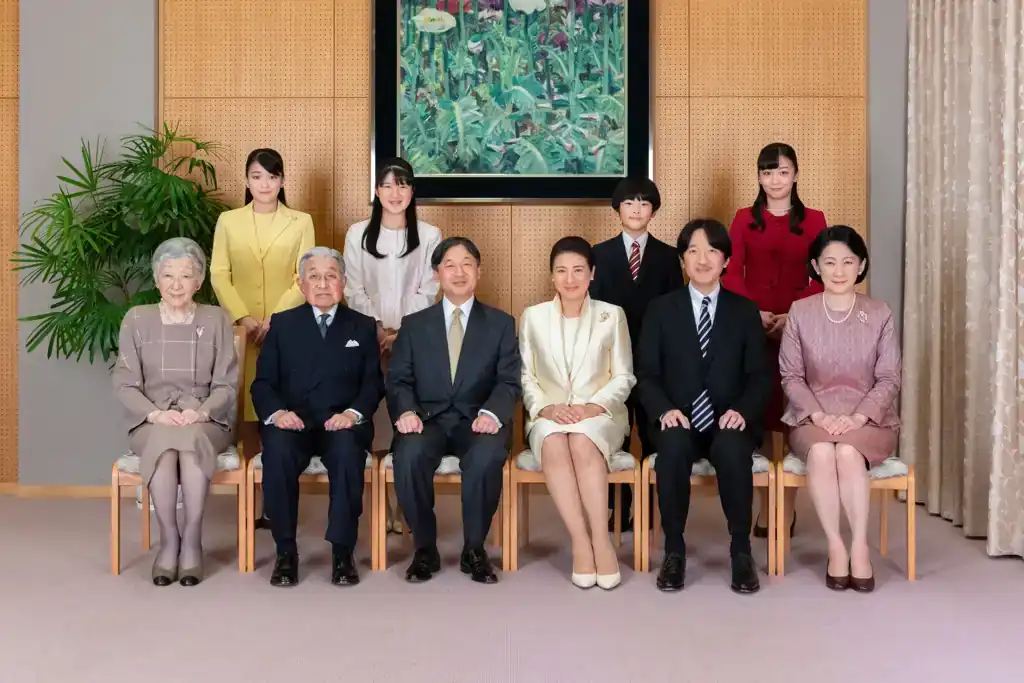
TOKYO, Japan – Japan’s revised Imperial House Law took effect on October 24, introducing changes intended to address the declining number of Imperial Family members while retaining the rule that only men descended from emperors through the male line can inherit the throne.
The amendment creates two main changes. Female members of the Imperial Family can retain their status after marrying men outside the family. The law also allows eligible male descendants of former imperial branches to be adopted into the Imperial Family.
However, the legislation does not allow a woman to become emperor. It also does not permit succession through a woman in the imperial bloodline. Princess Aiko, the only child of Emperor Naruhito and Empress Masako, therefore remains ineligible to inherit the throne.

The government says the reforms will help preserve the Imperial Family’s ability to carry out public duties as its membership declines. Critics argue that the changes leave the central succession problem unresolved and continue to exclude women from the highest position in the monarchy.
What the revised law changes
The amendment, promulgated on July 24 as Law No. 66 of 2026, took effect three months later. It marks the first major revision of the Imperial House Law’s central provisions since the law was enacted in 1947.
The first change allows eligible princesses to remain members of the Imperial Family after marrying men who are not royals. Under the previous rules, a female member who married a commoner had to leave the family.
The second change allows certain male descendants of former imperial branches to enter the Imperial Family through adoption. The eligible men must be at least 15 years old, unmarried and without children. They must also be legitimate descendants in the male line of former male members of the Imperial Family.
The adoption process requires approval by the Imperial House Council. The law excludes the Imperial Heir and the Imperial Heir’s spouse from adopting under this provision.
■ Related News




The two changes address different concerns. Retaining princesses preserves more members who can help with public duties. Adoption offers another way to increase the number of male members who may eventually have male-line descendants eligible to inherit the throne.
Neither measure introduces female succession.
Why Princess Aiko remains ineligible
Article 1 of the Imperial House Law states that the throne passes to a male descendant in the male line of the imperial lineage. The revised law leaves that principle in place.
The distinction between a female emperor and succession through the maternal line is important.
A female emperor would be a woman who inherits and occupies the throne. A maternal-line succession would allow the throne to pass through a woman in the imperial family, potentially to her child even if the child’s imperial descent came through the mother.
Japan’s revised law allows neither change. Princess Aiko cannot inherit the throne because she is a woman. Her future children would also remain outside the succession under the current rules, because they would not qualify through the required male line.
The law’s new adoption provision does not change that outcome. Although an eligible adopted man becomes a member of the Imperial Family, the adopted man himself cannot inherit the throne. His male-line descendants may qualify, with succession rights determined by their natural male-line ancestry.
This means the law creates a route to bring more male-line descendants into the family without opening succession to women or to descendants whose imperial connection runs through a woman.
The current line of succession
The current order of succession reflects the male-only rule.
- Crown Prince Akishino, the Emperor’s younger brother.
- Prince Hisahito, Akishino’s son and the Emperor’s nephew.
- Prince Hitachi, the Emperor’s uncle.
The order illustrates the narrow base of eligible successors. Emperor Naruhito has no son. His daughter, Princess Aiko, is excluded by law, leaving his brother and nephew as the principal younger successors.
The government’s adoption policy seeks to expand the pool of male-line family members. But adoption alone does not resolve the longer-term question of whether enough male heirs will be available in future generations.
Why the government says reform was necessary
The government has presented the amendment as a response to the declining number of Imperial Family members. Members undertake official engagements, attend ceremonies, receive foreign dignitaries and carry out public duties on behalf of the monarchy.
Under the previous rules, princesses generally left the Imperial Family when they married outside it. That reduced the number of members available to carry out those responsibilities.
Allowing women to remain is intended to slow that decline. The adoption provision offers a separate way to increase the number of eligible male-line members.
However, the two measures have different limits. A princess who remains after marriage does not bring her husband or children into the Imperial Family. An adopted male descendant also cannot personally inherit the throne under the revised provision, even though his eligible male-line descendants may qualify.
The law therefore increases the potential number of working royals without fundamentally changing who can become emperor.
What adoption will mean in practice
The adoption provision raises questions about how the Imperial Household Council will identify candidates, assess eligibility and obtain consent.
The law limits candidates to men who meet the age, ancestry and family-status requirements. They must be at least 15, unmarried and without children. The adoption must receive approval from the Imperial House Council.
The government has said implementation should respect the free will of those involved. But practical details will matter, including how candidates are approached, how their personal circumstances are considered and how the process will be explained to the public.
The historical distance between former imperial branches and the current family may also shape public debate. Eligibility based on male-line descent does not necessarily mean that a candidate has grown up within the modern Imperial Household or has experience of royal duties.
The selection process will therefore face questions about transparency, family consent, the role of the council and the support required for an adopted member to take on public responsibilities.
The law establishes a legal route. It does not guarantee that suitable candidates will come forward or that adoption will quickly resolve the shortage of male heirs.
Princesses may remain, but their families will have different legal status
The revised law also creates an unusual situation for princesses who choose to remain in the Imperial Family after marriage.
Their husbands and children will not automatically become members of the Imperial Family. The princesses will retain their imperial status, while their immediate families remain ordinary citizens.
That difference could affect household arrangements, public appearances, security, official duties and the treatment of family members at ceremonies. It may also raise questions about how the public understands a family in which the mother is a royal but her spouse and children are not.
The law increases the allowance for an eligible princess who maintains an independent household to match the relevant allowance for an independent male member of the Imperial Family. It also establishes a transitional choice for female members who are already in the family when the law takes effect: they may choose to leave the family when they marry.
The legislation does not answer every question about the daily operation of these arrangements. Further guidance will be needed on practical matters such as the role of spouses and children at official events, security and the boundaries between private and public life.
Public opinion favours allowing women to inherit
Public opinion is an important part of the debate, but survey questions must be read carefully. Support for a female emperor is not identical to support for maternal-line succession or approval of the government’s latest amendment.
A joint FNN–Sankei poll conducted on August 8 and 9, 2026, asked 1,012 eligible voters aged 18 or older across Japan about the amendment and possible future changes.
Asked whether the amended law should be revised again to allow a woman to become emperor, 78.1% supported the idea, 17.9% opposed it and 4% said they did not know or could not answer.
The same poll asked respondents to assess the amendment that had just been enacted. Some 50.5% said they approved of it, 39.1% disapproved and 10.3% were undecided.
The survey used random-digit dialing of landline and mobile telephones. Its sample was adjusted to approximate the national population in age, sex and region.
These results show that support for allowing a woman to inherit the throne was substantially higher than support for the specific amendment. They do not establish that every respondent who favoured a female emperor also supported maternal-line succession or opposed every part of the government’s reform.
The distinction matters because the amendment was designed to preserve male-only succession, not to respond directly to calls for a woman to become emperor.
The historical roots of the rules
The modern legal framework dates to the Imperial House Law enacted in 1947, alongside Japan’s postwar constitutional order. The law restricted succession to male descendants in the male line and required female members to leave the Imperial Family when they married outside it.
That framework followed major changes to the Imperial Family after the Second World War. Eleven former imperial branches lost their royal status in 1947, reducing the number of people within the formal Imperial Family.
The 2026 amendment draws on those former branches by permitting the adoption of eligible male-line descendants. It also reverses the marriage rule for female members, allowing them to remain within the family.
The reform is significant because it changes central provisions that had remained in place for nearly eight decades. But it preserves the principle that has become the central point of dispute: the throne remains restricted to men descended through the male line.
Japan’s history includes periods when women held the throne. That historical fact does not itself determine the current law, which sets out a specific modern succession rule. Whether Japan should change that rule remains a political and constitutional question.
What the law leaves unresolved
The amendment addresses the immediate concern about the declining number of Imperial Family members, but it leaves several long-term questions open.
The first is whether eligible male descendants will agree to join the family and whether adoption will provide a sustainable succession line. The second is how princesses who remain after marriage will balance family life with public responsibilities. The third is whether future governments will reopen the debate over female succession or maternal-line succession.
The law also leaves questions about public confidence. Supporters of reform argue that the monarchy needs enough members to carry out its duties. Critics say the adopted measures preserve gender-based restrictions and may place pressure on the family to produce male heirs.
Those are competing assessments, not interchangeable facts. The government’s stated aim is to maintain the Imperial Family’s numbers and duties. Critics’ objections concern equality, the narrow succession pool and the practical consequences of preserving male-only inheritance.
The amendment does not settle those disagreements.
A change to the family, not the succession principle
Japan’s revised Imperial House Law is now in effect. Princesses can remain members of the Imperial Family after marriage, and certain male descendants of former imperial branches can be adopted under the new rules.
Yet the throne remains reserved for male descendants in the male line. Princess Aiko remains ineligible, and her future children will not enter the line of succession through her.
The reforms may help preserve the Imperial Family’s capacity to perform public duties. Whether they provide a lasting answer to the succession problem will depend on the adoption process, the size of the family in future generations and whether lawmakers decide to revisit the rules.
For now, the law changes who can remain in the Imperial Family and how eligible men can join it. It does not change the fundamental rule governing who may become emperor.
Reporting Credit: Japan’s official e-Gov legal database — Imperial House Law and enacted amendment. Imperial Household Agency — official information on the Imperial Family and order of succession. Japan’s Cabinet Secretariat — government materials on the Imperial House Law amendment and related legislation. FNN–Sankei — August 8–9, 2026, public-opinion survey on imperial succession.