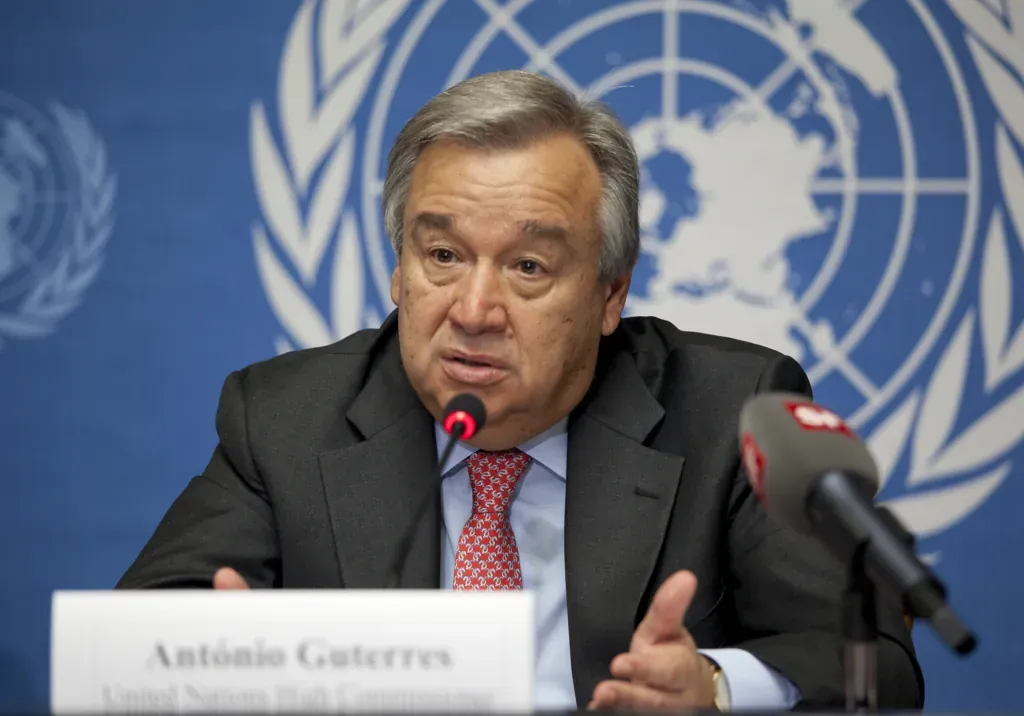
UNITED NATIONS, United States – When António Guterres leaves the United Nations secretary-generalship at the end of 2026, his successor will inherit an organization facing a difficult contradiction: the world needs international cooperation on more problems, even as political agreement among governments is becoming harder to achieve.
The transition is already underway. The UN has formally begun selecting its 10th secretary-general, with candidates submitting vision statements and other information and participating in public interactive dialogues with governments and civil society. Under Article 97 of the UN Charter, however, the final appointment still depends on a Security Council recommendation followed by a General Assembly appointment.
That structure defines the central challenge of the job.

The secretary-general can convene governments, mediate, use the office’s international platform, direct the Secretariat and bring threats to international peace and security to the Security Council’s attention. But the office does not possess independent authority to rewrite the Security Council, force governments to fund the organization or impose settlements on states.
The next UN chief will therefore be judged not simply by what the office can formally command, but by how effectively its occupant can turn limited institutional authority into political cooperation.
Five tests will define that challenge.
1. Can the UN Become a More Effective Diplomatic Intermediary?
The first test will be whether the next secretary-general can make the UN a useful diplomatic channel when major powers disagree.
The UN Charter gives the secretary-general an unusually important diplomatic tool. Article 99 allows the secretary-general to bring to the Security Council any matter that, in the secretary-general’s view, threatens international peace and security. Article 98 also gives the secretary-general functions assigned by the General Assembly, Security Council and other UN organs.
Those provisions give the office room to act, but they do not create an independent foreign policy.
The Security Council remains the principal UN organ for international peace and security, with five permanent members — China, France, Russia, the United Kingdom and the United States — holding permanent seats.
That means the secretary-general’s diplomatic influence depends heavily on credibility with governments that may disagree with one another and, sometimes, with the UN itself.
The practical test will be whether the next secretary-general can keep communication open across opposing camps, identify areas where negotiations remain possible and use the UN system where it has comparative advantages.
That does not mean the UN must become the principal mediator in every conflict. Regional organizations, individual governments and other diplomatic channels will continue to play major roles.
The challenge instead is to ensure that when the UN can contribute — through mediation, humanitarian coordination, ceasefire monitoring, political dialogue or international legitimacy — it has the credibility and political space to do so.
2. Can the Secretary-General Use Influence Without Overstating Power?
The second test is more fundamental: understanding the difference between formal authority and political influence.
The secretary-general is the UN’s chief administrative officer under the Charter. The office also represents the organization internationally and can use its diplomatic position to encourage cooperation. But major decisions remain with the member states and the UN’s principal organs.
That distinction matters particularly when expectations rise during crises.
A secretary-general cannot order Russia, the United States, China or any other government to accept a negotiated settlement. The office cannot independently authorize military action. It cannot change the permanent membership of the Security Council through executive decision.
Its leverage comes from persuasion, convening power, access, public diplomacy, institutional expertise and the ability to place issues before the appropriate UN bodies.
The next leader will therefore need to be both an advocate and a political operator: forceful enough to defend the UN Charter and international cooperation, but pragmatic enough to recognize where member states will not accept the organization’s preferred outcome.
The selection process itself reflects this expectation. The UN’s formal invitation to candidates called for proven leadership and managerial abilities, extensive international-relations experience, diplomatic and communication skills, multilingual ability, efficiency, competence and integrity.
Those are not merely résumé requirements. They describe the operating environment the next secretary-general will enter.
3. Can the UN Stay Operational During a Financial Crisis?
The third test is financial.
The UN’s funding problems are not simply a question of whether the organization has enough money on paper. The timing of member-state payments affects whether approved programs can actually operate.
The UN says its Secretariat has faced a severe liquidity crisis caused by delays and shortfalls in assessed contributions from member states. The organization has warned that unpaid or late contributions directly affect its ability to implement the budgets governments themselves have approved.
The problem has already affected the organization’s capacity.
The General Assembly approved a $3.45 billion regular budget for 2026, approximately 7 percent below the approved 2025 budget. The reduction came as the organization pursued the UN80 reform initiative and dealt with financial pressures.
In June, the General Assembly adopted a financial-rule change intended to give the UN greater flexibility in managing liquidity. The Assembly’s president said the measure prevented an imminent financial collapse and protected more than $900 million associated with peacekeeping operations and $400 million in the regular budget from being returned to member states under the previous system. She also stressed that the reform did not solve the underlying problem of member states failing to pay their obligations fully and on time.
That distinction will confront the next secretary-general immediately.
The office can improve management, prioritize programs, pursue efficiencies and press governments to meet their obligations. It cannot create assessed contributions by itself.
Financial management will therefore become part of the secretary-general’s political job.
The next leader will have to explain clearly what the organization can realistically deliver with the resources available, defend core capabilities from further erosion and persuade member states that their financial commitments are part of the international system they expect the UN to operate.
4. Can the UN Reform Without Pretending the Secretary-General Controls Reform?
Security Council reform is perhaps the clearest example of where expectations must be separated from institutional reality.
The Council has 15 members, including five permanent members and 10 members elected by the General Assembly for two-year terms. The permanent members are China, France, Russia, the United Kingdom and the United States.
Calls for a more representative Council have intensified, particularly from African states and other regions that argue the existing structure does not adequately reflect today’s international system.
The UN’s Pact for the Future explicitly calls for Security Council reform and recognizes the need to address Africa’s historical underrepresentation while improving representation for other underrepresented regions, including Asia-Pacific and Latin America and the Caribbean. It also identifies the size of the Council, categories of membership, working methods and the veto as issues in the reform debate.
The negotiations, however, are member-state driven.
The General Assembly’s intergovernmental negotiations on Council reform continued during its 80th session, including discussions on proposals and areas of convergence and disagreement among governments.
The next secretary-general can support that process, advocate for broader representation and use the office’s convening authority to keep reform on the political agenda.
But the secretary-general cannot unilaterally add permanent members or abolish the veto.
This is where credibility will matter.
A successful secretary-general may be able to help governments move toward compromise. But claiming that the office itself can deliver Security Council reform would misrepresent how the UN is structured.
The more realistic objective is to make reform politically harder to ignore while helping governments find areas of agreement.
5. Can the UN Govern Problems That Did Not Exist in 1945?
The fifth test reaches beyond traditional diplomacy.
The next secretary-general will take office in a world where international institutions must deal not only with conventional armed conflict, but also with climate change, artificial intelligence, technological disruption, inequality, humanitarian emergencies and new forms of security risk.
Guterres told the General Assembly in September that the world faces four major tests involving war and peace, inequality, climate change and artificial intelligence. He again called for Security Council reform and highlighted Africa’s continued lack of permanent representation.
Artificial intelligence is particularly important because governance is developing faster than many international rules.
The UN’s Pact for the Future and its Global Digital Compact already establish a framework for greater international cooperation on technology, while the organization is pursuing further work on digital governance and emerging technologies.
The next secretary-general will therefore have to connect issues that are often treated separately.
AI governance can become a security issue. Climate change can intensify humanitarian pressures and displacement. Economic inequality can undermine political stability. Technological disruption can affect labor markets, information systems and national security.
The challenge is not for the secretary-general to personally solve each problem.
It is to ensure that the UN system does not treat interconnected problems as isolated files.
The Financial and Political Tests Are Connected
The five tests ultimately converge on one question: can the UN still deliver enough practical results to justify confidence in multilateral cooperation?
That confidence cannot be restored through speeches alone.
The organization’s credibility depends partly on whether governments see the UN as useful when they need diplomacy, humanitarian coordination, peacekeeping, development assistance, international standards or a forum for negotiating problems that no country can solve alone.
But governments are also the source of the organization’s constraints.
They provide the funding. They determine the mandates. They elect most of the organization’s political bodies. They negotiate Security Council reform. And the Security Council determines who receives the recommendation required to become secretary-general.
This makes the next leader’s job unusually dependent on political persuasion.
A Different Kind of Leadership Test
The succession process is more open than earlier selection cycles.
The current process includes public vision statements, curriculum vitae and campaign-financing disclosures, along with webcast interactive dialogues in which candidates answer questions from member states and civil society. The General Assembly has described transparency and inclusivity as guiding principles for the 2025–26 process.
That transparency creates an opportunity to examine candidates against the actual demands of the office rather than simply their diplomatic credentials.
The key questions are practical.
Can a candidate mediate without sacrificing credibility?
Can that person manage a large international bureaucracy while the organization faces financial constraints?
Can the secretary-general defend multilateral principles without alienating governments whose cooperation is necessary?
Can the office push reform while recognizing that member states, not the Secretariat, hold the constitutional power to make fundamental changes?
And can the next leader make the UN useful on emerging problems without allowing its agenda to become so broad that its resources and political attention are diluted?
Those questions matter more than predicting which candidate will ultimately prevail.
What the Next Secretary-General Can Realistically Change
The incoming secretary-general will not inherit a blank institutional slate.
The Charter will remain. The permanent members will retain their veto. The General Assembly will continue to control major aspects of the budget and will appoint the secretary-general only after a Security Council recommendation. Member states will remain responsible for providing the resources that allow the organization to implement the mandates they approve.
What can change is how the institution uses the authority it already possesses.
A secretary-general can choose where to invest diplomatic capital. The office can strengthen mediation capacity, improve coordination across UN agencies, demand greater managerial discipline, communicate more effectively with the public and push member states to confront institutional weaknesses.
The office can also decide how directly to use the secretary-general’s political voice.
That choice carries risks. Too little political engagement can make the UN appear detached from crises. Too much can make the office less effective with governments that need to be brought into negotiations.
The most consequential leadership may therefore be measured not by how loudly the secretary-general speaks, but by whether the organization becomes more capable of turning international disagreement into limited areas of cooperation.
The Real Test Begins on January 1
The next secretary-general will take office at a moment when the gap between global problems and global political agreement is unusually visible.
Wars will continue to test the limits of diplomacy. Financial constraints will test the UN’s ability to implement mandates. Security Council reform will test whether the institution can adapt its political structure. AI, climate change and other emerging challenges will test whether international governance can keep pace with technological and environmental change.
None of these problems can be solved by the secretary-general alone.
That is precisely why the office matters.
The next UN chief will need enough independence to speak for the international organization, enough diplomatic credibility to remain in contact with governments that disagree, enough managerial discipline to operate under financial pressure and enough political judgment to know when the UN can lead, when it must facilitate and when member states themselves must make the decision.
The central challenge will not be restoring the UN to an imagined earlier era of influence.
It will be proving that a multilateral institution whose authority ultimately comes from its member states can still produce meaningful cooperation when those same states are increasingly divided.
Reporting Credit: United Nations; UN General Assembly; UN Security Council; UN Secretary-General’s Office; UN Charter and official UN institutional records; official UN financial and Security Council reform documents.