TOKYO, Japan – Global markets opened the week on a mixed footing Monday after U.S. stocks finished higher Friday, as renewed gains in oil prices and elevated bond yields offset some of the optimism from Wall Street’s strongest weekly performance in three weeks.
Asian markets came under pressure as investors reassessed the outlook for inflation and interest rates while uncertainty over the U.S.-Iran conflict continued to influence energy prices.
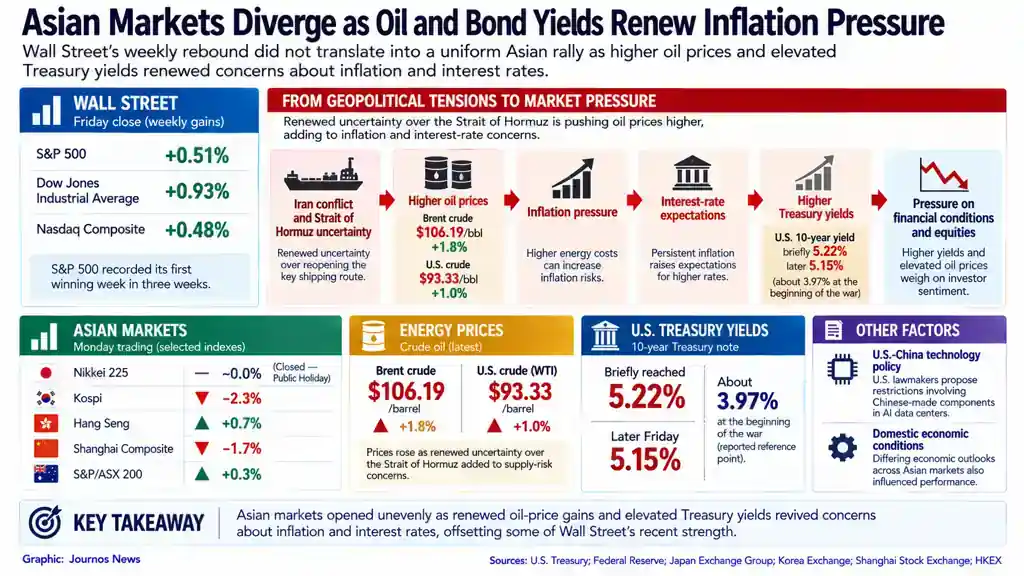
Japan’s Nikkei 225 was little changed in Monday trading, while South Korea’s Kospi fell about 2.3%. Hong Kong’s Hang Seng gained around 0.7%, while China’s Shanghai Composite declined about 1.7%. Australia’s S&P/ASX 200 added about 0.3%.

The moves followed a stronger session on Wall Street.
Wall Street ends week higher
The S&P 500 rose 0.51% Friday to 7,743.41, breaking a three-session losing streak. The Dow Jones Industrial Average gained 0.93%, or 478.64 points, to 51,828.62, while the Nasdaq Composite advanced 0.48% to 27,068.72.
The gains helped the S&P 500 record its first winning week in three weeks.
Lower oil prices during much of the week eased some of the pressure created by the war with Iran and concerns about disruptions around the Strait of Hormuz. European stocks also ended the week higher, with the STOXX 600 gaining 0.5% for the week after three consecutive weekly declines.
Technology stocks contributed to the U.S. advance. Microsoft and other AI-related shares helped lift the major indexes, while Akamai Technologies gained after announcing an $11.6 billion multiyear agreement with Anthropic. Costco also rose following stronger quarterly earnings.




Oil reverses course
The calmer oil market of last week did not carry into Monday.
Brent crude rose about 1.8% to around $106.19 a barrel, while U.S. crude gained about 1% to $93.33.
The rebound followed renewed uncertainty over efforts to reopen the Strait of Hormuz, a critical route for global oil shipments.
Reuters reported that U.S. President Donald Trump rejected an Iranian proposal related to reopening the waterway, while talks were expected to continue. Brent had briefly fallen to around $97 a barrel late last week as hopes for a diplomatic agreement increased.
The renewed oil increase matters for financial markets because sustained higher energy costs can feed into inflation and complicate expectations for monetary policy.
Bond yields remain a market concern
The other major pressure point is the bond market.
The U.S. 10-year Treasury yield briefly reached 5.22% Friday before retreating to about 5.15% later in the session. The yield has risen substantially since the beginning of the Iran war, when it was around 3.97%.
Higher yields can increase borrowing costs for households and businesses while reducing the relative attractiveness of stocks.
The increase also reflects concern that elevated energy prices could keep inflation higher for longer, potentially limiting the ability of central banks to reduce interest rates.
Investors are entering a week packed with economic data that could influence expectations for U.S. monetary policy.
Asian markets diverge
The uneven performance across Asia reflected different domestic and external pressures.
Japan’s Nikkei was roughly flat Monday after Wall Street’s gains, while South Korean shares fell sharply. Hong Kong stocks moved higher even as mainland Chinese markets weakened.
South Korean shares were pressured despite Friday’s gains in U.S. technology stocks. Samsung Electronics and SK hynix both fell in Seoul trading.
China’s market faced additional pressure from weaker domestic economic signals and renewed concerns over technology restrictions.
Chinese blue-chip stocks fell about 1.9% Monday, according to Reuters, while the CSI 300 was down more than 2% at midday. The Shanghai Composite fell 1.7%.
Chinese industrial-profit growth also slowed in August, adding to concerns about domestic demand.
U.S.-China tensions remain in focus
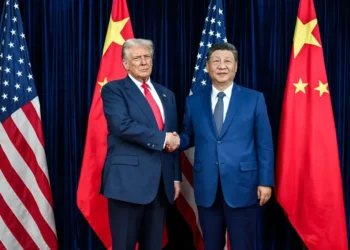
The mixed Asian session also followed last week’s meeting between Trump and Chinese President Xi Jinping.
The two sides agreed to extend a trade truce for two months, giving Washington and Beijing additional time to assess implementation of their broader economic arrangement.
But technology remains a point of disagreement.
A bipartisan group of U.S. lawmakers introduced legislation Friday that would restrict the federal government from using Chinese-made components involved in transmitting data in AI data centers. The proposal weighed on Chinese technology shares Monday.
The developments illustrate why global markets are responding not only to traditional economic indicators but also to supply-chain and technology-policy decisions.
Investors face a volatile week
The market’s stronger finish Friday has not removed the forces that have produced sharp swings during September.
Oil remains sensitive to developments in the Iran conflict. Treasury yields remain elevated. Inflation expectations are being watched closely, and investors are awaiting additional economic data that could affect expectations for interest rates.
For now, the global picture is divided.
Wall Street has regained ground after a volatile stretch, while Asian markets are responding more cautiously to renewed oil-price pressure and local economic concerns.
The divergence leaves investors focused on whether lower oil prices can return, whether the conflict around the Strait of Hormuz eases and how persistent inflation pressures will prove to be.
Reporting Credit: U.S. Federal Reserve — monetary-policy and financial-market information; U.S. Department of the Treasury — Treasury-market data; Japan Exchange Group — Japanese equity-market information; Korea Exchange — South Korean market data; Shanghai Stock Exchange — mainland Chinese market data; Hong Kong Exchanges and Clearing — Hong Kong market data.