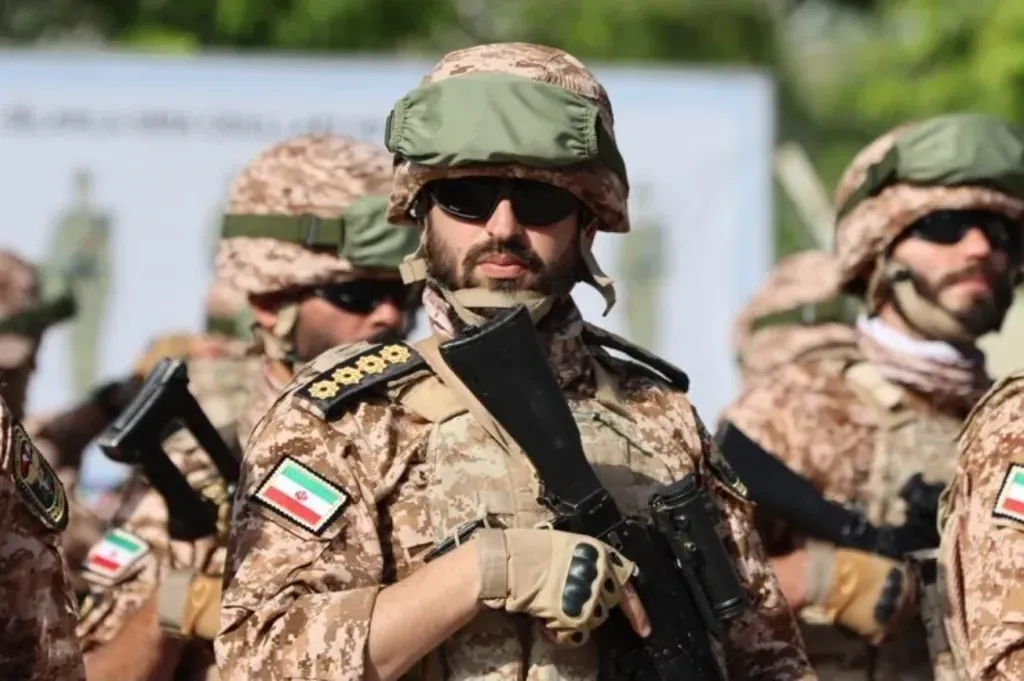
TEHRAN, Iran – Iran’s Islamic Revolutionary Guard Corps has warned that a new U.S. attack would expand the geography of the war and trigger changes in the weapons and targets Tehran uses, raising the prospect of a broader regional confrontation.
IRGC spokesman Brig. Gen. Hossein Mohebbi said Monday that Iran was prepared for a prolonged conflict and would respond differently if the United States launched another attack.
“If a new aggression occurs, we will certainly change the weaponry and the geography of the war,” Mohebbi said, according to Iran’s semi-official Fars news agency. He said Iran had weapons and targets that had not yet been used in the conflict.

The warning came as Washington weighs its next move in a war that has continued for nearly seven months and as fighting and attacks on shipping continue around the Strait of Hormuz.
IRGC threatens a broader battlefield
Mohebbi did not specify which new locations Iran might target or identify the weapons he said could be introduced.
He said Iran’s response would include changes to the geography of the conflict, the weapons deployed and the targets selected. He also said some Iranian weapons had not been used during earlier phases of the war and described them as strategic capabilities.
The comments were framed by the IRGC as a warning against renewed U.S. military action rather than an announcement of a specific imminent operation.
Iranian officials have continued to describe the conflict as ongoing. Mohebbi said the IRGC had prepared for a long war and was more prepared than before.
■ Related News


His remarks also included unverified claims about the condition of U.S. military bases and Washington’s ability to reopen the Strait of Hormuz. Those claims were not independently established in the IRGC statement.
Washington is considering its next move
The warning followed President Donald Trump’s comments that he was considering options for dealing with Iran.
Trump told Fox News on Sunday that he was in “deciding mode” and said he was considering alternatives that included renewed military action or reaching a new agreement with Tehran. He also said he was probably open to meeting Iranian President Masoud Pezeshkian during the United Nations General Assembly in New York.
Pezeshkian is scheduled to travel to New York for the U.N. gathering, according to Iranian reporting cited by CBS. Any meeting between the two presidents would take place against the backdrop of the continuing military confrontation.
The combination of military threats and possible diplomatic contact has left the next phase of the conflict uncertain.
Strait of Hormuz remains a major flashpoint
The IRGC warning also comes as the Strait of Hormuz remains at the center of the conflict.
The waterway carries a substantial share of global oil and gas shipments, making attacks on commercial vessels a direct security concern beyond the immediate U.S.-Iran confrontation.
The United States says its military has helped commercial shipping move through the waterway and maintains that it is working to keep energy supplies moving. The White House said in August that U.S.-protected commercial traffic had carried hundreds of millions of barrels of crude through the strait.
Iran, meanwhile, has continued to challenge shipping through the waterway.
On Sept. 21, an unidentified projectile struck a tanker entering the Strait of Hormuz, injuring two crew members, according to British maritime authorities and international reporting. The incident added another layer of risk for commercial vessels operating in the area.
The IRGC has previously claimed responsibility for attacks on vessels and accused some ships of attempting to violate restrictions imposed by Tehran.
U.S. and Iranian forces have already exchanged attacks
The latest warning follows months of direct military confrontation.
U.S. Central Command said in early September that American forces struck three Iranian crude-oil carriers after the IRGC launched ballistic missiles toward two U.S. Navy warships. CENTCOM said the vessels were disabled in separate operations near Iranian waters and the Gulf of Oman.
Earlier in the conflict, CENTCOM also announced strikes against Iranian air-defense systems, command-and-control networks, coastal radar and anti-ship missile capabilities after Iranian attacks on commercial vessels.
Iran has continued to launch missile and drone attacks in response, while the conflict has increasingly affected commercial shipping and energy infrastructure across the region.
The United States has described its military actions as responses to Iranian attacks and threats. Iran has presented its actions as resistance to U.S. and Israeli military operations.
Those competing accounts remain central to how each side describes the war.
Regional spillover is already underway
The possibility of a wider conflict is not limited to direct U.S.-Iran exchanges.
The war has already affected other parts of the region, including Yemen and the Red Sea.
Iran-backed Houthi forces have continued fighting in Yemen, while Saudi Arabia has faced attacks attributed to the Houthis. Reuters reported Monday that Houthi fighters were pushing to consolidate control of strategic territory in Yemen as the wider regional conflict continued.
The United States has also issued security alerts to Americans across the Middle East, warning of possible further escalation and disruptions to travel and commercial activity.
That creates several potential pathways for the conflict to expand: direct attacks between Iran and the United States, attacks on commercial shipping, strikes involving regional partners and renewed fighting involving Iran-aligned armed groups.
The IRGC’s latest statement did not specify which of those pathways Iran would pursue if the United States attacked again.
Military warning comes alongside diplomatic signals
The threats from Tehran are occurring alongside indications that diplomatic channels have not completely closed.
Trump has said he could meet Pezeshkian at the U.N. General Assembly. Iran has also continued to communicate conditions for negotiations through its political leadership.
That creates a sharply contrasting picture: military officials are warning of a broader war while political leaders remain engaged in discussions about possible diplomacy.
Neither development guarantees that the other will succeed.
The immediate issue is whether the two sides can prevent another cycle of attack and retaliation while maintaining enough diplomatic contact to negotiate an end to the conflict.
The next U.S. decision could determine the immediate trajectory
Mohebbi’s warning is conditional: the IRGC says its response would change if the United States launches another attack.
That leaves the scale and timing of any further escalation uncertain.
For Washington, the choices involve competing objectives, including military pressure on Iran, protection of U.S. forces and commercial shipping, and the possibility of a negotiated settlement.
For Tehran, the latest warning signals that another U.S. attack could be met with operations beyond the geographic and tactical boundaries of previous phases of the war.
The statement does not establish that such an expansion will occur.
It establishes that Iran’s military leadership is publicly threatening one if U.S. attacks resume.
With the Strait of Hormuz still contested, regional armed groups active and both governments considering their next moves, the consequences of another escalation would extend well beyond the immediate battlefield.
Reporting Credit: Islamic Revolutionary Guard Corps — September 21 statement from spokesman Brig. Gen. Hossein Mohebbi; U.S. Central Command — official releases concerning U.S. military operations against Iranian forces and vessels; White House — U.S. policy statements concerning the Strait of Hormuz and Iran; United Nations — regional diplomatic and security context.