LONDON, United Kingdom – Britain will provide Saudi Arabia with limited military support to help its aircraft defend against renewed missile and drone attacks by Yemen’s Houthi movement, Prime Minister Andy Burnham said Monday.
The Royal Air Force will provide air-to-air refueling for Saudi aircraft operating on defensive missions. The arrangement is expected to begin within days and initially last for several weeks, with the British government keeping the deployment under review.
The decision follows a request from Riyadh as Houthi attacks have intensified across Saudi Arabia and the wider conflict has threatened shipping routes and energy infrastructure in the region.

Burnham said the decision was taken after advice from the defense and foreign secretaries and was intended to support Saudi Arabia’s defensive capabilities.
Britain limits mission to defensive support
British officials have described the assistance as defensive rather than a commitment to conduct offensive strikes against Houthi positions.
The initial deployment is expected to involve a single RAF Voyager tanker aircraft. The aircraft’s role will be to refuel Saudi aircraft in flight, extending the time those aircraft can remain airborne while conducting defensive operations.
The distinction is significant.
The United Kingdom is not announcing that its aircraft will conduct strikes against the Houthis. Instead, the British contribution is intended to support Saudi aircraft involved in defending the kingdom against incoming attacks.



Burnham said Britain was responding to Saudi Arabia’s request while seeking to protect British and wider regional interests.
He also linked the decision to the need to keep regional energy and shipping routes open.
Houthi attacks have widened the security pressure on Saudi Arabia
The British decision comes after weeks of renewed fighting involving the Houthis and Saudi Arabia.
The United Kingdom has accused the Houthis of attacking Saudi civilian and energy infrastructure and has called for an end to the escalation.
In a September 15 statement to the U.N. Security Council, British Deputy Permanent Representative Kate Foster said recent Houthi attacks had injured civilians, damaged homes and residential areas and disrupted commercial aviation. She also said the group had expanded military operations inside Yemen and threatened shipping around the Bab el-Mandeb Strait.
Saudi Arabia has faced repeated missile and drone threats during the escalation.
One attack targeting Riyadh on Saturday was intercepted, according to current reporting. The Houthis have also declared a blockade affecting Saudi-linked shipping in the Red Sea and Bab el-Mandeb and have attacked Saudi-linked vessels and energy infrastructure, according to reports.
The latest British support therefore comes as Riyadh seeks additional defensive capacity rather than as part of a newly announced British offensive campaign in Yemen.
The Bab el-Mandeb adds an international dimension
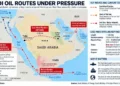
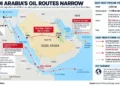
The conflict has implications beyond Saudi Arabia and Yemen because of the Bab el-Mandeb Strait.
The waterway connects the Red Sea with the Gulf of Aden and is an important route for vessels moving between the Indian Ocean and the Suez Canal.
British officials have repeatedly linked Houthi attacks to freedom of navigation and the security of international trade.
In its September 10 statement, the U.K. Foreign, Commonwealth & Development Office said Houthi attacks threatened regional stability and vital trade routes through the Red Sea and Bab el-Mandeb.
The United Kingdom has therefore framed its response in terms of both Saudi security and the protection of wider regional and international interests.
Saudi Arabia had sought help from several partners
The British decision follows Saudi requests for additional air-defense assistance from international partners.
The Associated Press reported that Saudi Arabia had asked France, Britain, Pakistan and Egypt for support against missiles and drones launched by the Houthis and other Iran-backed groups.
Britain already has a military relationship with Saudi Arabia and has deployed the Sky Sabre air-defense system to the kingdom during the wider regional crisis. The new refueling arrangement adds a different capability by supporting Saudi aircraft rather than providing another ground-based missile-defense system.
The United States, which has previously carried out strikes against the Houthis, has not announced participation in this new Saudi defensive arrangement.
British support comes as Yemen’s conflict expands again
The latest escalation follows renewed fighting between the Houthis and Yemen’s Saudi-backed government.
British officials say the Houthis have intensified their military operations inside Yemen, while the group has also expanded its ability to threaten Saudi territory and maritime traffic.
The United Kingdom has called for the Houthis to stop their attacks and return to a political process.
At the U.N. Security Council on September 15, Britain said the escalation was worsening Yemen’s humanitarian situation. The British government cited more than 126,000 displaced people and warned that food insecurity and humanitarian needs were increasing.
That creates a second concern for Britain alongside the immediate military threat: ensuring that additional military activity does not further restrict humanitarian access inside Yemen.
What the RAF deployment means
Air-to-air refueling does not itself provide missile interception.
Its value is operational. A tanker can allow fighter aircraft to remain on patrol longer without returning to base to refuel, potentially increasing the area and duration over which Saudi aircraft can conduct defensive operations.
The British contribution is therefore relatively limited in scale but significant in the capabilities it adds to Saudi air operations.
Officials have emphasized that the deployment is time-limited and subject to review.
The arrangement also marks one of the first significant military decisions announced by Burnham since becoming British prime minister, making the deployment an important test of how his government approaches Britain’s defense partnerships and regional security commitments.
For Saudi Arabia, the immediate objective is strengthening protection against continued missile and drone attacks.
For Britain, the government has connected the decision to Saudi security, regional stability, civilian protection and maintaining access to major trade routes.
The effectiveness and duration of the mission will depend on how the Houthi campaign develops and whether the broader conflict continues to threaten Saudi territory and regional shipping.
Reporting Credit: UK Foreign, Commonwealth & Development Office — British government statements on Houthi attacks, Saudi security and Red Sea/Bab el-Mandeb navigation; UK Prime Minister’s Office — announcement of defensive air-to-air refueling support; Saudi Arabian authorities — requests for defensive assistance and official reporting on attacks against the kingdom; United Nations Security Council — official record of British statements concerning the Yemen escalation.