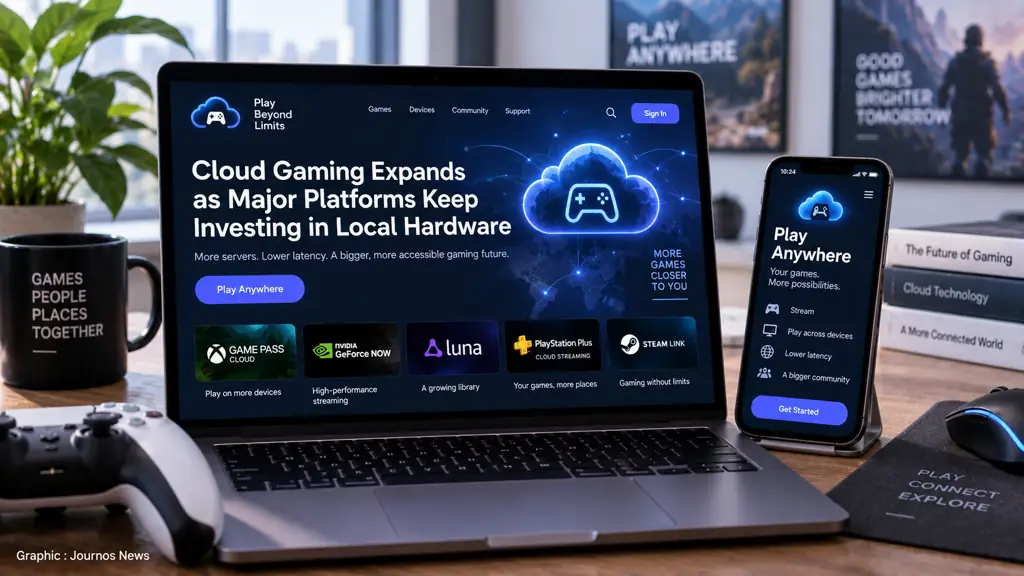
Cloud gaming has not eliminated the need for consoles and gaming PCs, but recent developments suggest the technology is becoming an additional way to access games rather than a complete replacement for local hardware.
The basic proposition behind cloud gaming remains straightforward: games run on remote servers while players receive the resulting video stream over the internet. This can reduce the need for powerful local hardware and allow games to be played across a wider range of devices.
Major technology companies continue to invest in that model, while console manufacturers are increasingly combining cloud access with traditional hardware.

The result is a gaming market in which local processing and cloud computing are increasingly being used together.
Cloud access is becoming part of console ecosystems
Microsoft has expanded Xbox cloud gaming through Xbox Cloud Gaming, allowing subscribers to stream selected games to supported devices without installing them locally.
The company has also continued to develop Xbox consoles rather than abandoning dedicated hardware.
That combination illustrates the industry’s current direction. Cloud gaming can provide flexibility for players who want to try a game quickly or play on a device that cannot run it locally, while a console or PC remains useful for players who want consistent performance and access to locally installed games.
Microsoft has also expanded cloud gaming to additional devices, including compatible smart TVs and other supported platforms.
■ Related News




Hardware still solves important problems
Local hardware has one major advantage over cloud streaming: the game does not have to travel across the internet before the player sees the result.
A locally running game can respond directly to controller input, with the console or PC handling graphics processing and other computational tasks.
Cloud gaming introduces another link into that chain.
A player’s input must travel to a remote data center, the game must process it, and the resulting image must then be transmitted back to the player’s device.
Fast connections can reduce the impact, but network latency, congestion and connection instability can still affect the experience.
For games where rapid responses are important, even relatively small delays can matter.
Internet infrastructure remains part of the gaming experience
Cloud gaming effectively makes the internet part of the gaming hardware.
A powerful server cannot completely compensate for an unreliable connection between the player and the data center.
The quality of that connection depends on factors including bandwidth, latency, network congestion and the distance between the player and the server.
Local gaming avoids many of those variables.
A player with a sufficiently powerful console or PC can continue playing an installed game even if the internet connection becomes unavailable, although online features may still require connectivity.
Cloud gaming, by contrast, depends on the remote service remaining reachable.
That makes cloud gaming particularly sensitive to outages and service availability.
Cloud gaming has an important advantage
Despite those limitations, cloud gaming offers something conventional hardware cannot easily provide: access to substantial computing resources without requiring the player to purchase a high-performance machine.
That can lower the hardware barrier for some players.
A compatible television, phone, tablet or lower-powered computer may be sufficient to access a streamed game, provided the service supports the device and the internet connection is adequate.
Cloud services can also make it easier for players to move between devices.
Someone who begins playing on a television could potentially continue on another supported device without moving a console or transferring an installation.
Game ownership remains complicated
Cloud gaming also changes the relationship between players and their games.
With locally installed software, players generally have a copy of the game data stored on their own hardware, although digital licenses can still depend on an online storefront or authentication system.
With cloud gaming, the underlying game is hosted by the service provider.
That means access depends on the continued availability of the service, the game’s inclusion in the cloud library and the player’s subscription or purchase rights.
A game can therefore become unavailable for streaming even though the player has previously accessed it through the platform.
This distinction has become an important consideration as companies experiment with different cloud gaming business models.
Developers still have to design for hardware
The continued importance of local hardware is also visible in game development.
Modern games can require substantial processing power for graphics, physics, artificial intelligence and large interactive environments.
Cloud infrastructure can provide that processing remotely, but it does not remove the computational cost. It simply moves much of the workload from the player’s machine to a data center.
Developers therefore still optimize games around hardware capabilities.
Cloud versions can introduce additional technical considerations, including video encoding, streaming quality and latency management.
The technology changes where computation takes place, but the computational requirements of the game itself remain.
The likely future is hybrid
The current direction of the industry points toward coexistence rather than a simple transition from hardware to the cloud.
Consoles and PCs remain important because they provide predictable performance, local processing and the ability to play installed games without relying entirely on a remote server.
Cloud gaming provides flexibility, device portability and access to computing resources that many consumer devices do not possess.
The two approaches can therefore serve different purposes.
A player may use a console for high-performance gaming at home and cloud streaming when traveling. Another may use cloud gaming to test a title before downloading it. A casual player may use a television or mobile device without purchasing a dedicated gaming machine.
Hardware is not disappearing
The original promise of cloud gaming was often framed around a future in which expensive gaming hardware would become unnecessary.
The industry’s recent direction is more measured.
Cloud gaming has demonstrated that games can be delivered effectively from remote infrastructure, but the experience remains dependent on network conditions, data-center capacity, service availability and the requirements of individual games.
Local hardware continues to provide an important alternative because it places much of that processing directly in the player’s hands.
Rather than making consoles and gaming PCs obsolete, cloud gaming is increasingly becoming another layer in the gaming ecosystem.
The future of gaming may therefore involve less competition between the cloud and hardware than a combination of both: local machines for performance and reliability, and remote infrastructure for flexibility and access.
Reporting Credit: Microsoft — Xbox Cloud Gaming and Xbox platform information; Sony Interactive Entertainment — PlayStation cloud-streaming and hardware information; NVIDIA — GeForce NOW cloud-gaming service and technical information; Amazon Web Services — cloud infrastructure information relevant to game streaming.