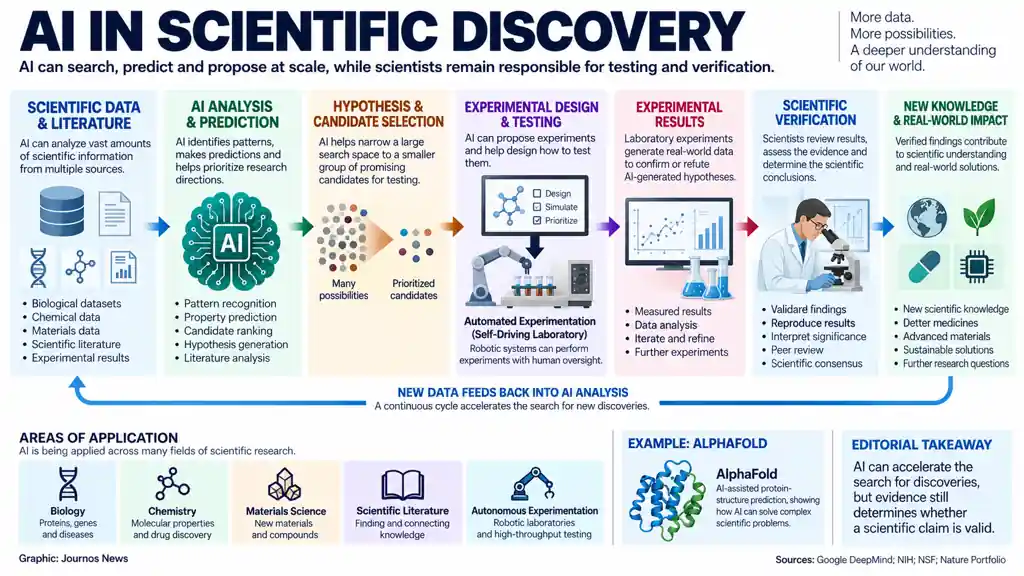
Artificial intelligence is moving beyond routine data analysis and into parts of the scientific research process traditionally handled by human researchers, as laboratories increasingly use AI to identify patterns, propose research directions and help design experiments.
Recent developments in scientific AI show systems being used across biology, chemistry, materials science and other fields. The technology is not replacing scientists outright, but it is beginning to change how some research tasks are performed and how quickly researchers can move from an observation to a testable hypothesis.
One of the most significant developments is the growing ability of AI systems to work with large scientific datasets and connect information that can be difficult for researchers to examine manually.

AI is becoming a research tool
Scientific research has long relied on computational methods to process large volumes of information. What has changed is the growing sophistication of AI systems and their ability to work across different stages of research.
Researchers can use machine-learning models to identify relationships in biological or chemical data, predict properties of molecules and materials, and prioritize experiments that are more likely to produce useful results.
Google DeepMind’s AlphaFold demonstrated one of the most prominent applications of AI in biology by predicting the structures of proteins. The AlphaFold database has since expanded to include predicted structures for hundreds of millions of proteins, giving researchers a resource for investigating biological systems and potential drug targets.
AI models are also being developed to address problems beyond protein structure prediction.
In chemistry, researchers are using machine learning to predict molecular properties and identify potentially useful compounds. In materials science, AI can help search enormous combinations of elements and structures for materials with particular characteristics.
■ Related News




Automated laboratories are extending the role of AI
The combination of AI with laboratory automation is taking the technology a step further.
Instead of simply analyzing experimental results, AI systems can increasingly help determine what experiment should be performed next.
Automated laboratories can combine machine-learning models with robotic equipment capable of preparing samples, conducting experiments and recording results.
The process can create a feedback loop: an AI system proposes an experiment, automated equipment performs it, the resulting data are analyzed, and the next experiment is selected based on what was learned.
Researchers refer to this approach in different contexts as autonomous experimentation or self-driving laboratories.
The potential advantage is speed. A system can perform repetitive experiments continuously while researchers concentrate on designing research questions, interpreting results and evaluating whether the machine’s conclusions make scientific sense.
Scientific discovery still requires verification
The growing role of AI does not remove the need for experimental confirmation.
An AI-generated hypothesis is not a scientific finding simply because a model produces it. A proposed molecule must be synthesized and tested. A predicted biological relationship must be investigated experimentally. A suggested physical phenomenon must be independently measured.
This distinction is particularly important because AI systems can produce incorrect results with considerable confidence.
Models trained on existing scientific information can also reproduce biases or gaps in the underlying data. If a system is unable to distinguish between well-established findings and uncertain or incomplete information, its output can lead researchers toward misleading conclusions.
Human researchers therefore remain responsible for assessing experimental design, validating results and determining whether an apparent discovery survives scientific scrutiny.
AI can narrow the search for new discoveries
One of AI’s clearest advantages is its ability to reduce the number of possibilities researchers need to investigate.
A chemical researcher may face millions of possible molecular structures. A materials scientist may have an enormous number of possible combinations of elements and manufacturing conditions.
Testing every possibility experimentally would be impractical.
Machine-learning systems can rank candidates according to predicted characteristics, allowing researchers to focus laboratory resources on a smaller group of promising possibilities.
This does not guarantee that the highest-ranked candidate will work. It changes the search process by making it easier to decide which possibilities deserve experimental attention first.
Scientists are also using AI to work with complex literature
Another area of rapid development involves scientific literature.
Researchers now have access to enormous collections of academic papers, databases and experimental results. Finding relevant information across those sources can itself consume substantial research time.
AI tools can help researchers search scientific literature, extract information and identify connections between findings from different disciplines.
That capability could be particularly useful when a discovery depends on combining knowledge that exists in separate scientific fields.
But automated literature analysis also creates risks. AI systems can misunderstand technical terminology, miss important qualifications or generate references that do not accurately support a claim.
Researchers therefore need to verify information against the underlying scientific literature rather than treating an AI-generated summary as authoritative.
The definition of a scientific assistant is changing
The growing use of AI is creating a new role for machines in research.
Traditional scientific software largely performed calculations or processed data according to instructions supplied by researchers. Newer AI systems can participate in more open-ended tasks, including suggesting hypotheses, identifying experimental candidates and helping researchers decide where to investigate next.
That does not make the systems independent scientists.
Scientific discovery still depends on questions, evidence, experimental testing and reproducibility. But AI can increasingly participate in several stages of that process.
The practical effect may be less about replacing researchers than changing how researchers spend their time.
Tasks that previously required extensive manual searching or repetitive analysis can increasingly be delegated to computational systems, leaving scientists with more time for experimental design, interpretation and judgment.
A new research model is emerging
The combination of increasingly capable AI models, scientific databases and automated laboratory equipment could eventually make parts of research substantially faster.
The most important developments are likely to come where these technologies work together: AI identifies a promising question or candidate, laboratory equipment tests it, new data are returned to the model, and the system proposes the next step.
That model remains subject to the same basic scientific requirement as traditional research: claims must be supported by reproducible evidence.
For now, AI is best understood as a rapidly developing scientific tool rather than an autonomous replacement for scientists.
Its significance lies in the possibility of compressing parts of the discovery process that have traditionally been limited by the amount of information researchers can analyze and the number of experiments laboratories can perform.
As those limits begin to shift, scientists are gaining a new kind of research assistant—one capable of searching, predicting and proposing at a scale that would be difficult for an individual researcher to match.
Reporting Credit: Google DeepMind — AlphaFold research and protein-structure database; U.S. National Institutes of Health — scientific AI and biomedical research resources; U.S. National Science Foundation — research programs supporting AI-enabled scientific discovery and autonomous experimentation; Nature Portfolio — scientific research and peer-reviewed literature on AI-assisted discovery.