NEW YORK – U.S. government bonds came under renewed selling pressure Tuesday as higher oil prices intensified fears that inflation could remain elevated, pushing Treasury yields higher and weighing on stocks.
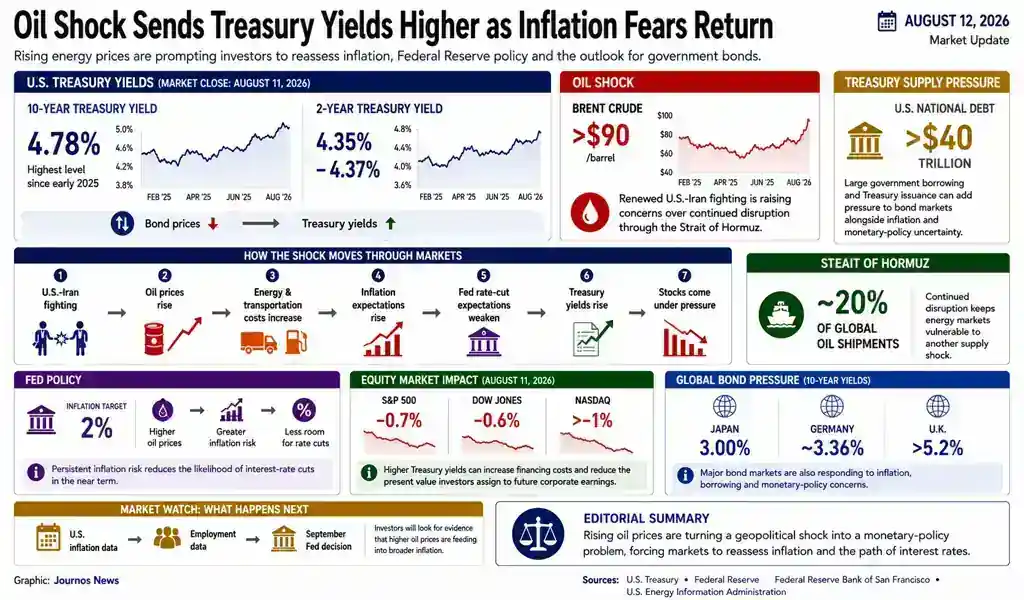
The yield on the 10-year Treasury rose to about 4.78%, its highest level since early 2025, while the two-year yield climbed to roughly 4.35%–4.37%. Because bond prices and yields move in opposite directions, the increases indicate that investors were demanding higher returns to hold government debt.
The move came as Brent crude rose above $90 a barrel, with renewed fighting between the United States and Iran raising concerns about continued disruption to oil shipments through the Strait of Hormuz.

Oil revives inflation fears
Higher energy prices can feed directly into gasoline and heating costs and indirectly increase transportation, manufacturing and shipping expenses.
That creates a difficult environment for the Federal Reserve. Inflation is already above its 2% target, and a prolonged oil shock could make it harder for policymakers to bring price growth down.
The San Francisco Federal Reserve has warned that elevated oil prices and geopolitical supply disruptions are increasingly important sources of inflation and economic risk.
Investors reassess Fed policy
The bond sell-off is also reflecting changing expectations about interest rates.
Federal Reserve Chair Kevin Warsh recently emphasized that the central bank still has work to do if underlying inflation does not move toward its target quickly enough. That message has increased expectations for a possible rate increase.
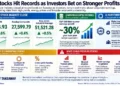



Money markets were pricing roughly a 65% probability of a September rate increase, according to LSEG data cited by MarketScreener, up substantially from before Warsh’s speech.
A higher-for-longer interest-rate environment would increase borrowing costs across the economy.
Government borrowing adds pressure
Inflation is not the only concern in the Treasury market.
The U.S. national debt recently surpassed $40 trillion, increasing the amount of debt the government must finance and the interest expense associated with it.
Investors are therefore weighing several pressures simultaneously: higher inflation, increased government borrowing, large Treasury issuance and uncertainty over the future path of monetary policy.
Those concerns can raise the additional return investors demand to hold longer-term government bonds.
Stocks also feel the pressure
Higher Treasury yields can make stocks less attractive because investors can earn greater returns from government securities while companies face higher financing costs.
The S&P 500 fell about 0.7%, while the Dow Jones Industrial Average dropped roughly 0.6%. The Nasdaq fell more than 1%, with technology stocks among the hardest hit.
Higher borrowing costs can also discourage corporate investment and make future corporate earnings less valuable when discounted back to today’s prices.
The sell-off is global
The pressure is not confined to the United States.
Japan’s 10-year government bond yield reached 3% for the first time since 1996, while Germany’s 10-year yield reached a 15-year high around 3.36%. Britain’s 10-year yield also moved above 5.2%.
The simultaneous rise in yields suggests investors are reassessing inflation, government borrowing and monetary policy across major economies.
Hormuz remains the key risk
The Strait of Hormuz is central to the latest market anxiety because roughly one-fifth of global oil shipments normally pass through the waterway.
The continuing conflict has sharply reduced commercial traffic, leaving energy markets vulnerable to further disruption.
If oil prices continue rising, the resulting inflation pressure could force central banks to maintain or increase interest rates even as higher energy costs weaken economic growth.
That combination would be particularly difficult for financial markets.
What happens next
Investors will closely watch upcoming U.S. inflation and employment data for evidence of whether the oil shock is translating into broader price pressures.
The Federal Reserve’s September meeting will then become a major focus for bond traders.
For now, the message from the Treasury market is clear: investors are demanding higher yields as inflation, oil prices, government borrowing and interest-rate uncertainty converge.
Key Facts
- 10-year Treasury yield: About 4.78%
- 2-year Treasury yield: About 4.35%–4.37%
- Brent crude: Above $90 per barrel
- U.S. debt: More than $40 trillion
- Fed inflation target: 2%
- Main inflation risk: Higher energy prices
- Major geopolitical factor: U.S.-Iran conflict and Strait of Hormuz disruption
- S&P 500: Down about 0.7%
- Status: DEVELOPING — MARKETS
Reporting Credit: U.S. Department of the Treasury — Treasury market and federal debt data; Federal Reserve — monetary policy and inflation outlook; Federal Reserve Bank of San Francisco — oil-price and supply-shock analysis; U.S. Energy Information Administration — crude-oil and energy-market data.